
Empower your strategies with our Likelihood of Approval and Phase Transition Success Rate Model – Ranibizumab in Retinopathy Of Prematurity report and make more profitable business decisions.
This report provides you with the data that allows you to track and predict the specific likelihood of approval (LOA) and phase transition success rate (PTSR) of a drug using GlobalData’s proprietary machine learning algorithms developed using over 10 years of historical data.
Ranibizumab in Retinopathy Of Prematurity Drug Details:
Ranibizumab (Lucentis, Patizra) is a humanized monoclonal antibody fragment and a recombinant humanized IgO 1 isotype designed to bind to and inhibit vascular endothelial growth factor (VEGF-A). It is formulated as an injection for ophthalmic intravitreal use. Lucentis is indicated for the treatment of patients with neovascular (Wet) age-related macular degeneration, macular edema following retinal vein occlusion (RVO) and diabetic macular edema. Lucentis also indicated to treat patients with visual impairment due to choroidal neovascularization (CNV) associated with causes other than neovascular age-related macular degeneration (nAMD), or secondary to pathologic myopia (PM), for the treatment of patients with myopic choroidal neovascularization (mCNV), a complication of severe near-sightedness that can lead to blindness, for the monthly treatment of all forms of diabetic retinopathy in people who have been diagnosed either with or without diabetic macular edema (DME), a complication of diabetic retinopathy that causes swelling in the back of the eye and also indicated for the treatment of retinopathy of prematurity (ROP) with zone I (stage1+, 2+, 3 or 3+), zone II (stage 3+) or AP-ROP (aggressive posterior ROP) disease in preterm infants, also for the treatment of proliferative diabetic retinopathy (PDR).Lucentis was also under development for uveitic cystoid macular edema, corneal neovascularization, polypoidal choroidal vasculopathy and pterygia neovascularization.
Report Coverage
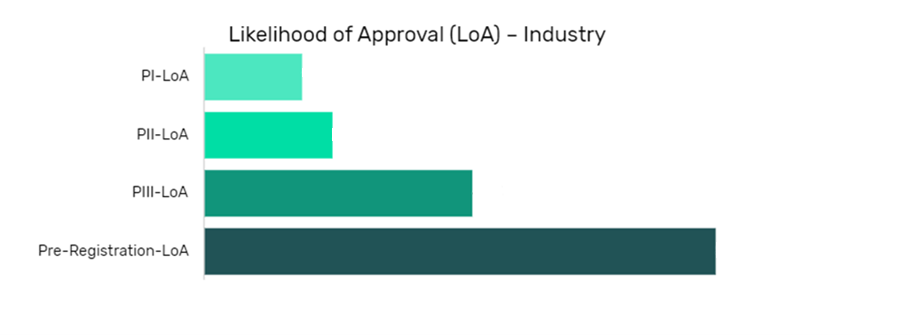
The data is segmented by drug name per indication and shows the current likelihood of approval for the drug compared to the indication benchmark and the industry benchmark.
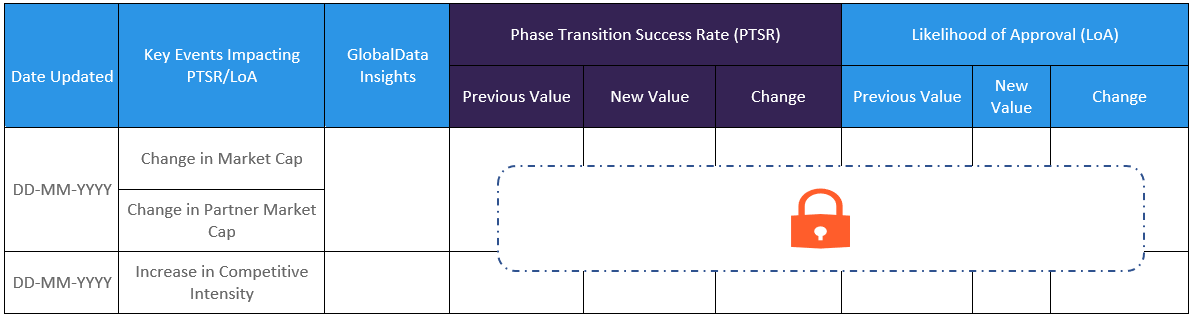
The Likelihood of Approval data is updated regularly based on events that take place which impact the clinical development process and regulatory considerations. GlobalDatas proprietary machine learning models consider these events in real time, to produce quantitative changes to the LOA and PTSR along with qualitative reasoning why the likelihood of approval has changed.
Scope of Report
- Drug Details: Drug name, Drug type, Intervention type
- Administration Pathway
- Therapeutic Areas
- Key Manufacturers
- Drug Development Status
Reasons to buy
- Precise Likelihood of Approval and Phase Transition Success Rates: Our machine learning and proprietary models provide accurate predictions, helping you gauge the potential success of a drug in the regulatory process.
- Competitive Strategy Planning: Access information on LOA and PTSR for competitors’ drugs, allowing you to plan your clinical development, commercialisation and marketing strategies
- Event-driven Updates: Track event-driven changes in LOA and PTSR benchmarked against indication LOA/PTSR. Get the latest insights to adapt your strategies promptly!
- Well-informed Investment Decisions: This data helps you navigate the dynamic landscape of drug development and regulatory considerations.







