Decarbonizing Cement and Concrete Industries: Net-Zero Strategies, CCUS, Alternative Fuels and Electrification
Powered by 
All the vital news, analysis, and commentary curated by our industry experts.

Cement decarbonization report: analyze CCUS, alternative fuels, electrification, and net-zero strategies. Identify risks, benchmark leaders, and support ESG and investment decisions with GlobalData insights.
Understand How the Cement Industry Is Transitioning to Net Zero
The cement and concrete industry is under growing pressure to decarbonize. However, it remains one of the hardest sectors to transition.
This report helps you understand how the industry is approaching net-zero targets. It explores the shift from traditional production methods to low-carbon alternatives.
Moreover, it highlights why decarbonization in cement is complex. Process emissions and high energy requirements continue to pose challenges. As a result, multiple solutions must work together.
Report Value Proposition – What This Means for You
This report goes beyond describing decarbonization pathways. It helps you interpret what they mean for your strategy and investments.
You can use it to:
- Identify viable decarbonization pathways across cement and concrete
- Evaluate the maturity and scalability of key technologies
- Benchmark leading producers and innovators globally
- Understand policy direction and regulatory pressure
- Support ESG, sustainability, and capital allocation decisions
In addition, the analysis is built on GlobalData’s proprietary research and industry expertise. It is trusted by Fortune 500 companies and leading governments worldwide.
Key Insights on Cement Decarbonization Technologies and Pathways
The report provides a comprehensive view of how the industry is reducing emissions:
- Energy efficiency and electrification remain the most widely adopted measures today
- Carbon capture, utilization and storage (CCUS) is emerging as a critical long-term solution
- Alternative fuels are gaining traction as companies reduce reliance on fossil fuels
- Material substitution is helping lower clinker content and emissions intensity
However, each pathway comes with trade-offs. For example, some technologies face high costs or raw material constraints. Therefore, adoption timelines vary across regions and companies.

Scope
What You Will Learn
The report provides a structured and detailed view of the cement decarbonization landscape:
- Emissions profile and net-zero requirements for the cement industry
- Company-level net-zero targets and emissions performance
- Key decarbonization pathways and technology timelines
- Deep dives into CCUS, alternative fuels, and electrification
- Material substitution strategies and novel concrete innovations
- Policy landscape and global trade dynamics
- Key challenges impacting adoption and scale
In addition, the report includes case studies and real-world examples of implementation.
Target Buyers for This Report
This report is designed for decision-makers across industrial and sustainability functions:
- Heads of Sustainability and ESG
- Strategy and Corporate Development Leaders
- Cement and Materials Industry Executives
- Energy Transition and Decarbonization Teams
- Infrastructure and Construction Leaders
- Investors, Analysts, and Climate Risk Teams
If you are responsible for decarbonization strategy or industrial innovation, this report can support your decisions.
How Companies Use This Report
Organizations across construction, materials, and energy ecosystems apply this report in practical ways:
- Cement and building material companies (e.g., Holcim, UltraTech Cement): Benchmark decarbonization strategies and prioritize technology investments
- Energy and industrial technology firms (e.g., Linde plc, Air Liquide): Identify opportunities in CCUS, electrification, and industrial gases
- Construction and infrastructure players align procurement strategies with low-carbon materials and future regulations
- Investors and private equity firms assess climate risk exposure and identify scalable decarbonization solutions
- Policy and sustainability teams understand regulatory frameworks and support net-zero roadmaps
Therefore, you can translate insight into action more effectively.
Key Highlights
Concrete is the second most consumed resource in the world after potable water and is the number one building material.
On average, the cement industry accounts for 8% of global greenhouse gas emissions and, as a country, would be the fourth largest contributor to emissions globally.
According to the UN, three quarters of infrastructure that will exist in 2050 has yet to be built, so decarbonization solutions are essential to ensure net-zero targets can be met.
The cement industry represents a significant source of industrial emissions and would rank fourth globally if considered as a country, emphasising the importance of its decarbonization.
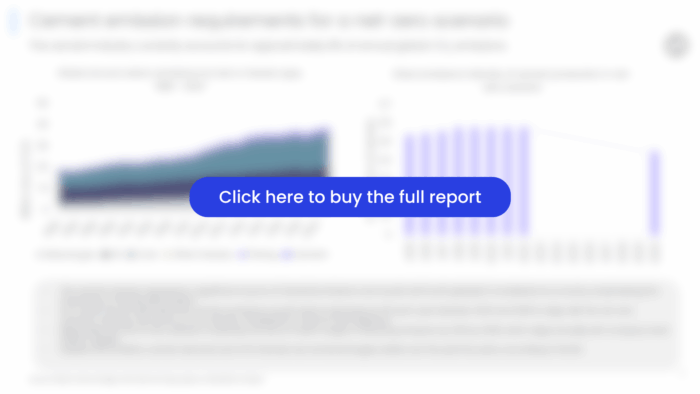
As a result, the IEA estimates that cement emissions would need to decrease by 3% each year between 2022 and 2030 to align with the net-zero scenario. However, the sector is not currently considered on track for this trajectory.
The cement industry currently ranks as the third largest contributor to upcoming carbon capture capacity, with 62 projects aiming to start operations by the end of the decade. This represents a significant uptick in project activity in comparison to the 9 projects in operation by year-end 2024.
Reasons to Buy
Built on Trusted Data and Expert Analysis
This report is backed by GlobalData’s established research capabilities:
- Built on proprietary datasets and industry frameworks
- Trusted by Fortune 500 companies and global institutions
- Developed by analysts with deep expertise in energy, materials, and industrial sectors
Therefore, you can rely on the insights to support critical decisions.
Benchmark Against Global Cement and Technology Leaders
- Understanding how industry leaders are responding is essential.
- This report enables you to benchmark strategies across major producers such as Holcim, Heidelberg Materials, UltraTech Cement, Cemex, and CRH plc.
- It also highlights innovators such as CarbonCure and Brimstone developing next-generation solutions.
As a result, you can identify competitive positioning, partnerships, and innovation gaps.
Act Now to Stay Ahead in Cement Decarbonization
- The transition to low-carbon cement is underway. However, the path forward remains complex and competitive.
- Early insight can help you position your organization effectively.
- This report helps you understand which technologies are gaining traction, how leaders are responding, and where opportunities may emerge.
Therefore, if you are planning investments, partnerships, or sustainability strategies, now is the time to act.
Taiwan Cement Corporation
Heidelberg Materials
Holcim
Aditya Birla Group
Ambuja Cements
Cemex
Anhui Conch Cement Company
Siam Cement Group
Buzzi SpA
UltraTech Cement
Coolbrook
SaltXTechnology
Climeon
Scwenk Zement GmbH
Titan SA
Linde plc
Cementir Holding NV
Vicat SA
L’Air Liquide SA
Petroceltic Bulgaria EOOD
CarbonFree Chemicals Holdings
Zachry Construction Corp
Calix Ltd
Grasim Industries Ltd
Hoffman Green Cement
Brimstone
CarbonCure
Carbon8
Table of Contents
Table
Figures
Get in touch to find out about multi-purchase discounts
reportstore@globaldata.com
Tel +44 20 7947 2745
Sample Report
Decarbonizing Cement and Concrete Industries: Net-Zero Strategies, CCUS, Alternative Fuels and Electrification was curated by the best experts in the industry and we are confident about its unique quality. However, we want you to make the most beneficial decision for your business, so we offer free sample pages to help you:
- Assess the relevance of the report
- Evaluate the quality of the report
- Justify the cost
Download your copy of the sample report and make an informed decision about whether the full report will provide you with the insights and information you need.


