
Empower your strategies with our Likelihood of Approval and Phase Transition Success Rate Model – Rituximab in Splenic Marginal Zone B-Cell Lymphoma report and make more profitable business decisions.
This report provides you with the data that allows you to track and predict the specific likelihood of approval (LOA) and phase transition success rate (PTSR) of a drug using GlobalData’s proprietary machine learning algorithms developed using over 10 years of historical data.
Rituximab in Splenic Marginal Zone B-Cell Lymphoma Drug Details:
Rituximab (MabThera, Rituxan, Ristova) is an anti-neoplastic agent. It is formulated as an injectable concentrate for solution for intravenous route and solution for subcutaneous route of administration. Rituximab intravenous formulation is indicated for the treatment of previously untreated adult patients with stage III-IV follicular lymphoma in combination with chemotherapy; as maintenance therapy is indicated for the treatment of adult follicular lymphoma patients responding to induction therapy; as monotherapy indicated for treatment of adult patients with stage III-IV follicular lymphoma who are chemoresistant or are in their second or subsequent relapse after chemotherapy; for the treatment of adult patients with CD20 positive diffuse large B cell non-Hodgkin’s lymphoma in combination with CHOP (cyclophosphamide, doxorubicin, vincristine, prednisolone) chemotherapy; in combination with chemotherapy is indicated for the treatment of pediatric patients (aged = 6 months to < 18 years old) with previously untreated advanced stage CD20 positive diffuse large B-cell lymphoma (DLBCL), Burkitt lymphoma (BL)/Burkitt leukemia (mature B-cell acute leukemia) (BAL) or Burkitt-like lymphoma (BLL) and for the treatment of patients with previously untreated and relapsed/refractory CLL. Rituximab in combination with methotrexate is indicated for the treatment of adult patients with severe active rheumatoid arthritis who have had an inadequate response or intolerance to other disease-modifying anti-rheumatic drugs (DMARD) including one or more tumor necrosis factor (TNF) inhibitor therapies; in combination with glucocorticoids, is indicated for the treatment of adult patients with severe, active granulomatosis with polyangiitis (Wegener’s) (GPA) and microscopic polyangiitis (MPA); in combination with glucocorticoids, is indicated for the induction of remission in pediatric patients (aged = 2 to < 18 years old) with severe, active GPA (Wegener’s) and MPA and for the treatment of patients with moderate to severe pemphigus vulgaris (PV). Rituximab subcutaneous formulation is indicated in adults for Non-Hodgkin’s lymphoma (NHL): for previously untreated patients with stage III-IV follicular lymphoma in combination with chemotherapy; as maintenance therapy is indicated for the treatment of follicular lymphoma patients responding to induction therapy and for the treatment of patients with CD20 positive diffuse large B cell non-Hodgkin’s lymphoma in combination with CHOP (cyclophosphamide, doxorubicin, vincristine, prednisolone) chemotherapy. Rituxan is indicated for the prevention of recurrence of neuromyelitis optica spectrum disorder (including neuromyelitis optica).It is under development for neuromyelitis optica (Devic’s syndrome), post-transplant lymphoproliferative disorder, refractory chronic inflammatory demyelinating polyneuropathy (CIDP), idiopathic membranous nephropathy with nephrotic syndrome (membranous glomerulonephritis), fibrillary glomerulonephritis, systemic sclerosis, melanoma, bullous pemphigoid, mucosa-associated lymphoid tissue lymphoma, schizophrenia spectrum disorder and obsessive-compulsive disorder and for pediatric patients with severe, active GPA (Wegener’s), marginal zone B-cell lymphoma, nodal marginal zone B-cell lymphoma, extranodal marginal zone B-cell lymphoma (mucosa-associated lymphoid tissue or MALT-lymphoma), splenic marginal zone B-cell lymphoma, microscopic polyangiitis (MPA), previously untreated advanced stage CD20 positive diffuse large B-cell lymphoma (DLBCL) and Burkitt lymphoma (BL)/Burkitt leukemia (mature B-cell acute leukemia) (BAL) or Burkitt-like lymphoma (BLL). It was under development for lupus nephritis, membranous nephropathy, refractory myasthenia gravis, Sjogren's syndrome, anti-neutrophil cytoplasmic antibody-associated vasculitis (ANCA vasculitis), systemic lupus erythematosus, hemophilia A, idiopathic thrombocytopenic purpura (immune thrombocytopenic purpura), granulomatosis with polyangiitis (GPA) or microscopic polyangiitis (MPA) in the US, primary progressive multiple sclerosis (PPMS), polymyalgia rheumatica (PMR) and relapsing-remitting multiple sclerosis.
Report Coverage
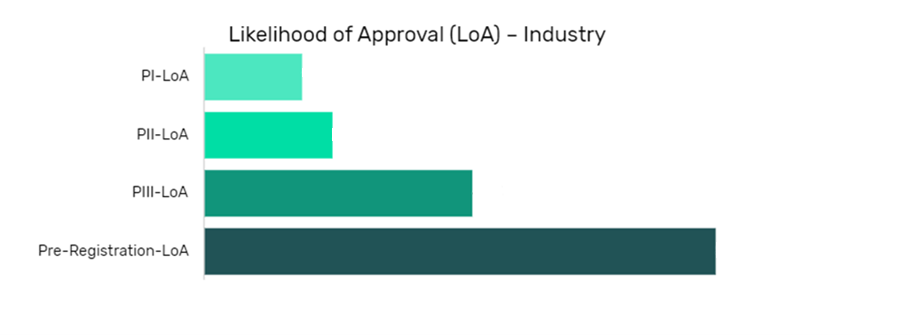
The data is segmented by drug name per indication and shows the current likelihood of approval for the drug compared to the indication benchmark and the industry benchmark.
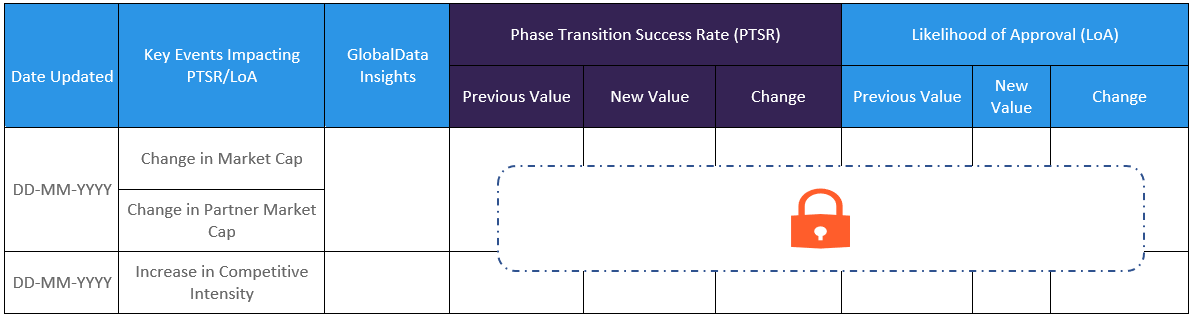
The Likelihood of Approval data is updated regularly based on events that take place which impact the clinical development process and regulatory considerations. GlobalData’s proprietary machine learning models consider these events in real time, to produce quantitative changes to the LOA and PTSR along with qualitative reasoning why the likelihood of approval has changed.
Scope of Report
- Drug Details: Drug name, Drug type, Intervention type
- Administration Pathway
- Therapeutic Areas
- Key Manufacturers
- Drug Development Status
Reasons to buy
- Precise Likelihood of Approval and Phase Transition Success Rates: Our machine learning and proprietary models provide accurate predictions, helping you gauge the potential success of a drug in the regulatory process.
- Competitive Strategy Planning: Access information on LOA and PTSR for competitors’ drugs, allowing you to plan your clinical development, commercialisation and marketing strategies
- Event-driven Updates: Track event-driven changes in LOA and PTSR benchmarked against indication LOA/PTSR. Get the latest insights to adapt your strategies promptly!
- Well-informed Investment Decisions: This data helps you navigate the dynamic landscape of drug development and regulatory considerations.







