
Empower your strategies with our Likelihood of Approval and Phase Transition Success Rate Model – Durvalumab in Human Epidermal Growth Factor Receptor 2 Negative Breast Cancer (HER2- Breast Cancer) report and make more profitable business decisions.
This report provides you with the data that allows you to track and predict the specific likelihood of approval (LOA) and phase transition success rate (PTSR) of a drug using GlobalData’s proprietary machine learning algorithms developed using over 10 years of historical data.
Durvalumab in Human Epidermal Growth Factor Receptor 2 Negative Breast Cancer (HER2- Breast Cancer) Drug Details:
Durvalumab (MEDI-4736, Imfinzi, Fidursi, Imfinzio) a programmed death-ligand 1 (PD-L1) blocking antibody. It is formulated as solution and concentrate solution for intravenous route of administration. Imfinzi is indicated as maintenance therapy after definitive chemoradiation therapy (CRT) in locally-advanced (Stage III), unresectable non-small cell lung cancer (NSCLC). and for the treatment of patients with unresectable, Stage III non-small cell lung cancer (NSCLC) whose disease has not progressed following concurrent platinum-based chemotherapy and radiation therapy (CRT), 1st-line treatment for adult patients with extensive-stage small cell lung cancer (ES-SCLC) in combination with standard-of-care (SoC) chemotherapies, etoposide plus either carboplatin or cisplatin (platinum-etoposide), and adult patients with locally advanced or metastatic biliary tract cancer (BTC) in combination with gemcitabine and cisplatin. Imfinzi, in combination with platinum-containing chemotherapy as neoadjuvant treatment, followed by Imfinzi continued as a single agent as adjuvant treatment after surgery, for the treatment of adult patients with resectable (tumors = 4 cm and/or node positive) nonsmall cell lung cancer (NSCLC) and no known epidermal growth factor receptor (EGFR) mutations or anaplastic lymphoma kinase (ALK) rearrangements.It is under development for the treatment of advanced or metastatic papillary renal cell carcinoma, poorly differentiated thyroid carcinoma, anaplastic thyroid cancer, HER2 negative metastatic breast cancer, esophageal squamous cell carcinoma, secondary central nervous system lymphoma and secondary diffuse large B-cell lymphoma (DLBCL), pulmonary sarcomatoid carcinoma, bile duct cancer, non-small cell lung cancer, esophageal squamous cell carcinoma (ESCC), hepatocellular carcinoma, metastatic biliary tract cancer, esophageal cancer, adenocarcinoma of the gastro-esophageal junction, renal cell carcinoma, epithelial ovarian cancer, metastatic hormone refractory (castration resistant, androgen-independent) prostate cancer, muscle invasive bladder cancer (MIBC), mycosis fungoides, sezary syndrome, malignant pleural mesothelioma, small-cell lung cancer, non-muscle invasive bladder cancer (NMIBC) (superficial bladder cancer), endometrial cancer, diffuse large b-cell lymphoma, primary mediastinal B-cell lymphoma, follicular thyroid cancer, oropharyngeal cancer, human papillomavirus (HPV) associated cancer, primary mediastinal b-cell lymphoma, germ cell tumors, soft tissue sarcoma, transitional cell carcinoma (urothelial cell carcinoma), b-cell chronic lymphocytic leukemia, lymphoma, refractory multiple myeloma, relapsed multiple myeloma, B-cell non-Hodgkin lymphoma, breast cancer, endometrial cancer, hormone-sensitive prostate cancer, esophageal cancer, primary CNS lymphoma, anaplastic large cell lymphoma, neuroblastoma, small-cell lung cancer, malignant pleural mesothelioma, fallopian tube cancer, peritoneal cancer, oropharyngeal cancer, metastatic adenocarcinoma of the pancreas, vulvar cancer, vaginal cancer, human papillomavirus (HPV) associated cancer, gastric cancer, esophageal cancer, melanoma, oral cavity (mouth) cancer, leiomyosarcoma, gallbladder cancer, metastatic melanoma, oropharyngeal cancer, hypopharyngeal cancer, laryngeal cancer, metastatic biliary tract cancer, papillary renal cell carcinoma, metastatic renal cell carcinoma, transitional cell carcinoma (urothelial cell carcinoma), angiosarcoma, dedifferentiated liposarcoma, osteosarcoma, ureter cancer, urethral cancer, chronic lymphocytic leukemia (CLL) and large cell neuroendocrine carcinoma of the lung.It was also under development for solid tumors, metastatic breast cancer, metastatic castration-resistant prostate cancer, metastatic colorectal cancer, bladder carcinoma, ovarian cancer, mantle cell lymphoma, Hodgkin lymphoma, myelodysplastic syndrome, acute myelocytic leukemia, metastatic cervical cancer, pancreatic ductal adenocarcinoma, neuroendocrine tumor, multiple myeloma (Kahler disease) as firstline therapy, Epstein-Barr virus positive (EBV+) nasopharyngeal carcinoma, glioblastoma multiforme, relapsed and refractory multiple myeloma, diffuse large B-cell lymphoma, peripheral T-cell lymphomas (PTCL), Post-Polycythemia Vera myelofibrosis (PPV-MF), post-essential thrombocythemia myelofibrosis (POST-ET MF), primary myelofibrosis, B-cell chronic lymphocytic leukemia, lymphoma and recurrent head and neck cancer squamous cell carcinoma, small-cell lung cancer, non-small cell lung cancer, follicular thyroid cancer, medullary thyroid cancer, papillary thyroid cancer and unspecified cancer.
Report Coverage
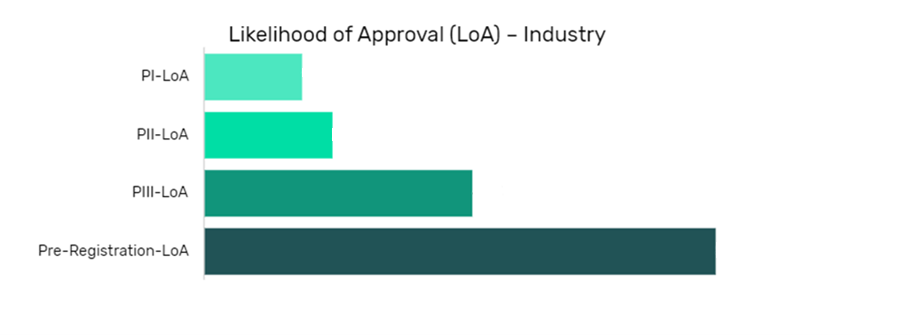
The data is segmented by drug name per indication and shows the current likelihood of approval for the drug compared to the indication benchmark and the industry benchmark.
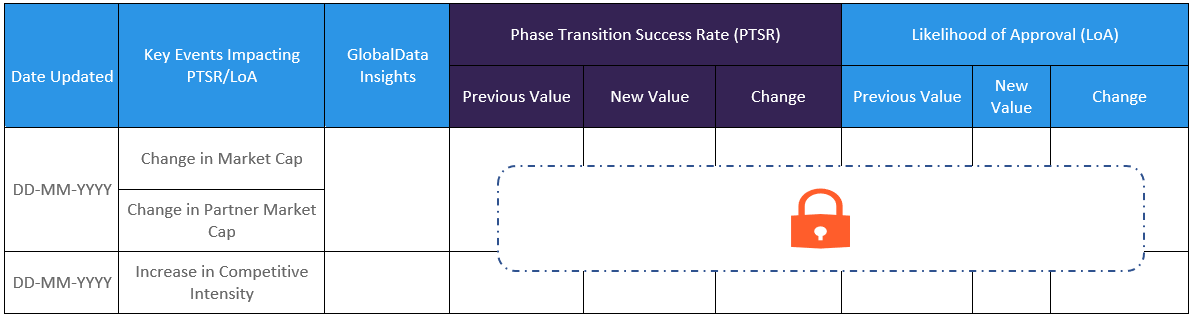
The Likelihood of Approval data is updated regularly based on events that take place which impact the clinical development process and regulatory considerations. GlobalData’s proprietary machine learning models consider these events in real time, to produce quantitative changes to the LOA and PTSR along with qualitative reasoning why the likelihood of approval has changed.
Scope of Report
- Drug Details: Drug name, Drug type, Intervention type
- Administration Pathway
- Therapeutic Areas
- Key Manufacturers
- Drug Development Status
Reasons to buy
- Precise Likelihood of Approval and Phase Transition Success Rates: Our machine learning and proprietary models provide accurate predictions, helping you gauge the potential success of a drug in the regulatory process.
- Competitive Strategy Planning: Access information on LOA and PTSR for competitors’ drugs, allowing you to plan your clinical development, commercialisation and marketing strategies
- Event-driven Updates: Track event-driven changes in LOA and PTSR benchmarked against indication LOA/PTSR. Get the latest insights to adapt your strategies promptly!
- Well-informed Investment Decisions: This data helps you navigate the dynamic landscape of drug development and regulatory considerations.







