
Empower your strategies with our Likelihood of Approval and Phase Transition Success Rate Model – Olaparib in Pulmonary Arterial Hypertension report and make more profitable business decisions.
This report provides you with the data that allows you to track and predict the specific likelihood of approval (LOA) and phase transition success rate (PTSR) of a drug using GlobalData’s proprietary machine learning algorithms developed using over 10 years of historical data.
Olaparib in Pulmonary Arterial Hypertension Drug Details:
Olaparib (Lynparza) is an antineoplastic agent. It is formulated as hard gelatin capsules, coated tablets and film-coated tablets for oral route of administration. Lynparza is indicated for the treatment of the first therapy for the maintenance treatment of adult patients with platinum-sensitive relapsed BRCA-mutated (germline and somatic) high grade serous epithelial ovarian, liposarcoma, bone arcoma, soft tissue sarcoma, fallopian tube, or primary peritoneal cancer who are in complete response or partial response to platinum-based chemotherapy. Lynparza is indicated as monotherapy in patients with deleterious or suspected deleterious germline BRCA mutated advanced ovarian cancer who have been treated with three or more prior lines of chemotherapy, and also indicated for the first line maintenance treatment of adult patients with deleterious or suspected deleterious germline or somatic BRCA-mutated (gBRCAm or sBRCAm) advanced epithelial ovarian, pulmonary arterial hypertension,fallopian tube or primary peritoneal cancer who are in complete or partial response to first-line platinum-based chemotherapy, as a monotherapy for the treatment of adult patients with germline BRCA1/2-mutations (gBRCAm), and who have human epidermal growth factor receptor 2 (HER2)-negative locally-advanced or metastatic breast cancer, as a first line maintenance treatment for women with BRCA1/2-mutated (germline and/or somatic) high-grade epithelial ovarian, fallopian tube or primary peritoneal cancer who are in response (complete or partial) following completion of 1st-line platinum-based chemotherapy.Lynparza is also indicated for the maintenance treatment of adult patients with deleterious or suspected deleterious germline BRCA-mutated (gBRCAm) metastatic pancreatic adenocarcinoma (pancreatic cancer) whose disease has not progressed on at least 16 weeks of a 1st-line platinum-based chemotherapy regimen, and also in combination with bevacizumab for first-line maintenance treatment of adult patients with advanced epithelial ovarian, fallopian tube, or primary peritoneal cancer who are in complete or partial response to first-line platinum-based chemotherapy and whose cancer is associated with homologous recombination deficiency positive status defined by either a deleterious or suspected deleterious BRCA mutation, and/or genomic instability. Lynparza for adult patients with deleterious or suspected deleterious germline or somatic homologous recombination repair (HRR) gene-mutated metastatic castration-resistant prostate cancer (mCRPC), who have progressed following prior treatment with enzalutamide or abiraterone. Lynparza is indicated in combination with abiraterone and prednisone or prednisolone for the treatment of adult patients with deleterious or suspected deleterious BRCA-mutated (BRCAm) metastatic castration-resistant prostate cancer (mCRPC). Lynparza in combination with durvalumab is indicated for the maintenance treatment of adult patients with primary advanced or recurrent endometrial cancer that is mismatch repair proficient (pMMR) whose disease has not progressed on first-line treatment with durvalumab in combination with carboplatin and paclitaxel.It is under development for the treatment of metastatic pancreatic ductal adenocarcinoma, recurrent osteosarcoma, advanced pheochromocytoma and paraganglioma, metastatic colorectal cancer, castration sensitive recurrent non-metastatic prostate cancer, renal cell cancer second line therapy), metastatic breast cancer (HER2+), gBRCAm HER negative breast cancer, ovarian cancer for first and second line therapy, intracranial glioma, neuroblastoma, recurrent endometrial cancer, relapsed glioblastoma, cholangiocarcinoma, non-small cell lung cancer, small-cell lung cancer, cervical cancer, malignant mesothelioma, soft tissue sarcoma, non-Hodgkin lymphoma, diffuse large B-cell lymphoma, Hodgkin lymphoma, gBRCA mutated metastatic pancreatic cancer, advanced squamous cell carcinoma of the head and neck (HNSCC), laryngeal carcinoma and oropharyngeal squamous cell carcinoma, metastatic urothelial carcinoma, Pancreatic Acinar Cell Carcinoma, gastric acncer, adenocarcinoma of gastroesophageal junction, metastatic uveal melanoma, triple negative breast cancer and advanced urothelial carcinoma, fallopian tube cancer and peritoneal cancer.It was also under development for muscle-invasive bladder cancer (MIBC), colorectal cancer, HER2 negative metastatic breast cancer, gastric cancer including gastro-esophageal (GE) junction cancer and metastatic uterine leiomyosarcoma and first line unresectable stage IV bladder cancer, renal pelvic cancer, ureter cancer, urethral cancer and urothelial cancer and for second line therapy or greater BRCAm PSR ovarian cancer as maintenance monotherapy. It is under development for second and third line homologous-recombination deficient (HRD) metastatic colorectal cancer.It was also under development for the treatment of castration-resistant prostate cancer (CRPC).
Report Coverage
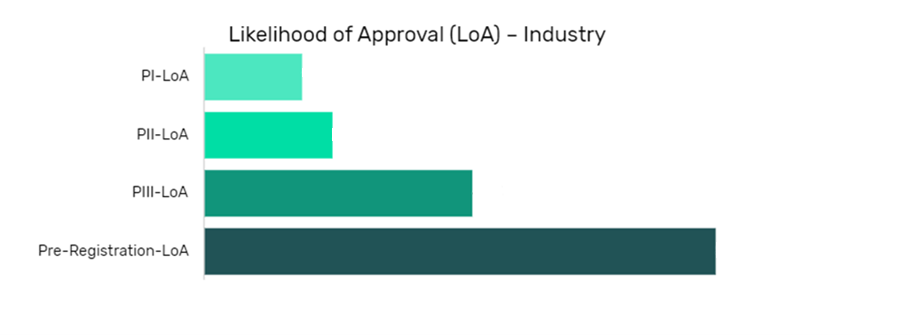
The data is segmented by drug name per indication and shows the current likelihood of approval for the drug compared to the indication benchmark and the industry benchmark.
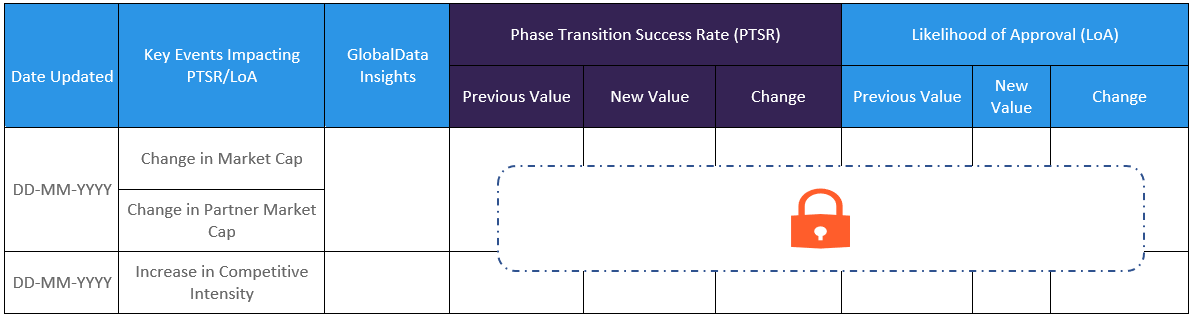
The Likelihood of Approval data is updated regularly based on events that take place which impact the clinical development process and regulatory considerations. GlobalData’s proprietary machine learning models consider these events in real time, to produce quantitative changes to the LOA and PTSR along with qualitative reasoning why the likelihood of approval has changed.
Scope of Report
- Drug Details: Drug name, Drug type, Intervention type
- Administration Pathway
- Therapeutic Areas
- Key Manufacturers
- Drug Development Status
Reasons to buy
- Precise Likelihood of Approval and Phase Transition Success Rates: Our machine learning and proprietary models provide accurate predictions, helping you gauge the potential success of a drug in the regulatory process.
- Competitive Strategy Planning: Access information on LOA and PTSR for competitors’ drugs, allowing you to plan your clinical development, commercialisation and marketing strategies
- Event-driven Updates: Track event-driven changes in LOA and PTSR benchmarked against indication LOA/PTSR. Get the latest insights to adapt your strategies promptly!
- Well-informed Investment Decisions: This data helps you navigate the dynamic landscape of drug development and regulatory considerations.







