Decarbonizing the Road and Rail Freight Industry – Trends, Assessing Technologies, Challenges and Case Studies

Powered by

All the vital news, analysis, and commentary curated by our industry experts.

Decarbonizing the Road and Rail Freight Industry Report Overview

In 2022, road transport accounted for 74% of all transport-related emissions. The road and rail freight industry accounts for approximately 2% of emissions and is the largest industrial energy consumer. However, over the previous 20 years, diesel train operations have been increasing their direct CO2 emissions by 0.6% yearly. To meet the IEA’s 2050 NZE scenario, the transportation sector needs to cut CO2 emissions by more than 3% year by 2030. Both industries will need to reduce emissions using a range of energy transition technologies in order to achieve this criterion.

The ‘Decarbonizing the Road and Rail Freight Industry – Trends, Assessing Technologies, Challenges, and Case Studies’ report provides an overview of the road and rail freight industry including carbon emissions. The report identifies four key methodologies for improving the sector’s emissions footprint; increasing process efficiency and electrification, green hydrogen, CCUS, and biomass and waste-based feedstocks. These four measures address the sector’s process energy and feedstock requirements. This report outlines how applications of AI, the Internet of Things (IoT), and digital twins can be used to identify equipment inefficiencies and optimize chemical plant operations.

Buy the Full Report to Know More About the Decarbonization of Road and Rail Freight Industry

Download a Free Report Sample

Decarbonizing Technologies ·       Electrification

·       Alternative Fuels

·       Hydrogen

Leading Companies ·       DAF Trucks

·       MAN Truck & Bus

·       Volvo Group

·       Dennis Eagle

·       Mercedes-Benz (Daimler Group)

Enquire & Decide Discover the perfect solution for your business needs. Enquire now and let us help you make an informed decision before making a purchase.

Road and Rail Freight Industry – Decarbonizing Technologies

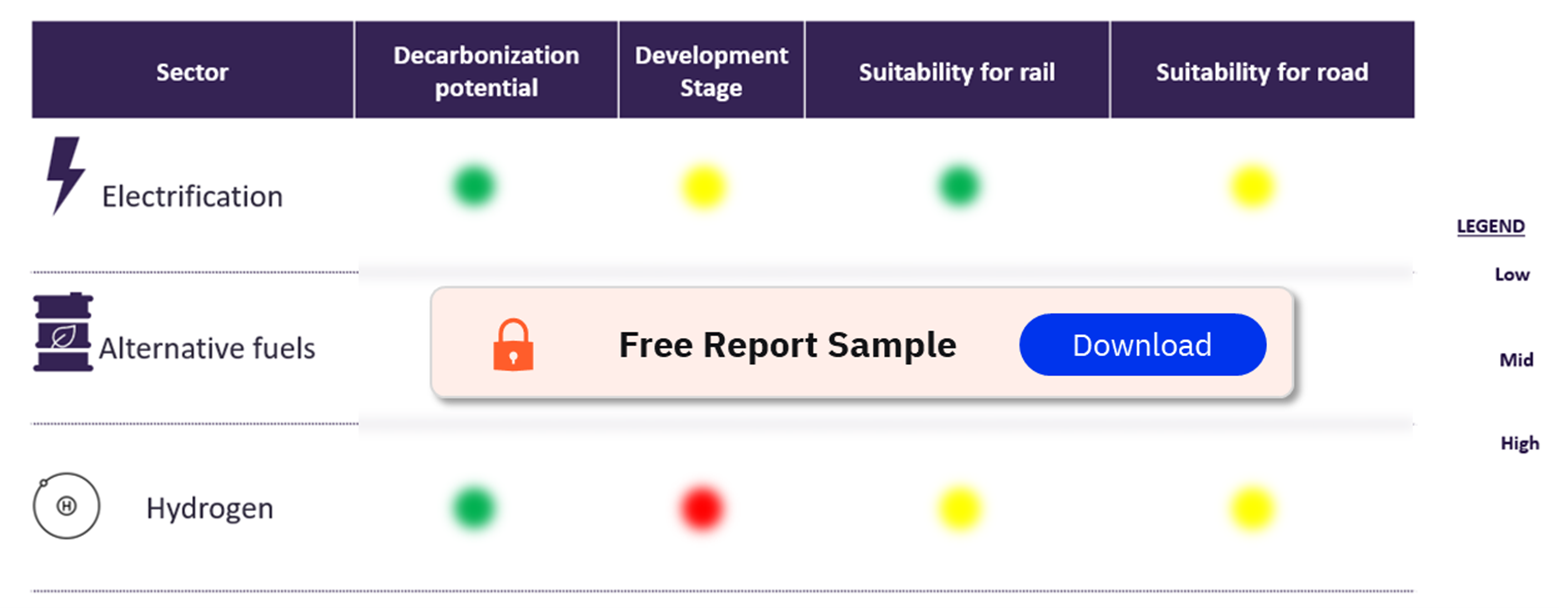
The top three decarbonization technologies for the road and rail freight industry are electrification, alternative fuels and hydrogen.

Electrification: Electrification offers huge decarbonizing potential to both rail and road freight transportation as a substitute from traditional ICEs (internal combustion engines). Electric motors in battery-electric cars are powered by electricity stored in battery packs.r. Electric motors are also more energy-efficient than gasoline or diesel engines, e.g.: the battery recharges when braking (regenerative braking) utilizing kinetic energy.

Technologies for Decarbonizing the Road and Rail Freight Industry
Technologies for Decarbonizing the Road and Rail Freight Industry

Buy the Full Report to Know More about Road and Rail Freight Decarbonizing Technologies

Download a Free Report Sample

Decarbonizing the Road and Rail Freight Industry - Competitive Landscape

A few companies associated with the decarbonization of the road and rail freight industry are:

  • DAF Trucks
  • MAN Truck & Bus
  • Volvo Group
  • Dennis Eagle
  • Mercedes-Benz (Daimler Group)

Headquartered in Netherlands, DAF Trucks reduce scope 1 & 2 emissions by 45% by 2030 from a 2018 baseline. It also reduces CO2 emissions of sold trucks by 45% by 2030 (no baseline given).

Decarbonization of Road and Rail Freight Industry Analysis by Companies

Decarbonization of Road and Rail Freight Industry Analysis by Companies

Buy the Full Report to Know More about Company Insights into the Road and Rail freight Industry

Download a Free Report Sample

Scope

The report provides Global CO2 emissions from the road and rail freight industry, relevant policies for the

decarbonization of the industry, analysis of strategies adopted by major players in the road and rail freight

industry – including case studies, analysis of different decarbonizing technologies such as electrification,

adoption of alternative fuels, and hydrogen.

Key Highlights

  • In 2022, road transport accounted for 74% of all transport-related emissions, with heavy freight vehicles contributing 16% and rail only contributing 1% of all transport-related emissions.
  • To align with the IEA’s 2050 NZE scenario, the transport sector must reduce CO2 emissions by over 3% per year by 2030.
  • Increasing efficiencies and optimization measures will represent the fastest and most cost-effective way to reduce emissions from land freight.
  • Electrification will offer huge decarbonizing potential to both rail and road freight transportation as a substitute from traditional ICEs (internal combustion engines).
  • The utilization of alternative fuels such as FAME biodiesel, HVO, and synthetic fuels will provide an interim solution for emission reductions whilst the industry awaits further development of more innovative technologies such as hydrogen.
  • Hydrogen fuel cells and hydrogen combustion engines will offer great decarbonization potential for the land freight industry by replacing hydrocarbon-based fuels with the input of hydrogen. Widespread adoption of the technology is currently hindered by the high costs of both electricity and new infrastructure.
  • Ultimately, collaboration between road and rail will yield the biggest results. Going forward, land freight is likely to be intermodal, i.e.: a combination of both modes of transport, as trains are better suited for long-haul, and trucks are able to cover the first and last kilometres with better flexibility.

Reasons to Buy

  • Identify market trends within the industry and assess who the biggest players in land freight are and what they are doing to reduce emissions.
  • Develop market insight of the major technologies used to decarbonize land freight through case studies from industry leaders in both road and rail.
  • Understand adoption trends of emerging low-carbon technologies such as hydrogen fuel cell vehicles and hydrogen-powered rail.

DAF Trucks
MAN Truck & Bus
Volvo Group
Dennis Eagle
Mercedes-Benz (Daimler Group)
Isuzu Trucks
Renault Trucks
Iveco
Scania
Mitsubishi Fuso
SNFC Groupe
Indian Railways
Union Pacific Corp
BNSF Railway
East Japan Railway
Ferrovie dello Stato Italiane
Canadian National Railway
Kintetsu Group Holdings
Network Rail
Hitachi Rail
Trenitalia
Hyzon Motors
Verne
PACCAR
Toyota Motor
VDL Group
Hyundai
XCIENT
H2 Accelerate TRUCKS.

Table of Contents

  • 1. Executive summary
  • 2. Road and rail freight carbon emissions
  • 3. Introduction to energy transition technologies
  • 4. Assessing the decarbonization potential of energy transition technologies
  • 5. Main challenges to decarbonizing road and rail freight
  • 6. Road and rail freight net-zero emission targets
  • 7. Electrifying road and rail freight
  • 8. Alternative fuels in road and rail freight: biodiesel and synthetic fuels
  • 9. Hydrogen in road and rail freight
  • 10. The way forward: sector cooperation

Table

Decarbonization potential, development stage, suitability for rail, and suitability for road for electrification, alternative fuels, and hydrogen.

Advantages and disadvantages for biofuels, synthetic fuels, BEV, FCEV, overhead charging.

Long-term and interim targets for top 10 heavy-duty companies

Long-term and interim targets for top 10 railway companies

Railway companies’ interim strategies

Advantages and disadvantages for road and rail

Figures

CO2 emissions by sector, 2019-2022

CO2 emissions by transport sub-sector in 2022

CO2 emissions from rail and NZE scenario, 2010-2030

CO2 emissions from heavy freight truck and NZE scenario, 2010-2030

Road freight CO2 emissions by heavy duty trucks by region, 2020

HDV production forecast by fuel type, 2024-2035

FAME biodiesel production capacity, 2021-2030

Renewable diesel production capacity, 2021-2030

Upcoming low-carbon hydrogen capacity allocated to synthetic fuels and project count, 2025-2030

Global low-carbon hydrogen capacity, 2024-2030

Hydrogen plants by end-use, 2024 YTD

Frequently asked questions

Decarbonizing the Road and Rail Freight Industry – Trends, Assessing Technologies, Challenges and Case Studies standard reports
Currency USD
$2,500

Can be used by individual purchaser only

$7,500

Can be shared globally by unlimited users within the purchasing corporation e.g. all employees of a single company


Undecided about purchasing this report?

Enquire Before Buying Download FREE Resources

Get in touch to find out about multi-purchase discounts

reportstore@globaldata.com
Tel +44 20 7947 2745

Sample Report

Decarbonizing the Road and Rail Freight Industry – Trends, Assessing Technologies, Challenges and Case Studies was curated by the best experts in the industry and we are confident about its unique quality. However, we want you to make the most beneficial decision for your business, so we offer free sample pages to help you:

  • Assess the relevance of the report
  • Evaluate the quality of the report
  • Justify the cost

Download your copy of the sample report and make an informed decision about whether the full report will provide you with the insights and information you need.

Below is a sample report to understand what you are buying

See what our customers are saying
testimonial-image
testimonial-image
testimonial-image
testimonial-image
testimonial-image
testimonial-image
testimonial-image

“The GlobalData platform is our go-to tool for intelligence services. GlobalData provides an easy way to access comprehensive intelligence data around multiple sectors, which essentially makes it a one-for-all intelligence platform, for tendering and approaching customers.

GlobalData is very customer orientated, with a high degree of personalised services, which benefits everyday use. The highly detailed project intelligence and forecast reports can be utilised across multiple departments and workflow scopes, from operational to strategic level, and often support strategic decisions. GlobalData Analytics and visualisation solutions has contributed positively when preparing management presentations and strategic papers.”

Business Intelligence & Marketing Manager, SAL Heavy Lift

“COVID-19 has caused significant interference to our business and the COVID-19 intelligence from GlobalData has helped us reach better decisions around strategy. These two highlights have helped enormously to understand the projections into the future concerning our business units, we also utilise the project database to source new projects for Liebherr-Werk to use as an additional source to pitch for new business.”

Market Analyst & Management, Liebherr-Werk

Your daily news has saved me a lot of time and keeps me up-to-date with what is happening in the market, I like that you almost always have a link to the source origin. We also use your market data in our Strategic Business Process to support our business decisions. By having everything in one place on the Intelligence Center it has saved me a lot of time versus looking on different sources, the alert function also helps with this.

Head of Key Accounts, Saab AB

Having used several other market research companies, I find that GlobalData manages to provide that ‘difficult-to-get’ market data that others can’t, as well as very diverse and complete consumer surveys.

Marketing Intelligence Manager, Portugal Foods

Our experience with GlobalData has been very good, from the platform itself to the people. I find that the analysts and the account team have a high level of customer focus and responsiveness and therefore I can always rely on. The platform is more holistic than other providers. It is convenient and almost like a one stop shop. The pricing suite is highly competitive and value for our organisation.

I like reports that inform new segments such as the analysis on generation Z, millennials, the impact of COVID 19 to our banking customers and their new channel habits. Secondly the specialist insight on affluent sector significantly increases our understanding about this group of customers. The combination of those give us depth and breadth of the evolving market.

I’m in the business of answering and helping people make decisions so with the intelligence center I can do that, effectively and efficiently. I can share quickly key insights that answer and satisfy our country stakeholders by giving them many quality studies and primary research about competitive landscape beyond the outlook of our bank. It helps me be seen as an advisory partner and that makes a big difference. A big benefit of our subscription is that no one holds the whole data and because it allows so many people, so many different parts of our organisation have access, it enables all teams to have the same level of knowledge and decision support.

Head of Customer Insight and Research, Standard Chartered

“I know that I can always rely on Globaldata’s work when I’m searching for the right consumer and market insights. I use Globaldata insights to understand the changing market & consumer landscape and help create better taste & wellbeing solutions for our customers in food, beverage and healthcare industries.

Globaldata has the right data and the reports are of very high quality compared to your competitors. Globaldata not only has overall market sizes & consumer insights on food & beverages but also provides insights at the ingredient & flavour level. That is key for B2B companies like Givaudan. This way we understand our customers’ business and also gain insight to our unique industry”

Head of Consumer Sensory Insights, Givaudan

GlobalData provides a great range of information and reports on various sectors that is highly relevant, timely, easy to access and utilise.  The reports and data dashboards help engagement with clients; they provide valuable industry and market insights that can enrich client conversations and can help in the shaping of value propositions. Moreover, using GlobalData products has helped increase my knowledge of the finance sector, the players within it, and the general threats and opportunities.

I find the consumer surveys that are carried out to be extremely beneficial and not something I have seen anywhere else. They provided an insightful view of why and which consumers take (or don’t) particular financial products. This can help shape conversations with clients to ensure they make the right strategic decisions for their business.

One of the challenges I have found is that data in the payments space is often piecemeal. With GD all of the data I need is in one place, but it also comes with additional market reports that provide useful extra context and information. Having the ability to set-up alerts on relevant movements in the industry, be it competitors or customers, and have them emailed directly to me, ensures I get early sight of industry activity and don’t have to search for news.

Senior Account Manager, TSYS
Go even deeper with GlobalData Intelligence Center

Every Company Report we produce is powered by the GlobalData Intelligence Center.

Subscribing to our intelligence platform means you can monitor developments at Decarbonizing the Road and Rail Freight Industry – Trends, Assessing Technologies, Challenges and Case Studies in real time.

  • Access a live Decarbonizing the Road and Rail Freight Industry – Trends, Assessing Technologies, Challenges and Case Studies dashboard for 12 months, with up-to-the-minute insights.
  • Fuel your decision making with real-time deal coverage and media activity.
  • Turn insights on financials, deals, products and pipelines into powerful agents of commercial advantage.