Artificial Intelligence (AI) Chips – Thematic Intelligence
Powered by 
All the vital news, analysis, and commentary curated by our industry experts.

Artificial Intelligence (AI) Chips Thematic Intelligence Report Overview
AI chips are becoming the new industrial battleground Artificial intelligence (AI) has been a dream of humanity for centuries. Yet it has not been until recent progress in machine learning on the back of improved algorithms (e.g., Google’s AlphaGo, OpenAI’s GPT-4, Tesla’s AutoPilot) and increasing computing power that it has been possible for AI to solve real-life problems. However, as these AI models dramatically grow in complexity, chips specifically optimized for AI become imperative.
The ‘Artificial Intelligence (AI) Chips Thematic Intelligence’ report offers a technology briefing and how the key technology, macroeconomic, and regulatory trends are impacting this theme. The report provides AI chips industry analysis with in-depth insights into the industry value chain components. This thematic study enlists the leading companies that will make a mark within the AI chips sector in the coming years.
| Key Trends | · Technology Trends
· Macroeconomic Trends · Regulatory Trends |
| Key Value Chain Components | · Pre-Competitive Basic Research
· Design · Fabrication · Assembly and Testing · End Products |
| Key Public Companies | · Alphabet
· Amazon · Microsoft |
| Key Private Companies | · Biren Technology
· Bitmain (Sophon.ai) · Cerebras Systems |
| Enquire & Decide | Discover the perfect solution for your business needs. Enquire now and let us help you make an informed decision before making a purchase. |
AI Chips Industry Trends
The key trends that will shape the AI chips industry are classified into technology trends, macroeconomic trends, and regulatory trends.
Technology Trends: The key technology trends shaping the AI chip theme are the development of neural networks, AI accelerators, and generative AI among others.
Macroeconomic Trends: The trade war between China and the US, the dominant position of Taiwan in the semiconductor industry, and the Ukraine conflict will have a significant impact on the AI chip theme.
Regulatory Trends: Regulatory divergence, technology protectionism, and AI ethics are some of the regulatory trends that will influence the AI chips sector.
Buy the Full Report for More Insights on the Key Trends that will Influence the AI Chips Industry, Download a Free Sample Report
Semiconductor Value Chain
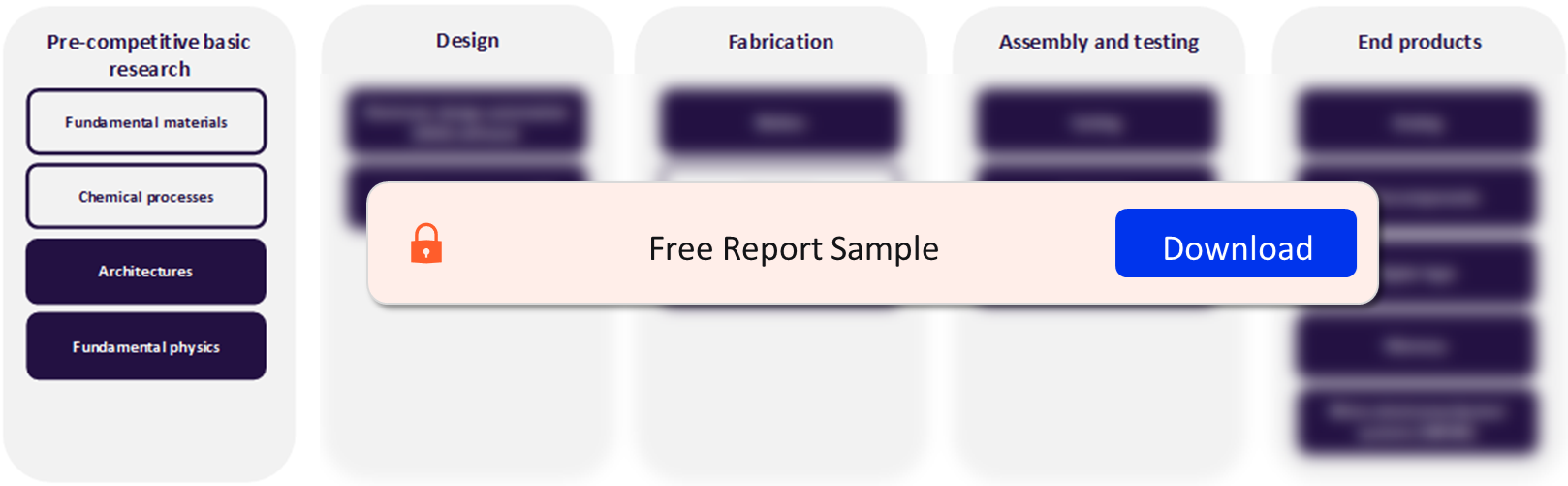
The semiconductor industry value chain comprises pre-competitive basic research, design, fabrication, assembly and testing, and end products.
Pre-competitive basic research: This is typically led by the public sector and academia, with contributions from the private sector, and it can often be 10 to 15 years away from commercialization. It is largely focused on core research into fundamental materials, chemical processes, fundamental physics, and systems architecture. Nowadays, a large part of ongoing basic research in fundamental materials and chemical processes applies to all types of semiconductors, whether intended for AI workloads or not. However, within the architectures and fundamental physics, significant research on quantum computing or neuromorphic computing falls within the category of AI chips.
Semiconductor Industry Value Chain Analysis
 Buy the Full Report for More Value Chain Insights into the AI Chips Industry,
Download a Free Sample Report
AI Chips Industry – Competitive Landscape
The key public companies in the AI chips theme are:
- Alphabet
- Amazon
- Microsoft
The key public companies in the AI chip theme are:
- Biren Technology
- Bitmain (Sophon.ai)
- Cerebras Systems
Leading Public Companies in the AI Chips Industry
 Buy the Full Report for More Insights on the Leading Companies in the AI Chips Industry, Download a Free Sample Report
Semiconductor Sector Scorecard
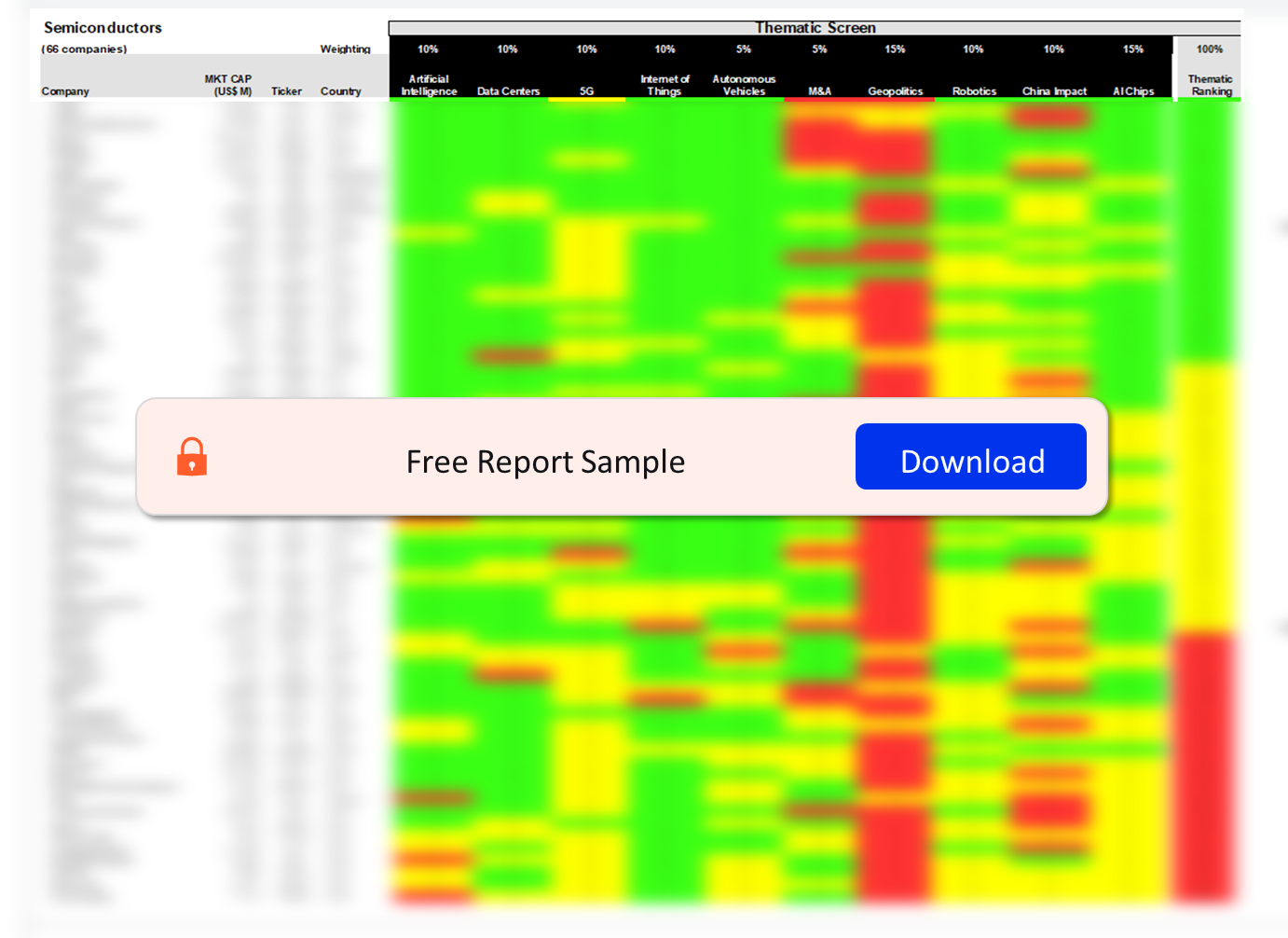
The sector scorecard approach is used to predict tomorrow’s leading companies with each sector. They have three screens including a thematic screen, a valuation screen, and a risk screen.
Semiconductor Sector Thematic Screen Analysis
 Buy the Full Report for More Insights on the Sector Scorecard,
Download a Free Sample Report
Scope
- This report provides an overview of the AI chips theme.
- It identifies the key trends impacting the growth of the theme over the next 12 to 24 months, split into three categories: technology trends, macroeconomic trends, and regulatory trends.
- It contains an overview of the semiconductor industry, including its structure, key participants, interdependencies, and latest innovations, with a particular focus on AI chips.
- It includes global market forecasts for the semiconductor industry and AI chips and analysis of patents, company filings, hiring, and foreign direct investment trends.
- It contains details of M&A deals driven by the AI chips theme, and a timeline highlighting milestones in the development of AI chips.
- The detailed value chain consists of five segments: pre-competitive basic research, design, fabrication, assembly and testing, and end products.
Key Highlights
Environmental sustainability will drive demand The adoption of generative AI, with models growing exponentially in size, is accelerating the consumption of energy and natural resources such as water. AI chips optimized for power consumption and performance can offset this trend, so demand will accelerate over time.
Reasons to Buy
- This report analyzes the changes that are already underway in the global semiconductor industry and identifies the companies that are likely to dominate this rapidly evolving market.
Advantest
Aemulus Holdings
Aibaba
Air Liquide
Aixtron
Aldec
Alibaba
Altium
Amazon
AMD
AMD (Xilinx)
Ampere Computing
Analog Devices
Ansys
Apple
Applied Materials
Arm
ASM
ASML
ASMPT
AST
Averna Test Systems
Axera Technology
Baidu
BASF
BE Semi
Bitmain (sophon.ai)
Bitmain/sophon.ai
Black Semiconductor
Black Sesame
Blaize
BrainChip
Broadcom
Broadcom (Agere)
Brooks Automation
Cadence
Cambricon
Cambridge
Canon
CEC Huada
Celestial AI
Cerebras Systems
CEVA
ChangXin Memory
China Integrated Circuit Investment Industry Fund (CICIIF)
China Semiconductor Industry Association (CSIA)
Chroma ATE
Cirrus Logic
Cohu
Dialog Semiconductors
Disco
DowDuPont
Dresden
eMemory Tech
Esperanto
Eta Compute
Eteched.ai
ETH Zurich
EU Interuniversity Microelectronics Center (IMEC)
Ferrotec
Fingerprint Cards
Fitipower
Focaltech
Fujian Jin Hua
Fujifilm (KMG Chemicals)
Fujitsu
GigaDevice
GlobalWafers
Gowin Semiconductor
GrAI Matter Labs
Graphcore
Gritek
Groq
GyrFalcon
HangZhou Changchuan
Hermes-Epitek
Himax Technologies
HiSilicon
Honeywell
Horizon Robotics
HPE (HP Labs)
Huawei (HiSilicon)
IBM
IC-Haus
Iluvatar CoreX
Imagination
Infineon
Innatera Nanosystems
Institute of Electrical and Electronics Engineers (IEEE)
Institute of Semiconductors at Chinese Academy of Sciences
Intel
Intel (Altera)
IonQ
Japan National Institute of Advanced Industrial Science and Technology (AIST)
JSR
JX/Nikko
Kanto Chemical
Keysight Tech
Kioxia (Toshiba)
KLA
Kneron
Korea Advanced Institute of Science and Technology (KAIST)
Korea Semiconductor Physics Research Center (SPRC)
Kulicke & Soffa
Lam Research
Lattice
LG Electronics
Lightmatter
Littelfuse (IXYS)
Macronix
Macrotest
Magnachip
Marvell
MediaTek
MEMSIC
Mercury Systems
Mercury Systems
Microchip
Micron
Micron Technology
Microsoft
MIT
Mitsubishi
Mobileye
Moore Threads
Murata
Mythic
Nanya
Nanyang Technological University
National Cheng Kung University
National Taiwan University (NTU)
Network (STARnet)
Nichia
Nikon
Nippon Sanso
Nokia (Bell Labs)
Novatek
Nvidia
NXP
NXP Datang
Oki Electric
OmniVision
ON Semi
ON Semiconductor
OnSemi
Onto Innovation
Osram
Oxford
Oxford Ionics
Oxford Quantum Circuits
Palomar Technologies
Peking University
Phytium
Powerchip
PsiQuantum
Qualcomm
QuickLogic
Rambus
Raydium
Rebellions
Recogni
Renesas
Rigetti
Robert Bosch
Rohm
Rohm
S2C
SambaNova
Samsung Electronics
Sanken
Sapeon Korea
Semitronix
Seoul National University
Seoul Semiconductors
Shibasoku
Shin Etsu
Shinkawa
Siemens (Mentor)
SiFive
SiFive (Open-Silicon)
Silicon Labs
Silicon Works
Siltronic
Sitronix
SK Hynix
SK Siltron
SMIC
Socionext
Sony
SPEA
Stanford
STMicroelectronics
Sumco
Synaptics
Synopsys
SynSense
Tachyum
TDK (InvenSense)
Technische Universität
TensTorrent
Teradyne
Tesla
Texas Instruments
Tokyo Electron
Tokyo Ohka
Tokyo Seimitsu
Toshiba
Tosoh
Toyota
Tsinghua University
TSMC
TU Delft
UC Berkley
Unisoc
United Microelectronics
Universal Quantum
University of Tsukuba
US Defence Advanced Research Projects Agency (DARPA)
US Semiconductor Industry Association (SIA)
US Semiconductor Research Corporation (SRC)
US Semiconductor Technology Advanced Research
Ventana Micro Systems
Versum Materials
Vishay
Wafer Works
Western Digital
Winbond
WingTech (Nexperia)
Wolfspeed
Xpeedic Technology
Yangtze River Storage
Yonsei University
Zhaoxin
Table of Contents
Frequently asked questions
-
What are the key trends that will influence the AI chips industry?
The key trends that will shape the AI chips industry are classified into technology trends, macroeconomic trends, and regulatory trends.
-
What are the main value chain components of the semiconductor industry?
The semiconductor industry value chain comprises pre-competitive basic research, design, fabrication, assembly and testing, and end products.
-
Which are the leading public companies in the AI chips sector?
The public key companies in the AI chips industry that will make their mark in the coming years include Alphabet, Amazon, and Microsoft among others.
-
Which are the leading private companies in the AI chips sector?
The key private companies in the AI chips industry that will make their mark in the coming years include Biren Technology, Bitmain (Sophon.ai), and Cerebras Systems among others.

Get in touch to find out about multi-purchase discounts
reportstore@globaldata.com
Tel +44 20 7947 2745
Sample Report
Artificial Intelligence (AI) Chips – Thematic Intelligence was curated by the best experts in the industry and we are confident about its unique quality. However, we want you to make the most beneficial decision for your business, so we offer free sample pages to help you:
- Assess the relevance of the report
- Evaluate the quality of the report
- Justify the cost
Download your copy of the sample report and make an informed decision about whether the full report will provide you with the insights and information you need.


Related reports
View more Technology reports