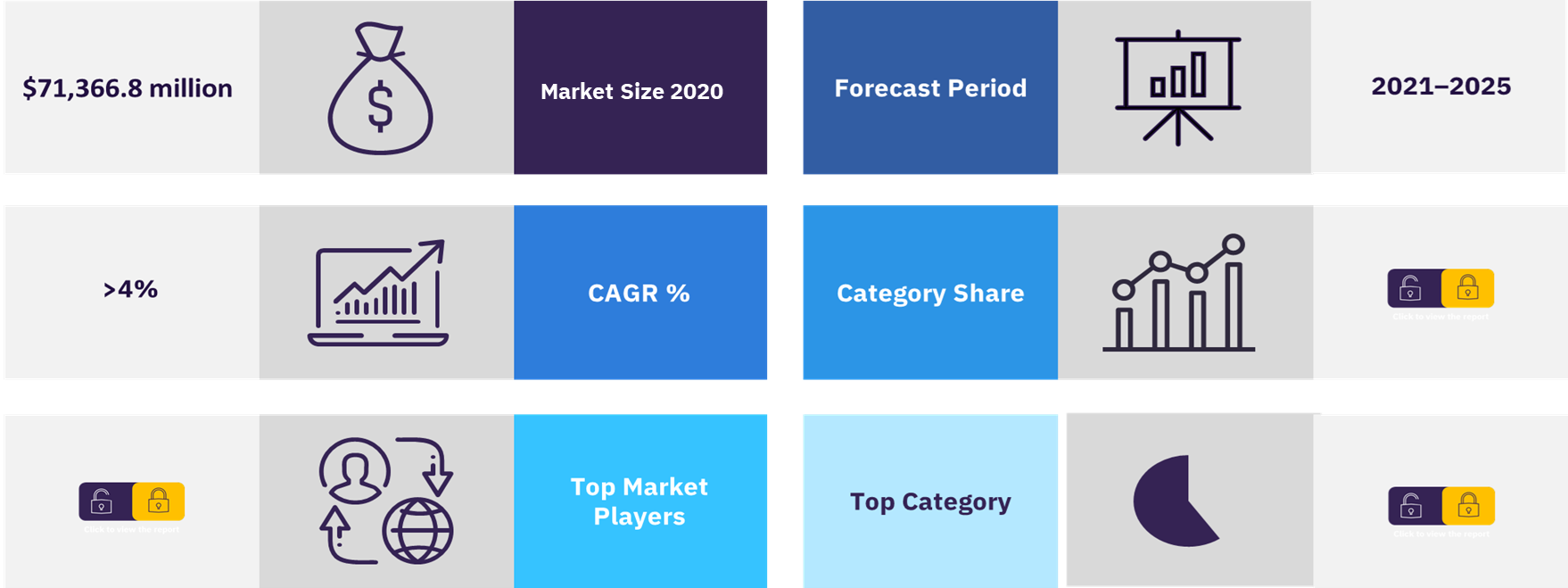
The Asia-Pacific skincare market was valued at $71,366.8 million in 2020 and is projected to grow at a CAGR of more than 4% during the forecast period 2021-2025. Asia-Pacific skincare market is forecast to record growth in both value and volume terms during the forecast period. The rise of the skincare sector can be attributed to manufacturers’ efforts to establish a strong e-commerce platform during the pandemic. Based on the relative performance of countries on multiple metrics, South Korea, Malaysia, Australia, and Thailand were shortlisted as high-potential countries, primarily due to their large market sizes, projected increases in value growth rates, and per capita value growth levels. Among the high-potential countries, South Korea was the largest market in terms of both value and volume sales in 2020.
Overview of the Asia-Pacific skincare market
For more insights on this report, download a free sample
What are the market dynamics of Asia Pacific skincare market?
Anti-aging products have a positive future business outlook in the Asia-Pacific. Companies are targeting older consumers with customized products and focusing on anti-aging formulations and active-aging products. The aging of certain populations in the Asia-Pacific is set to spark a surge in availability of new cosmetic products in the region. Consumers in Asia-Pacific are also becoming more and more concerned about maintaining aspects of their culture and tradition. This, in turn, is leading to the widespread use of local ingredients in skincare products in the region. For instance, the Japanese yuzu fruit is among the skincare ingredients gaining notable popularity in the region. The main reason behind the rising popularity of local ingredients is governments’ eagerness to promote domestic goods.
Many Asia-Pacific countries are negatively affected by high levels of pollution, principally caused by increasing levels of industrialization, farming, and urbanization. Pollution-related skin concerns include inflammation and dull skin. Among the anti-pollution skincare products on the market, some physically protect the skin from pollution while others cleanse the skin and remove nanoparticles. Due to the adverse effects of pollution on the skin, demand for anti-pollution skincare products is likely to increase in the coming years.
What are the key categories of the Asia-Pacific skincare market?
The key categories of the skincare market in the Asia-Pacific include facial care, body care, hand care, depilatories, and make-up remover.
Facial care in the Asia-Pacific skincare market
Facial care was the largest category, of the Asia-Pacific skincare sector. Facial care led the skincare sector in 2020 with the highest per capita consumption. China is projected to make the highest contributions to the growth of the facial care and hand care categories during the forecast period. The consumption of facial care products is expected to rise in all high-potential countries except Thailand.
Body care in the Asia-Pacific skincare market
Body care is forecast to be the fastest-growing skincare category in both value and volume terms in the Asia-Pacific skincare sector. Japan is anticipated to contribute the highest sales increase in body care. In regards with per capita consumption body care stands at the second position after facial care in the Asia-Pacific skincare sector. In the price segmentation of various skincare categories, body care is at the second position.
Hand Care in the Asia-Pacific skincare market
China is projected to make the highest contributions to the growth of the facial care and hand care categories during the forecast period. Also, in the market analysis of the Asia- Pacific skincare sector, hand care is the third highest. The hand care category in the Asia-Pacific is expected to grow in the forecast period rapidly.
Depilatories in the Asia-Pacific skincare market
The depilatories category in the Asia-Pacific is expected to grow in the Asia-Pacific skincare sector. India is expected to increase the sale of depilatories. Australia registered the highest PCC in depilatories.
Make-up remover in the Asia-Pacific skincare market
In terms of price, out of all the categories, make-up remover accounted for the largest premium market. In the leading companies of the Asia-Pacific skincare sector, Unilever posted the highest CAGR, in the make-up remover category.
Asia-Pacific skincare market, by category
For more segment insights, download a free sample
Which are the key countries in the Asia-Pacific skincare market?
Based on the relative performance of countries on multiple metrics, South Korea, Thailand, Malaysia, and Australia were shortlisted as high potential countries primarily due to the large skincare sector size, projected increase in value growth rates, and per capita value growth levels in each country.
Skincare market in South Korea
Amid growing awareness of beauty techniques and products, South Korean consumers are becoming increasingly keen to experiment with their appearance each day. The launch of innovative skincare products is contributing to beauty enhancement. South Korean consumers often try new or different varieties of skincare products. Consumers in South Korea also seek natural, preservative-free skincare products.
Skincare market in Malaysia
As Malaysians are become increasingly becoming ethically conscious, more and more Malaysian consumers are seeking vegan skincare products. Malaysian consumers are growing increasingly interested in products that contain natural ingredients. The consumers seek skincare products that offer personalized care. For instance, many seek face wash products that decrease blemishes and dark spots and acts as an antioxidant.
Skincare market in Australia
Consumers in Australia seek skincare products that meet their specific requirements and align with their moral values, such as those that do not cause any harm to animals. In Australia, demand is growing rapidly for skincare products containing only natural ingredients.
Skincare market in Thailand
Thai consumers are focusing more and more on the ingredients of the skincare products they use, especially when the product is necessary for their health or wellbeing. Many Thai consumers seek skincare products that are vegan and made from natural ingredients, as these are deemed to be the best ‘skin food’. Consumers of all ages are becoming increasingly concerned about age-related skin problems such as fine lines, wrinkles, and skin dullness. This is leading to increased demand for anti-aging skincare products.
Asia-Pacific skincare market, by key countries
For more regional insights, download a free sample
Which are the key players in the Asia-Pacific skincare market?
The key players in the skincare market in the Asia Pacific are L’Oréal S.A., Shiseido Company Limited, Procter & Gamble, Unilever, Amorepacific Corporation, LG Corp, The Estée Lauder Companies Inc., Amway Corporation, Kao Corporation, and KOSÉ Corporation.
Asia-Pacific skincare market, by key players
To know more about key players, download a free sample
Market report scope
| Market size (year – 2020) | $71,366.8 million |
| Growth rate (CAGR) | >4% |
| Base year for estimation | 2020 |
| Forecast period | 2021-2025 |
| Key categories | Body Care, Depilatories, Facial Care, Hand Care, and Make-Up Remover |
| Key countries | South Korea, Malaysia, Australia, and Thailand |
| Key companies | L’Oréal S.A., Shiseido Company Limited, Procter & Gamble, Unilever, Amorepacific Corporation, LG Corp, The Estée Lauder Companies Inc., Amway Corporation, Kao Corporation, and KOSÉ Corporation |
Scope
This report brings together multiple data sources to provide a comprehensive overview of the Asia-Pacific skincare sector, analyzing data from 20 countries in the region. It includes analysis on the following:
- Market Environment: Includes sector size, market size, and growth analysis by category.
- High-Potential Countries’ Analysis: Indicates changing share of value consumption in the various skincare categories across high-potential countries in the Asia-Pacific region. It also provides risk-reward analysis of four countries in Asia-Pacific based on market assessment, economic development, socio-demographic trends, governance indicators, and technological infrastructure.
- Country Deep Dive: Provides the overview, demographic analysis, and key trends across high-potential countries.
- Success Stories: Provides some of the most compelling skincare manufacturers, brands, products, and marketing campaigns in the Asia-Pacific region. It also provides a better understanding of how a certain manufacturer achieved success in the sector, and insights.
- Competitive Environment: Provides an overview of leading companies in the Asia-Pacific region, besides analyzing the growth of private label in the region.
- Distribution Analysis: Provides analysis on the leading distribution channels in the Asia-Pacific skincare sector in 2020. It covers food & drinks specialists, eRetailers, cash & carries & warehouse clubs, convenience stores, hypermarkets & supermarkets, department stores, “Dollar Stores”, variety stores & general merchandise retailers, vending machines, drugstores & pharmacies, and others.
- Packaging Analysis*: The report provides percentage share (in 2020) and growth analysis (during 2015-2025) for various pack materials, pack types, closure, and primary outer types based on the volume sales (by pack units) of skincare products.
- Challenges and Future Outlook: Provides the challenges and future outlook pertaining to Asia-Pacific skincare sector
Reasons to Buy
- Manufacturing and retailers seek the latest information on how the market is evolving to formulate their sales and marketing strategies. There is also demand for authentic market data with a high level of detail. This report has been created to provide its readers with up-to-date information and analysis to uncover emerging opportunities for growth within the sector in the region.
- The report provides a detailed analysis of the countries in the region, covering the key challenges, competitive landscape, and demographic analysis, that can help companies gain insight into the country-specific nuances.
- The analysts have also placed a significant emphasis on the key trends that drive consumer choice and the future opportunities that can be explored in the region, that can help companies in revenue expansion.
Key Stakeholders
Table of Contents
Tables
List of Tables
Regional comparison: Market size, growth, and per capita analysis, 2020-2025
Overview of high-potential countries in Asia-Pacific
Value share analysis of skincare sector compared to other cosmetics & toiletries sectors
Change in consumption of category within skincare (value terms), by country, 2020-2025
Top five companies share by brand (in value terms) in the Asia-Pacific skincare sector, 2020
Private label penetration (in value terms) in the skincare sector, 2020
Leading distribution channels in Asia-Pacific by country, 2020
Leading distribution channels in Asia-Pacific by category, 2020
Graphs
List of Figures
Annual value growth analysis by region, 2020-2025
Annual volume growth analysis by region, 2020-2025
Category volume growth analysis of countries compared to regional average growth
Country value size and CAGR analysis grid based on regional average
Value and volume growth analysis by category in Asia-Pacific, 2020-2025
Country-level contribution to the growth of body care in Asia-Pacific, 2020-2025
Country-level contribution to the growth of depilatories in Asia-Pacific, 2020-2025
Country-level contribution to the growth of facial care in Asia-Pacific, 2020-2025
Country-level contribution to the growth of hand care in Asia-Pacific, 2020-2025
Country-level contribution to the growth of make-up remover in Asia-Pacific, 2020-2025
Per capita consumption by category in Asia-Pacific by country, 2020
Per capita expenditure by category in Asia-Pacific by country, 2020
South Korea: category share
Malaysia: category share
Australia: category share
Thailand: category share
Leading companies in the Asia-Pacific skincare sector by value sales (% share), 2020
Mass vs. premium segmentation by category (in value terms), 2020
Leading companies in the Asia-Pacific skincare sector by value sales (US$ million), 2020
Leading brands (including private label) in Asia-Pacific skincare sector by value sales (US$ million), 2020
Growth analysis by key pack material and pack type
Growth analysis by closure type and primary outer type