Australia Energy Transition Market Report Overview
The Australian government has significantly increased its emissions reduction targets, with the 2022 Climate Change Act legally committing the country to reducing its emissions by 43% (relative to a 2005 baseline) by 2030 and reaching net zero by 2050. While the country has significantly increased its renewable capacity in recent years, sectors such as hydrogen, electric vehicles, renewable fuels, and Carbon Capture, Use, and Storage (CCUS) remain in a relatively early stage of development.
Buy the Full Report for Additional Insights into the Australia Energy Transition Market Overview
Download a Free Sample Report
The ‘Australia Energy Transition Market Report’ analyzes the region’s energy transition to renewable energy sources from a fossil fuel-dominated market into a sustainable energy-producing region.
| Key Sectors | · Renewable Energy
· Electric Vehicles · Renewable Fuel · CCS/CCU · Hydrogen |
| Key Players (Solar) | · Sun Cable Pte Ltd
· Pilbara Energy Generation Pty Ltd · Lightsource BP Renewable Energy Investments Ltd · TotalEnergies SE · Total Eren SA |
| Key Players (Wind) | · Electricite de France SA
· Copenhagen Energy AS · BP Plc · Macquarie Group Ltd. |
| Enquire & Decide | Discover the perfect solution for your business needs. Enquire now and let us help you make an informed decision before making a purchase. |
Australia Energy Transition Market Segmentation by Sectors
Renewable Energy A large increase in renewable capacity has decreased the country’s reliance on thermal resources. By individual technology, solar PV will have the largest share of power capacity, experiencing a strong CAGR of more than 12% between 2023 and 2035. The large share of solar PV reflects the environmental potential of this technology within Australia as well as the suite of government incentives that have been rolled out to encourage installations.
The second biggest renewable energy will be wind power, forecast to grow significantly in the coming years. The bulk of wind power will be provided by onshore wind farms, with this sub-segment accounting for 84% of total wind generation in 2030.
Electric Vehicles: Adoption of electric vehicles in Australia is expected to increase strongly between 2023 and 2030. This represents a strong increase compared to the 2018, where electric vehicles accounted for just 2% of light vehicles.
A strong increase in hybrid vehicles production has taken place in recent years because of their lower cost and greater availability. Car manufacturers such as Toyota have capitalized on the Australian appetite for hybrid vehicles, accounting for approximately 90% of hybrid vehicles sold within the country.
Renewable Fuels: Biofuels have had limited traction within Australia, with no active renewable refineries. Although its pipeline of projects will give a renewable fuel production capacity of 670mmgy by 2026. Factors such as high production costs, limited feedstock availability, and concerns of increasing food prices from using arable land for biofuel production rather than food production have all hampered adoption.
CCU: Australia currently has one Carbon Capture, and Utilization (CCU) project, with a further 24 projects in various stages of development. However, the development of this market has been significantly undermined by the scrapping of Australia’s CCUS Hubs and Technologies Program in October 2022.
Hydrogen: Australia’s hydrogen market is also in an early stage of development. However, several large-scale projects are expected to come online by the end of the decade, which will significantly boost production. A range of government grant schemes will also help to establish pipeline projects.
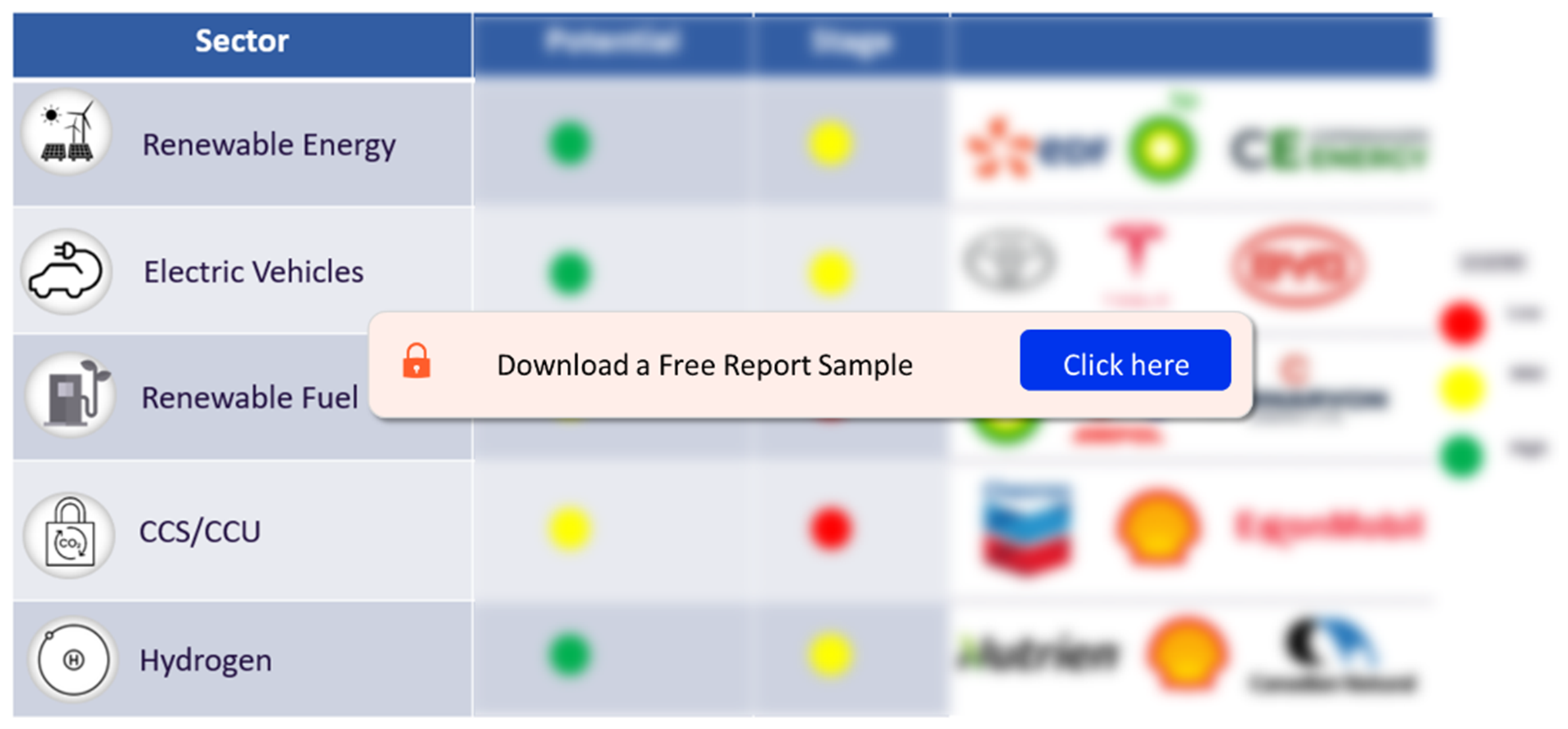
Australia Energy Transition Sector Grid and Leaders
Buy the Full Report for Additional Insights on the Key Sectors of the Australia Energy Transition Market
Download a Free Sample Report
Australia Energy Transition Market – Competitive Landscape
The ‘Australia Energy Transition Market Report’ analyses key players in the market. The leading companies in the Australian energy transition market are Sun Cable Pte Ltd, Pilbara Energy Generation Pty Ltd, Lightsource BP Renewable Energy Investments Ltd, TotalEnergies SE, Total Eren SA, Electricite de France SA, Copenhagen Energy AS, BP Plc, and Macquarie Group Ltd., among others.
Australia Energy Transition Market Players

Buy the Full Report for More Insights on the Key Players in the Australia Energy Transition Market, Download a Free Sample Report
Segments Covered in the Report
Australia Energy Transition Market Sectors Outlook (2018-2035)
- Electric Vehicles
- Renewable Fuels
- CCS/ CCU
- Hydrogen
Scope of Report
The report provides:
- Regional Energy Transition in Australia
- Policies supporting energy transition
- Power renewable capacity and generation by 2035 and thermal decommissioning capacity
- Electric vehicles market and growth
- Renewable refineries in the EU
- Active and upcoming CCUS projects
- Hydrogen market analysis
Key Highlights
• Renewable power capacity share is expected to strongly increase in the coming years. As a result, renewables will overtake thermal in the power capacity share in 2028.
• By individual technology, solar PV will have the largest share of power capacity, alone accounting for 58.7% in 2035 after experiencing a strong CAGR of 12.4% between 2023 and 2035.
• While coal previously accounted for 60% of generation in 2018, the coming year will see its share in the power generation mix rapidly decline, with a negative CAGR of -6.5% between 2023 and 2035. Despite this rapid turnaround and Australia’s renewable energy aspirations, coal will still retain 14.6% share of power generation in 2035.
• Adoption of electric vehicles in Australia is expected to increase strongly between now and 2030, so that electric vehicles will account for 69% of light vehicle ownership.
• With no active renewable refineries, Australia currently has a low standing within the renewable fuels market. Although NSW and Queensland have their own biofuel polices, Australia lacks a federal biofuel mandate, which has arguably undermined business confidence.
• The bulk of Australia’s CCUS projects are in the feasibility stage and account for a maximum carbon capture capacity of 27.5mtpa.
• Australia’s 2023/24 budget sets aside over $2 billion for the nation’s renewable hydrogen industry.
Reasons to Buy
- Identify the latest trends, policies, and leaders in energy transition technologies.
- Develop market insight of current, in development, and announced capacity and latest trends of each of the sectors.
- Understand the potential market growth and policy support for renewable power, hydrogen, renewable refineries, CCU, and EVs.
- Facilitate understanding of where the market is growing as it is positioned as one of the main topics of the international agenda.
Key Stakeholders
Table of Contents
Tables
Australia energy transition leaders
Australia renewable energy policy snapshot
Australia major EPCs and manufacturers for solar energy
Australia major EPCs and manufacturers for wind energy
Upcoming renewable refineries in Australia
Australia CCUS Projects
Australia largest upcoming low carbon hydrogen projects
Examples of hydrogen development in Australia across sectors
Graphs
Average LCOE- Australia
Australia power capacity share, 2018 – 2035
Australia power generation share, 2020 – 2035
Australia renewable generation by type, 2020 – 2035
Decommissioning and upcoming thermal capacity, 2023 – 2035
Australia carbon emissions from thermal power, 2020 – 2035
Top 10 solar owners by capacity in Australia
Top 10 wind owners by capacity in Australia
Australia electric vehicle production, 2019 – 2023
Type and value of Australian EV deals, Jan 2019 – August 2023
Australia renewable fuel production, 2023 – 2030
Australia’s renewable refinery project pipeline as of September 2023
Australia’s top 10 renewable fuel producers by 2030 capacity
Australia CCUS project count by development stage in 2023
Australia CCUS capacity, 2019 – 2030
Australia low carbon hydrogen scenarios, 2020 – 2030