
Empower your strategies with our Likelihood of Approval and Phase Transition Success Rate Model – Brentuximab Vedotin in Head And Neck Squamous Cell Carcinoma (HNSC) report and make more profitable business decisions.
This report provides you with the data that allows you to track and predict the specific likelihood of approval (LOA) and phase transition success rate (PTSR) of a drug using GlobalData’s proprietary machine learning algorithms developed using over 10 years of historical data.
Brentuximab Vedotin in Head And Neck Squamous Cell Carcinoma (HNSC) Drug Details:
Brentuximab vedotin (Adcetris) is an anti-neoplastic agent. It is formulated as a lyophilized powder for solution, solution for intravenous route of administration. Brentuximab vedotin is indicated for the treatment of patients with Classical Hodgkin lymphoma (HL) after failure of autologous hematopoietic stem cell transplantation (auto-HSCT) or after failure of at least two prior multi-agent chemotherapy regimens in patients who are not auto-HSCT candidates. It is indicated for the treatment of patients with Classical HL at high risk of relapse or progression as post-auto-HSCT consolidation. It is also indicated for the treatment of patients with Systemic anaplastic large cell lymphoma (sALCL) after failure of at least one prior multi-agent chemotherapy regimen. Adcetris is also indicated for the treatment of adult patients with CD30+ Hodgkin lymphoma at increased risk of relapse or progression following autologous stem cell transplant (ASCT), also indicated for the treatment of adult patients with relapsed or refractory systemic anaplastic large cell lymphoma, for the treatment of adult patients with primary cutaneous anaplastic large cell lymphoma (pcALCL) and CD30-expressing mycosis fungoides (MF) who have received prior systemic therapy, for the treatment of adult patients with relapsed or refractory CD30+ cutaneous T- cell lymphoma (CTCL) after at least 1 prior systemic therapy. Adcetris is indicated for the first-line pediatric treatment for CD30-positive Hodgkin lymphoma.Adcetris is under development for treatment of relapsed or refractory metastatic squamous or nonsquamous non-small cell lung cancer, head and neck cancer squamous cell carcinoma, metastatic cutaneous melanoma, relapsed and refractory follicular lymphoma, relapsed CD30-positive cutaneous peripheral T-cell lymphoma including non systemic anaplastic large cell lymphoma, angioimmunoblastic T-cell lymphoma, adult T-cell leukemia/lymphoma, enteropathy-associated T-cell lymphoma, hepatosplenic T-cell lymphoma, monomorphic epitheliotropic intestinal T-cell lymphoma, indolent T-cell lymphoproliferative disorder (T-LPD) of the gastrointestinal (GI) tract, follicular T-cell lymphoma and nodal peripheral T-cell lymphoma with T-follicular helper (TFH) phenotype, third line therapy in diffuse large b-cell lymphoma (DLBCL), T-cell lymphomas, relapsed or refractory metastatic solid tumors and for the retreatment of adult patients with who previously responded to ADCETRIS and who later relapse, adult T-cell leukemia/lymphoma. It is under development for CD30-positive malignancies other than lymphoma, multiple myeloma, relapsed and refractory peripheral T-cell lymphoma, lymphomatoid papulosis (LyP), CD30-positive primary cutaneous anaplastic large T-cell lymphoma (pc-ALCL), Hodgkin’s lymphoma, other lymphomas and CD30+ Hodgkin lymphoma, and it is indicated in combination with CHP chemotherapy (cyclophosphamide, doxorubicin, prednisone) for adults with previously untreated systemic anaplastic large cell lymphoma (sALCL) or other CD30-expressing peripheral T-cell lymphomas (PTCL), including angioimmunoblastic T-cell lymphoma and PTCL not otherwise specified, and for the treatment of adult patients with previously untreated CD30+ Stage IV Hodgkin lymphoma in combination with AVD (Adriamycin, vinblastine and dacarbazine). Adcetris is also indicated in combination with CHP (cyclophosphamide, doxorubicin, prednisone) chemotherapy for the treatment of previously untreated adult patients with systemic anaplastic large cell lymphoma (sALCL), peripheral T-cell lymphoma-not otherwise specified (PTCL-NOS) or angioimmunoblastic T-cell lymphoma (AITL), whose tumours express CD30.It is under development for the treatment of malignant mesothelioma, Sezary syndrome and diffuse cutaneous systemic sclerosis.It was also under development for the treatment of non-Hodgkin lymphoma (NHL), acute Graft vs. Host Disease (GvHD), testicular germ-cell cancer, relapsed or refractory (R/R) Hodgkin lymphoma or R/R systemic anaplastic large cell lymphoma (sALCL) and systemic lupus erythematosus. Acute myelocytic leukemia, diffuse large B-Cell lymphoma and follicular Lymphoma and acute lymphoid leukemia, acute myeloid leukemia and mycosis fungoides, systemic mastocytosis and mast cell leukemia, human immunodeficiency virus (HIV) infections.
Report Coverage
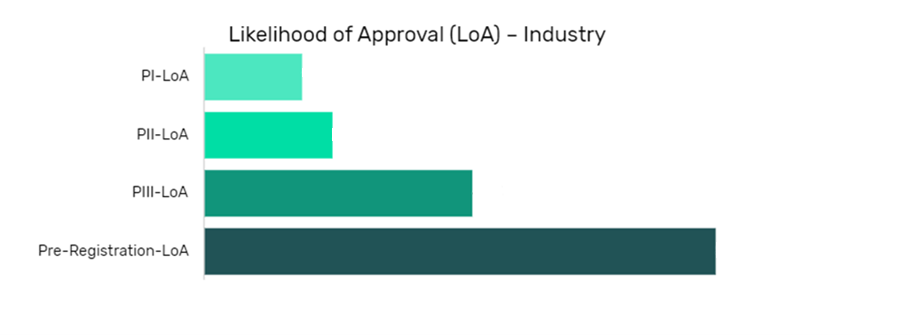
The data is segmented by drug name per indication and shows the current likelihood of approval for the drug compared to the indication benchmark and the industry benchmark.
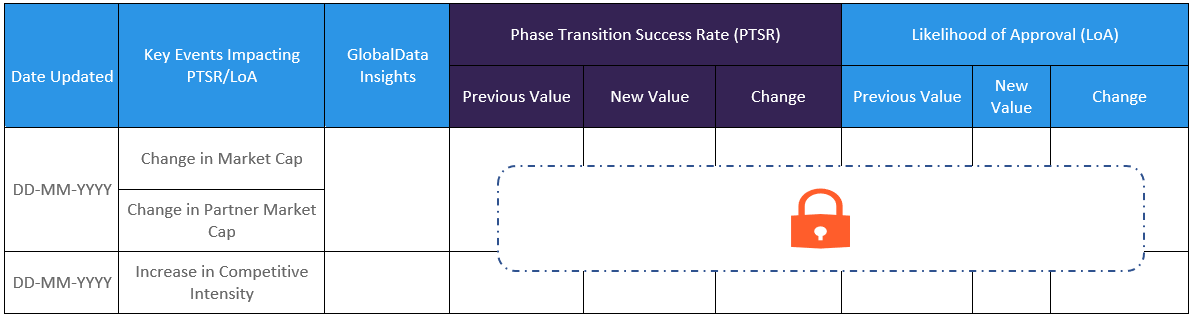
The Likelihood of Approval data is updated regularly based on events that take place which impact the clinical development process and regulatory considerations. GlobalData’s proprietary machine learning models consider these events in real time, to produce quantitative changes to the LOA and PTSR along with qualitative reasoning why the likelihood of approval has changed.
Scope of Report
- Drug Details: Drug name, Drug type, Intervention type
- Administration Pathway
- Therapeutic Areas
- Key Manufacturers
- Drug Development Status
Reasons to buy
- Precise Likelihood of Approval and Phase Transition Success Rates: Our machine learning and proprietary models provide accurate predictions, helping you gauge the potential success of a drug in the regulatory process.
- Competitive Strategy Planning: Access information on LOA and PTSR for competitors’ drugs, allowing you to plan your clinical development, commercialisation and marketing strategies
- Event-driven Updates: Track event-driven changes in LOA and PTSR benchmarked against indication LOA/PTSR. Get the latest insights to adapt your strategies promptly!
- Well-informed Investment Decisions: This data helps you navigate the dynamic landscape of drug development and regulatory considerations.







