
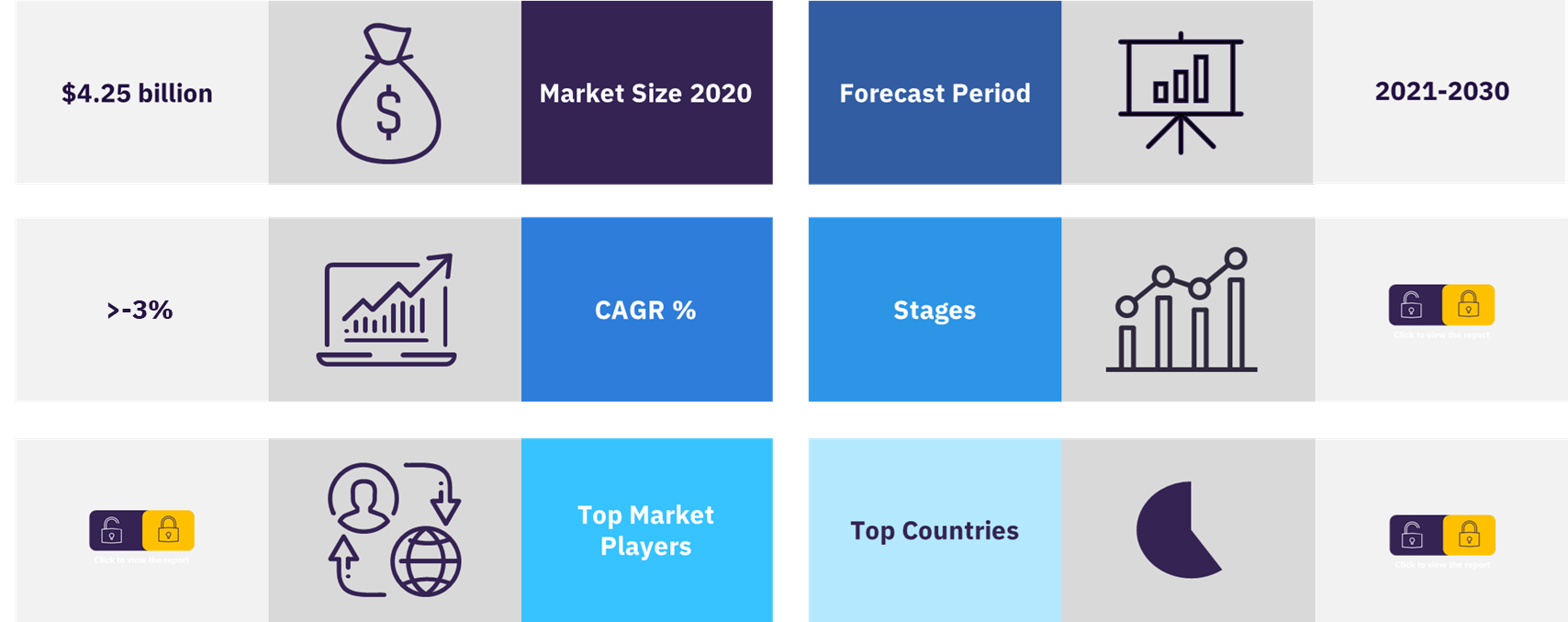
The 8MM CML market was valued at $4.25 billion in 2020, and expects sales to peak in 2023, before falling at a CAGR of more than -3% during the period 2020-2030. The market growth will be driven by the launch or expansion of four agents, an increase in prevalent cases, and increased adoption of branded second and third-generation tyrosine kinase inhibitors (TKIs). Growth will be substantially inhibited by the patent expiries of all but one of the currently marketed TKIs in the 8MM, including Bristol Myers Squibb’s (BMS’) Sprycel (dasatinib), Novartis’ Tasigna (nilotinib), Takeda/Incyte’s Iclusig (ponatinib), and Pfizer’s Bosulif (bosutinib).
The US is the largest market, accounting for more than 60% of total CML sales in 2020. GlobalData expects this share to increase by 2030 as a result of slow growth in the 5EU, which will see these markets reduce their market share combined with increased adoption of novel agents in the US market. The current major players in the CML space are Novartis and BMS and to a lesser extent Pfizer, Takeda, and Incyte. The success of both Novartis and BMS is driven by strong sales across all markets for their second-generation inhibitors, Tasigna and Sprycel, respectively. Additionally, Novartis also benefits from sales of branded Gleevec (imatinib), particularly in markets where generic competition is weaker. The report for chronic myeloid leukemia (CML) in the eight major pharmaceutical markets (8MM) covered in this report- the US, 5EU (France, Germany, Italy, Spain, and the UK), Japan, and Canada during the forecast period from 2020-2030.
Overview of the global chronic myeloid leukemia drug market
For more insights, download a free report sample
What are the market dynamics in the global chronic myeloid leukemia drug market?
The major drivers of growth in the forecast period in the eight major markets (8MM) are approval and launch of premium-priced therapeutics in the 8MM during the forecast period: two TKIs and one stem cell transplant (SCT) cell therapy product, increased prevalence across the 8MM, approval of Novartis’ Scemblix (asciminib) in the 5EU, Japan, and Canada (this has accelerated approval in the US), and label expansion in the 8MM into the first and second lines of therapy, and increased adoption of branded second and third-generation inhibitors over generic imatinib. Patent expiries of the leading brands across the 8MM, increased cost-consciousness, limiting the uptake of branded therapies and novel agents in Europe and Canada, increased awareness of treatment-free remission (TFR) as a long-term target for newly diagnosed chronic phase (CP) patients, resulting in more patients attempting stopping therapy are some of the major barriers to growth in the forecast period in the 8MM.
What are the diagnosed incident cases of CML in the 8MM?
The 8MM include the US, Canada, France, Germany, Italy, Spain, the UK, and Japan. In 2020, the US accounted for more than 45% of the diagnosed incident cases of CML among the 8MM, with 7,433 cases. There were 4,988 cases in the 5EU in 2020, of the diagnosed incident cases, while Japan had more than 12% cases and Canada had more than 5% cases. In the 8MM, the number of the diagnosed incident cases of CML will grow by more than 10% over the forecast period at an Annual Growth Rate (AGR) of more than 1% by 2030. Of the 8MM, Canada is expected to have the highest AGR of more than 2% with the diagnosed incident cases increasing by 2030. Canada will have the lowest number of diagnosed incident cases of CML in 2030. Any change in the diagnosed incident cases of CML is attributable to changing population demographics and changing diagnosed incident rates based on trend analysis in the 8MM.
Diagnosed incident cases of CML in the 8MM, both sexes, by country
For more segment insights, download a free report sample
Who are the key players in the global CML drug market?
The current major players in the CML space are Novartis and BMS, and to a lesser extent Pfizer, Takeda, and Incyte. The success of both Novartis and BMS is driven by strong sales across all markets for their second-generation inhibitors, Tasigna and Sprycel, respectively. Additionally, Novartis also benefits from sales of branded Gleevec (imatinib), particularly in markets where generic competition is weaker.
Global chronic myeloid leukemia drug market, by key players
For more insights on key players, download a free report sample
Market report scope
| Market Size (Year – 2020) | $4.25 billion |
| Growth rate (CAGR) | >-3% |
| Base Year | 2020 |
| Forecast Period | 2021-2030 |
| Key Countries | The US, Canada, France, Germany, Italy, Spain, the UK, and Japan |
| Key Players | Novartis, BMS, Pfizer, Takeda, and Incyte |
Scope
This report provides an in-depth analysis of the following:
- Overview of CML including epidemiology, pathophysiology, symptoms, diagnosis, and treatment guidelines.
- Topline CML market revenue, the annual cost of therapy, and major pipeline product sales in the forecast period.
- Key topics covered include current treatment and pipeline therapies, unmet needs and opportunities, and the drivers and barriers affecting CML therapeutics sales in the 8MM.
- Pipeline analysis: Comprehensive data split across different phases, emerging novel trends under development, and detailed analysis of late-stage pipeline drugs (Phase II-III).
- Analysis of the current and future market competition in the global CML therapeutics market. Insightful review of the key industry drivers and challenges. Each trend is independently researched to provide qualitative analysis of its implications.
Reasons to buy
The report will enable you to:
- Develop and design your in-licensing and out-licensing strategies, using a detailed overview of current pipeline products and technologies to identify companies with the most robust pipelines.
- Develop business strategies by understanding the trends shaping and driving the global CML therapeutics market.
- Drive revenues by understanding the key trends, innovative products and technologies, market segments, and companies likely to impact the global CML market in the future.
- Formulate effective sales and marketing strategies by understanding the competitive landscape and by analyzing the performance of various competitors.
- Identify emerging players with potentially strong product portfolios and create effective counter strategies to gain a competitive advantage.
- Track drug sales in the global CML therapeutics market from 2019-2029.
- Organize your sales and marketing efforts by identifying the market categories and segments that present maximum opportunities for consolidations, investments, and strategic partnerships.
Key Stakeholders
Table of Contents
Tables
Table 1: CML: Key Metrics in the 8MM
Table 2: Staging of CML as Defined by Commonly Used Staging Systems
Table 3: Prognostic Scoring Systems for CML
Table 4: Risk Factors and Comorbid Conditions Associated with CML
Table 5: Treatment Guidelines for CML
Table 6: Top Deals by Value, 2016–2020
Table 7: CML Market – Global Drivers and Barriers, 2020–2030
Table 8: Key Events Impacting Sales for CML in the US, 2020–2030
Table 9: CML Market – Drivers and Barriers in the US, 2020–2030
Table 10: Key Events Impacting Sales for CML in the 5EU, 2020–2030
Table 11: CML Market – Drivers and Barriers in the 5EU, 2020–2030
Table 12: Key Events Impacting Sales for CML in Japan, 2020–2030
Table 13: CML Market – Drivers and Barriers in Japan, 2020–2030
Table 14: Key Events Impacting Sales for CML in Canada, 2020–2030
Table 15: CML Market – Drivers and Barriers in Canada, 2020–2030
Table 15: High-Prescribing Physicians (non-KOLs) Surveyed, By Country
Graphs
Figure 1: Global Sales Forecast by Country for CML in 2020 and 2030
Figure 2: Analysis of the Company Portfolio Gap in CML During the Forecast Period
Figure 3: Competitive Assessment of the Late-Stage Pipeline Agents that GlobalData Expects to Be Licensed for the Treatment of CP CML Patients During the Forecast Period
Figure 4: Competitive Assessment of the Late-Stage Pipeline Agents that GlobalData Expects to Be Licensed for the Treatment of Advanced-Phase CML Patients During the Forecast Period
Figure 5: Diagram of the Translocation Event that Occurs Between Chromosomes Nine and 22 in CML
Figure 6: 8MM, Diagnosed Incidence of CML, Men, Cases Per 100,000 Population, All Ages, 2010–2030
Figure 7: 8MM, Diagnosed Incidence of CML, Women, Cases Per 100,000 Population, All Ages, 2010–2030
Figure 8: 8MM, Sources Used to Forecast Diagnosed Incident Cases of CML (ICD-10 = C92.1)
Figure 9: 8MM, Sources Used to Forecast the Five-, 10-, 15-, and 20-Year Diagnosed Prevalent Cases of CML (ICD-10 = C92.1)
Figure 10: 8MM, Sources Used to Forecast the Diagnosed Incident Cases of CML (ICD-10 = C92.1) by Staging
Figure 11: 8MM, Sources Used to Forecast the Diagnosed Incident Cases of CML (ICD-10 = C92.1) by Risk Status
Figure 12: 8MM, Sources Used to Forecast the Diagnosed Incident Cases of CML (ICD-10 = C92.1) by T315I Mutation
Figure 13: 8MM, Diagnosed Incident Cases of CML, N, Both Sexes, All Ages, 2020
Figure 14: 8MM, Diagnosed Incident Cases of CML by Age, N, All Ages, 2020
Figure 15: 8MM, Diagnosed Incident Cases of CML by Sex, N, All Ages, 2020
Figure 16: 8MM, Diagnosed Prevalent Cases of CML by Staging, N, All Ages, 2020
Figure 17: 8MM, Diagnosed Incident Cases of CML by Risk Status, N, All Ages, 2020
Figure 18: 8MM, Diagnosed Incident Cases of CML by T315I Mutation, N, Both Sexes, All Ages, 2020
Figure 19: 8MM, 20-Year Diagnosed Prevalent Cases of CML, N, Both Sexes, All Ages, 2020
Figure 20: Overview of the Treatment Algorithm in CML
Figure 21: Unmet Needs and Opportunities in CML
Figure 22: Overview of the Development Pipeline in CML
Figure 23: Key Late-Stage Trials for the Promising Pipeline Agents that GlobalData Expects to Be Licensed for CML in the 8MM During the Forecast Period
Figure 24: Competitive Assessment of the Marketed and Pipeline Drugs Benchmarked Against Sprycel in CP Disease
Figure 25: Competitive Assessment of the Marketed and Pipeline Drugs Benchmarked Against Iclusig in Advanced Disease
Figure 26: Analysis of the Company Portfolio Gap in CML During the Forecast Period
Figure 27: Global (8MM) Sales Forecast by Country for CML in 2020 and 2030
Figure 28: Sales Forecast by TKI for CML in the US in 2020 and 2030
Figure 29: Sales Forecast by TKI for CML in the 5EU in 2020 and 2030
Figure 30: Sales Forecast by TKI for CML in Japan in 2020 and 2030
Figure 31: Sales Forecast by TKI for CML in Canada in 2020 and 2030







