
Cloud Computing in Agriculture Thematic Overview
Cloud computing refers to the provision of IT infrastructure, operating software, middleware, and applications hosted within a data center and accessed by the end user via the internet. Key segments for the agricultural sector include cloud services (specifically software as a service (SaaS), platform as a service (PaaS), and infrastructure as a service (IaaS)).
The cloud computing in agriculture thematic intelligence report assesses how agriculture, combined with other emerging technologies, can be used across the agriculture value chain. It provides an overview of the current landscape, as well as key players, while also highlighting opportunities for the use of agriculture in the future.
Cloud Computing in Agriculture - Data Analysis
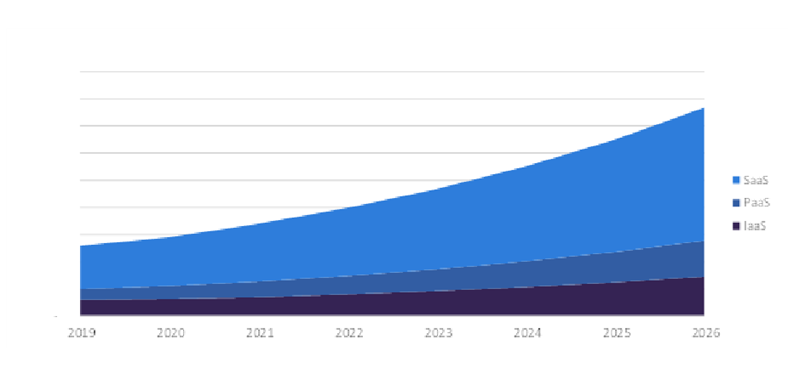
The total global spending by enterprises on IaaS, PaaS, and SaaS was $340.4 billion in 2021. It is expected to increase at a CAGR of more than 17% between 2021 and 2026. SaaS represents the largest portion of global cloud services revenue and will maintain this dominance over the coming years.
The Cloud Computing in agriculture data analysis also covers:
- Mergers and acquisitions
- Patent trends
- Company filings trends
- Cloud computing timeline
Global Cloud Service Revenue, 2019-2026 ($billion)
For more insights into cloud computing in agriculture, download a free report sample
Cloud Computing in Agriculture- Value Chain Analysis
The cloud computing value chain consists of three segments- cloud infrastructure, cloud services, and cloud professional services.
Cloud services (PaaS and IaaS)
In the IaaS and PaaS markets, traditional IT stack infrastructure vendors, specializing in everything from databases and operating systems to virtualization, computing, storage, and networking, face competition from public cloud service providers. The latter use subscription-based, pay-as-you-use business models to offer a full portfolio of IT infrastructure, as well as tools and platforms for application developers. Despite their incumbency, many traditional IT infrastructure vendors, including DXC Technology, Dell, and Fujitsu, now offer cloud-based, IT-as-a-service options alongside traditional IT solutions.
Cloud Computing Value Chain Analysis

For more insights into the cloud computing value chain, download a free report sample
Leading Cloud Computing Adopters in Agriculture
Some of the leading agricultural companies that are currently deploying cloud computing:
- AGCO
- Bayer
- Cargill
Leading Cloud Computing Vendors
Some of the leading vendors in the cloud computing theme:
- Alibaba
- Alphabet (parent company of Google)
- Amazon
Specialist Cloud Computing Vendors in Agriculture
Some of the specialist cloud computing vendors in the agricultural sector:
- Aggio
- Cropin
- Dynaspace
To know more about the leading cloud computing vendors, adopters, and specialist vendors in the agriculture industry, download a free report sample
Cloud Computing in Agriculture Market Report Overview
| Report Pages | 50 |
| Regions Covered | Global |
| Value Chain Components | Cloud Infrastructure, Cloud Services, and Cloud Professional Services |
| Leading Cloud Computing Vendors | Alibaba, Alphabet (parent company of Google), and Amazon |
| Leading Cloud Computing Adopters | AGCO, Bayer, and Cargill
|
| Specialist Cloud Computing Vendors | Aggio, Cropin, and Dynaspace |
Segments Covered in the Report
Cloud Computing in Agriculture Value Chain Outlook (Value, $ billion, 2019-2030)
- Cloud Infrastructure
- Cloud Services
- Cloud Professional Services
Scope of Report
– This report provides an overview of cloud computing sector.
– It explains why cloud will continue to grow in importance for the agriculture industry.
– The report outlines how cloud computing is used in precision agriculture and is improving the efficiency of agricultural operations.
– It also provides examples of what companies and organizations in the agriculture industry are doing in relation to this theme and how they create differentiation.
– Finally, the report highlights companies that are leading in this theme.
Key Highlights
Cloud computing refers to the provision of IT infrastructure, operating software, middleware, and applications hosted within a data center and accessed by the end user via the internet. Key segments for the agricultural sector include cloud services (specifically software as a service (SaaS), platform as a service (PaaS), and infrastructure as a service (IaaS)). Global cloud services revenue was $340.4 billion in 2021 and will grow at a compound annual growth rate (CAGR) of 17.7% between 2021 and 2026, reaching $768.5 billion by the end of the period. The majority of cloud services revenue is derived from SaaS.
Cloud computing helps farmers achieve precision agriculture: a management technique based on responding to the spatiotemporal variability of crops for improved resource efficiency. Precision agriculture requires a vast amount of data from onsite sensors and satellite imagery. This information is collected and sent to the cloud, where it is aggregated to help farmers make decisions about their crop or livestock management.
The agricultural industry is impacted by the huge variability inherent in biological systems. This variability is further exacerbated by extreme weather and geopolitical events. Cloud computing helps agricultural companies deal with this variability by providing computing power on a usage basis. Therefore, agricultural players can process varying amounts of fluctuating data as and when required without wasting resources on maintaining computing infrastructure or paying for services when they are not required.
The agricultural sector is undergoing a technological revolution, and the adoption of cloud computing is central to this. Cloud computing helps farming to achieve precision agriculture. The vast amount of data required from the farm can be collected, stored and analysed to better understand crop health. There is rapid innovation in the area, helping farmers and the wider industry adopt precision agricultural techniques while eliminating the need for farmers to purchase and maintain expensive IT infrastructure.
Reasons to buy
– To understand cloud computing and its current and future impact on the agriculture industry.
– To understand how key challenges that the agriculture sector is facing have accelerated the need for the integrating cloud computing.
– To identify the leading cloud computing adopters and specialist vendors.
– GlobalData’s thematic research ecosystem is a single, integrated global research platform that provides an easy-to-use framework for tracking all themes across all companies in all sectors. It has a proven track record of identifying the important themes early, enabling companies to make the right investments ahead of the competition, and secure that all-important competitive advantage.







