
Accessing the in-depth insights from the ‘Cloud Computing’ report can help:
- Understand the current and future state of the market, allowing businesses to make informed decisions about market entry, product development, and investments.
- Identify competitors’ capabilities to stay ahead in the market.
- Identify segments and get an understanding of various stakeholders across different stages of the entire value chain.
- Anticipate changes in demand and adjust the business development strategies.
- Identify potential regions and countries for growth opportunities.
How is our ‘Cloud Computing’ report different from other reports in the market?
- The report presents in-depth market sizing and forecasts at a segment level for more than 20 countries, including historical and forecast analysis for the period 2020-2027 for market assessment.
- The report offers detailed segmentation by:
-
- IT Infrastructure – Service and Software/Application
- Product/Service – Cloud Management Platforms, Infrastructure as a service (IaaS), Platform as a service (PaaS), Software as a service (SaaS), Hybrid Cloud Services, Managed Cloud Services, and Private Cloud Services
- Vertical – BFSI, Information Technology, Manufacturing, Retail, Energy, Government, Transport & Logistics, and Others
- Enterprise Size Band – Micro (Less than 50), Small (51-250), Medium (251-1000), Large (1001-4999), and Very Large (5000+)
- Region – North America, Europe, Asia-Pacific, South & Central America, and Middle East & Africa
- The report covers key market trends and challenges impacting the cloud computing market.
- The report covers dashboard analytics for M&A deals, venture financing/private equity deals, job activity, and patent activities.
- The value chain in the report can help identify key companies involved in each stage of the value chain. This helps in understanding the competitive landscape and potential collaboration opportunities.
- Competitive profiling and benchmarking of key companies in the market to provide a deeper understanding of industry competition.
- The report can be a valuable tool for stakeholders to improve their operations, increase customer satisfaction, and maximize profitability by analyzing the latest cloud computing trends, tracking market growth and demand, and evaluating the existing competition in the market.
We recommend this valuable source of information to:
- Venture Capital/Equity Firms/Investment Firms
- SaaS, IaaS, and PaaS Provider Companies
- Tech Startups
- Cloud Integration Companies
- Cloud Professional Service Companies
- Cloud and Seed Companies
Get a Snapshot of the Cloud Computing market, Download a Free Report Sample
Cloud Computing Market Report Overview
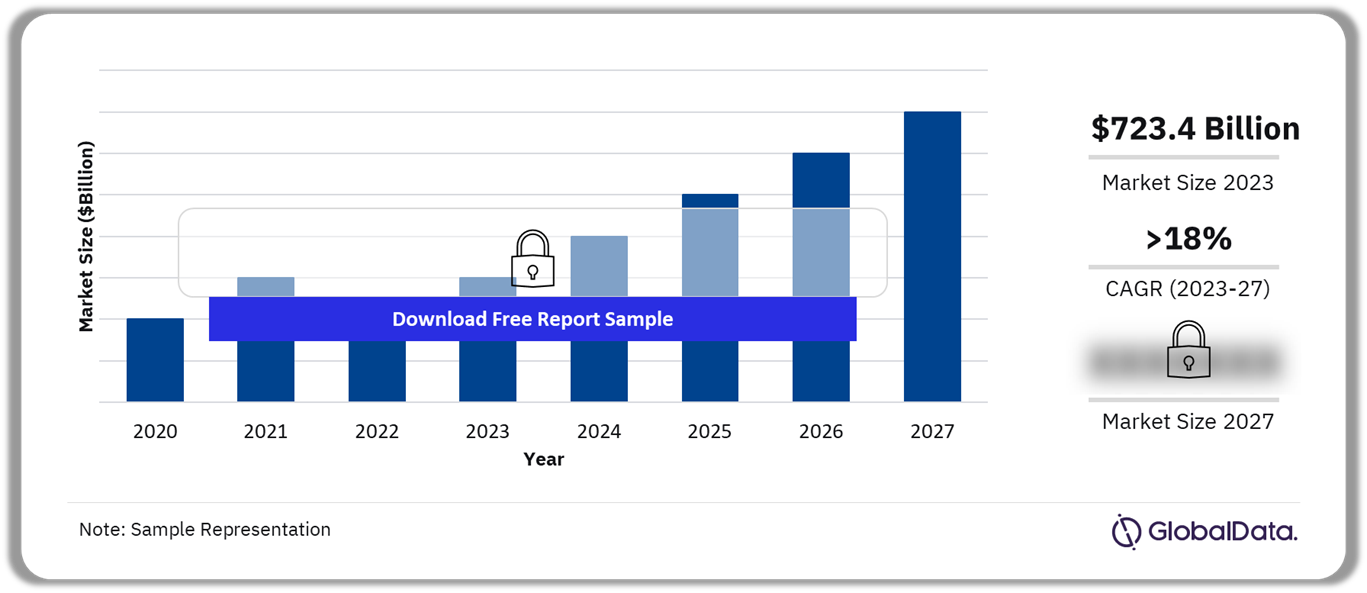
The cloud computing market size revenue was valued at $723.4 billion in 2023 and is expected to grow at a compound annual growth rate (CAGR) of more than 18% over the forecast period. The anticipated growth is fueled by several key factors, including the seamless integration of IoT devices, escalating demand for artificial intelligence (AI), widespread adoption of microservices architecture, and the increasing utilization of the DevOps model. These factors are driving a transformative shift in how businesses leverage cloud technology to focus on their core competencies while offloading infrastructure management and driving digital transformation across their organizations.
The increasing need for AI has greatly accelerated the adoption of cloud services. The competition among cloud service providers to deliver top-notch AI platforms and services is intensifying in the business landscape, driven primarily by the surge in generative AI. The opportunity to attract AI-intensive tasks to their cloud platforms by offering robust models and tools for AI-driven solutions is inducing innovation. As a result, the trend has sparked significant partnerships between cloud providers and leading AI startups, demonstrated by Microsoft’s agreement with OpenAI and AWS’s collaboration with Anthropic.
Cloud Computing Market Outlook, 2020-2027 ($Billion)
Buy the Full Report for Additional Insights on the Cloud Computing Market Forecast
The growing demand for cloud computing is linked to the integration of IoT. The widespread use of IoT devices is driving the expansion of the cloud computing market, necessitating scalable storage, and processing solutions for the large influx of data. IoT deployments often involve many geographically dispersed devices. Cloud computing facilitates centralized management and control of these devices, providing robust analytics tools and services that empower organizations to process and analyze IoT data in real-time.
In addition, application lifecycle management (ALM) is a significant driver of the cloud computing market, as businesses increasingly rely on cloud-based tools and platforms to streamline software development, deployment, and maintenance processes. ALM solutions hosted in the cloud offer scalability, collaboration, and integration capabilities, enabling organizations to efficiently manage the entire lifecycle of their applications from ideation to retirement while leveraging the benefits of cloud infrastructure and services.
Although cloud computing has revolutionized business operations by offering scalability, agility, and cost-effectiveness, concerns over data security and privacy remain significant barriers to widespread adoption. Despite these challenges, adopting mitigation strategies such as a thorough assessment of cloud service providers and implementing data encryption and access controls can enhance overall security and facilitate compliance with data privacy regulations.
| Market Size (2023) | $723.4 billion |
| CAGR (2023 – 2027) | >18% |
| Forecast Period | 2023-2027 |
| Historic Data | 2020-2022 |
| Report Scope & Coverage | Revenue Forecast, Value Chain, Company Landscape, Company Profiles, Market Trends & Challenges, and M&A analysis |
| IT Infrastructure | Service and Software/Application |
| Product/Service | Cloud Management Platforms, Hybrid Cloud Services, IaaS, Managed Cloud Services, PaaS, Private Cloud Services, and SaaS |
| Vertical | BFSI, Information Technology, Manufacturing, Retail, Energy, Government, Transport & Logistics, and Others |
| Enterprise Size Band | Micro (Less than 50), Small (51-250), Medium (251-1000), Large (1001-4999), and Very Large (5000+) |
| Region | North America, Europe, Asia-Pacific, South & Central America, and Middle East & Africa |
| Key Countries | US, Canada, Mexico, UK, Germany, France, Italy, Spain, China, India, Japan, Singapore, Australia, Saudi Arabia, UAE, South Africa, Brazil, Argentina, Chile, and Colombia |
| Key Companies | Microsoft Corp., Alphabet Inc., Amazon.com Inc., Alibaba Group Holding Ltd., Tencent Holdings Ltd., Oracle Corp., Cisco Systems Inc., Salesforce Inc., International Business Machines Corp. (IBM), SAP SE, and ADOBE Inc. |
| Enquire & Decide | Discover the perfect solution for your business needs. Enquire now and let us help you make an informed decision before making a purchase. |
Cloud Computing Market Segmentation by IT Infrastructure
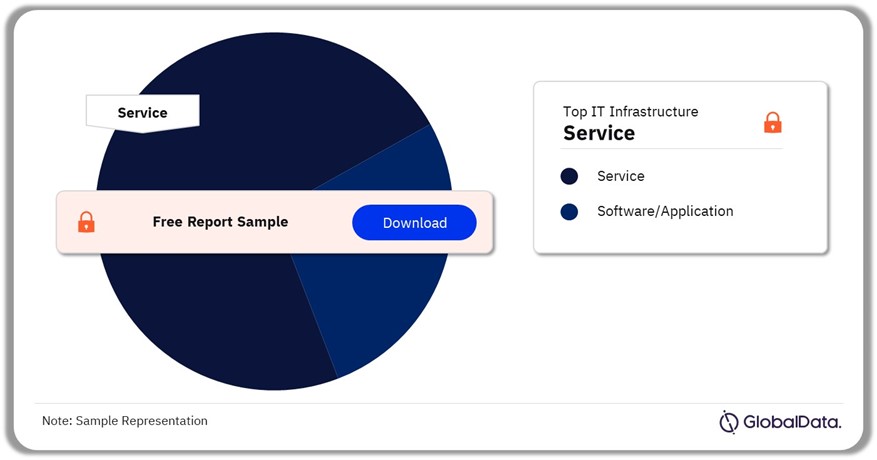
The market is segregated by IT infrastructure into software/application and service. While software and applications are important, services tend to hold the major market share. This is because cloud services encompass a wide range of offerings, including infrastructure as a service (IaaS), platform as a service (PaaS), and software as a service (SaaS), among others. The service segment is the backbone of cloud computing, allowing organizations to leverage scalable, on-demand resources without requiring heavy upfront investment in hardware or software.
The shift towards cloud-native solutions has spurred innovation and accelerated digital transformation initiatives across industries. As a result, enterprises are increasingly prioritizing investments in cloud services to drive operational efficiency, enhance competitiveness, and unlock new avenues for growth.
Cloud Computing Market Share by IT Infrastructure, 2023 (%)
Buy the Full Report for More Information on the Cloud Computing Market by IT Infrastructure
Software plays a crucial role in the domain of cloud computing IT infrastructure, enabling the functionality and management of cloud-based infrastructure. Software solutions are essential for deploying, managing, securing, and optimizing cloud resources and workloads. For instance, software solutions such as AWS Management Console and Azure Portal provide centralized interfaces for managing cloud resources, monitoring performance, and optimizing costs. These platforms offer features such as resource provisioning, monitoring, and billing management, simplifying the management of complex cloud environments.
Cloud Computing Market Segmentation by Product/Service
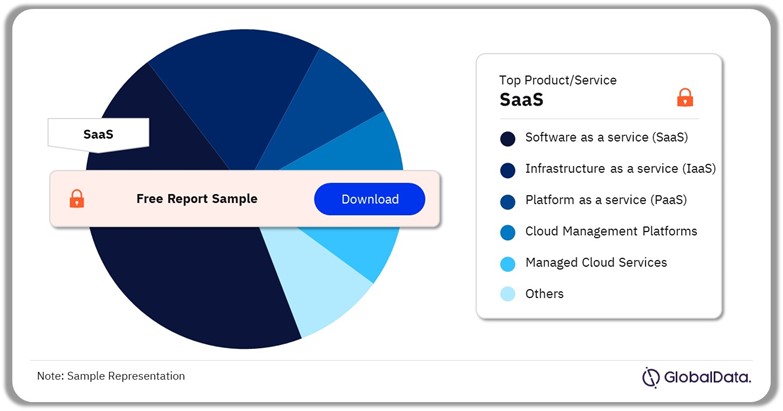
The SaaS segment by product/service will hold the largest market share in 2023. SaaS models typically operate on a subscription basis, spreading costs over time rather than requiring a substantial upfront investment. This makes them appeal to businesses looking to manage their expenses efficiently.
Furthermore, businesses across industries are undergoing digital transformation to stay competitive in the digital age. In addition to SaaS, IaaS and PaaS offer the essential infrastructure and resources required for enterprises to upgrade their IT systems, optimize workflows, and introduce inventive digital offerings. With IaaS, organizations can outsource their hardware needs to cloud providers, eliminating the need for expensive data centers and equipment maintenance. PaaS further enhances cost efficiency by providing pre-configured development platforms and tools, reducing development time and resources.
Cloud Computing Market Share by Product/Service, 2023 (%)
Buy the Full Report for More Information on Cloud Computing Market by Product/Service
Moreover, private cloud services have been gaining significant traction in recent years. Many organizations are opting for private clouds due to the increased control, security, and customization they offer compared to public cloud solutions. One of the key advantages of private clouds is that they allow organizations to host their resources in their own data centers or dedicated environments, providing more control over data security and regulatory compliance.
Cloud Computing Market Segmentation by Vertical
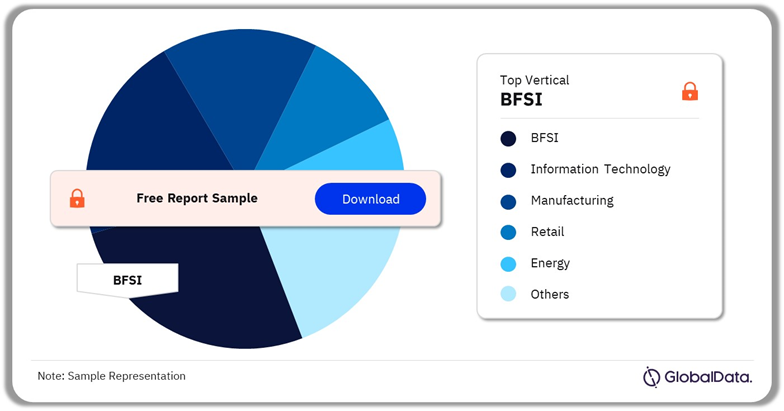
this vertical segment is expected to experience steady growth, with an anticipated CAGR exceeding 15% during the forecast period.
The manufacturing industry has also played a significant role in driving market growth. Cloud technology provides several benefits to manufacturers, allowing them to streamline operations, improve efficiency, and foster innovation across different facets of their business. Cloud-based technologies are transforming manufacturing, enabling advancements such as artificial intelligence, the Internet of Things, and data management warehousing.
Cloud Computing Market Share by Vertical, 2023 (%)
Buy the Full Report for More Information on Cloud Computing Market by Vertical
Additionally, the government sector is a major contributor to the growth of cloud computing. Many governments have launched digital transformation initiatives aimed at modernizing their IT systems and embracing cloud computing as a key enabler.
Cloud Computing Market Segmentation by Enterprise Size Band
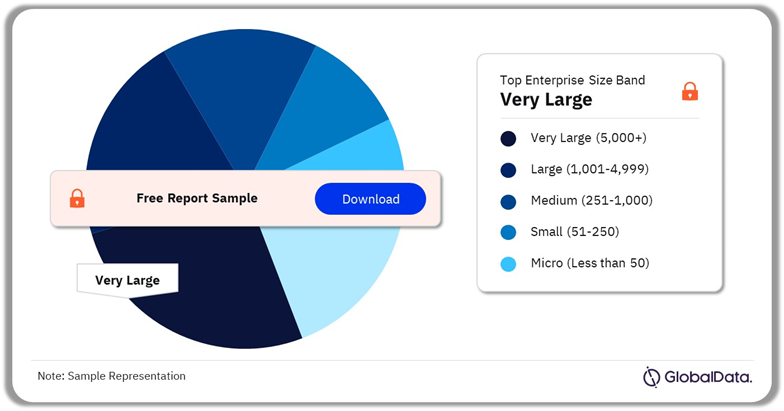
The enterprise size band segment is categorized into very large, large, medium, small, and micro. In 2023, the very large enterprise size band captured a sizeable market share exceeding 35%, and the segment is anticipated to witness strong growth, recording a CAGR surpassing 15% over the forecast period.
Large enterprises have played a crucial role in the adoption of cloud computing. Such enterprises often have a worldwide presence with operations spanning multiple geographies. Cloud computing enables these organizations to deploy applications and services, ensuring consistent performance, reliability, and compliance with local regulations through the cloud provider’s infrastructure and data center footprint.
Cloud Computing Market Share by Enterprise Size Band, 2023 (%)
Buy the Full Report for More Information on the Cloud Computing Market by Enterprise Size Band
Small and medium-sized businesses (SMBs) are also major contributors to the growth of the market. While large enterprises have substantial IT resources and budgets, SMBs often have limited resources and face unique challenges that make cloud computing particularly attractive for their needs. Cloud computing provides SMBs with the flexibility and agility they need to respond quickly to market changes, seize new opportunities, and stay competitive in today’s fast-paced business environment.
Cloud Computing Market Analysis by Region
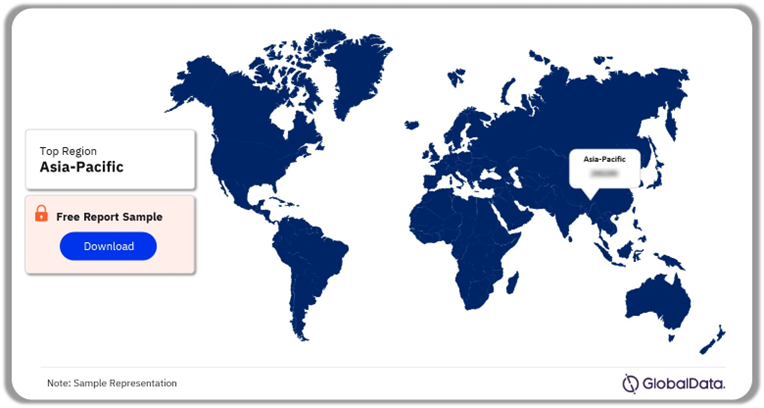
Asia-Pacific held the highest share in 2023, capturing over 30% of the overall market size. China and Japan led the regional market, collectively accounting for over 50% of the regional market in 2023. In particular, the Chinese government has been actively promoting cloud adoption as part of its broader digital transformation efforts, which has fueled the growth of both domestic and international cloud service providers in the country.
North America, particularly the US, has been at the forefront of cloud adoption, with a robust ecosystem of cloud providers, tech companies, and enterprises leveraging cloud services. The region is home to many tech giants and startups that continuously drive innovation in cloud computing. As cloud technologies continue to evolve, North America is poised to remain a key driver of growth and innovation in the cloud computing landscape.
Cloud Computing Market Share by Region, 2023 (%)
Buy the Full Report for Regional Insights into the Cloud Computing Market
The growth of the cloud computing market in South & Central America is a significant trend. The region is home to many emerging markets such as Brazil, Argentina, and Chile with growing economies and populations. Governments in the region are actively promoting the adoption of cloud computing as part of their efforts to drive economic growth and improve public services.
Cloud Computing Market – Competitive Landscape
The industry is highly competitive. Established giants such as Microsoft, AWS, and Google continuously innovate their product offerings and service models to maintain their competitive edge. Furthermore, traditional IT companies, telecommunications companies, and even startups are entering the cloud market, adding to the competitive landscape. This competition benefits customers by driving innovation, improving service quality, and driving down prices as providers vie for customers’ business.
The worldwide enthusiasm surrounding generative AI has led to increased complexity in managing infrastructure and applications. As a result, companies are actively pursuing innovation and introducing AI-related products to gain a larger market share. As part of this strategy, in April 2014, IBM made a significant move by acquiring HashiCorp Inc., a cloud software company specializing in tools for managing digital infrastructure. The deal, valued at $6.4 billion, is aimed at expanding IBM’s portfolio of cloud-based software products, capitalizing on the growing demand for AI solutions.
In the dynamic landscape of cloud computing, strategic collaborations and acquisitions play a pivotal role in maintaining a competitive edge. For instance, in April 2024, Orange Egypt and Huawei announced a strategic partnership aimed at introducing Huawei Cloud services to the Egyptian market. This collaboration aims to address the unique needs of businesses across various sectors and sizes in Egypt.
Leading Companies in the Cloud Computing Market
- Microsoft Corp.
- Alphabet Inc.
- Amazon.com Inc.
- Alibaba Group Holding Ltd.
- Tencent Holdings Ltd.
- Oracle Corp.
- Cisco Systems Inc.
- Salesforce Inc.
- International Business Machines Corp. (IBM)
- SAP SE
- ADOBE Inc.
Other Cloud Computing Vendors Mentioned
Google LLC, VMware LLC, KT Cloud Co. Ltd., SB Technology (Sandbox AQ), and Fujitsu Limited, among others.
Buy the Full Report to Know More About Leading Cloud Computing Companies
Cloud Computing Market Segments
GlobalData Plc has segmented the cloud computing market report by IT infrastructure, product/service, enterprise size band, vertical, and region:
Cloud Computing Market IT Infrastructure Outlook (Revenue, $Million, 2020-2027)
- Service
- Software/Application
Cloud Computing Market Product/Service Outlook (Revenue, $Million, 2020-2027)
- Cloud Management Platforms
- SaaS
- IaaS
- PaaS
- Hybrid Cloud Services
- Private Cloud Services
- Managed Cloud Services
Cloud Computing Market Enterprise Size Band Outlook (Revenue, $Million, 2020-2027)
- Micro (Less than 50)
- Small (51-250)
- Medium (251-1000)
- Large (1001-4999)
- Very Large (5000+)
Cloud Computing Market Vertical Outlook (Revenue, $Million, 2020-2027)
- BFSI
- Information Technology
- Manufacturing
- Retail
- Energy
- Government
- Transport & Logistics
- Others
Cloud Computing Market Regional Outlook (Revenue, $Million, 2020-2027)
- North America
- US
- Canada
- Mexico
- Europe
- Germany
- UK
- Italy
- France
- Spain
- Rest of Europe
- Asia-Pacific
- China
- Japan
- India
- Australia
- Singapore
- Rest of Asia-Pacific
- Middle East & Africa
- Saudi Arabia
- South Africa
- UAE
- Rest of the Middle East & Africa
- South & Central America
- Brazil
- Argentina
- Chile
- Colombia
- Rest of South & Central America
Scope of Report
• This report provides overview and service addressable market for global cloud computing market.
• It identifies the key trends and challenges impacting growth of the cloud computing market over the next 12 to 24 months.
• It includes global market forecasts for the cloud computing market along with value chain, company profiling and benchmarking of key companies in the market.
• It covers detailed segmentation by IT Infrastructure, product/service, vertical, enterprise size band, and regional segmentation.
• The report includes dashboard analytics section that covers M&A deals, venture financing/private equity deals, job activity, and patent activities.
Key Highlights
The cloud computing market size revenue was valued at $723.4 billion in 2023 and is expected to grow at a compound annual growth rate (CAGR) of 18.1% over the forecast period. The anticipated growth is fueled by several key factors, including the seamless integration of IoT devices, escalating demand for artificial intelligence (AI), widespread adoption of microservices architecture, and the increasing utilization of the DevOps model. These factors are driving a transformative shift in how businesses leverage cloud technology to focus on their core competencies while offloading infrastructure management and driving digital transformation across their organizations.
Reasons to buy
• This market intelligence report offers a thorough, forward-looking analysis of the global cloud computing market by IT infrastructure, product/service, vertical, enterprise size band, regional, and key trends in a concise format to help executives build proactive and profitable growth strategies.
• Accompanying GlobalData’s Forecast products, the report examines the trends, challenges, and macro impact assessment in the cloud computing market.
• Detailed segmentation by IT Infrastructure – service and software/application; by product/service – Cloud Management Platforms, Infrastructure as a service (IaaS), Platform as a service (PaaS), Software as a service (SaaS), Hybrid Cloud Services, Managed Cloud Services, and Private Cloud Services, and SaaS; by vertical – BFSI, Information Technology, Manufacturing, Retail, Energy, Government, Transport & Logistics, and Others; and by enterprise size band – Micro (Less than 50), Small (51-250), Medium (251-1000), Large (1001-4999), and Very Large (5000+). Additionally, the report also emphasizes segmentation across various regions.
• The report includes 100+ charts and tables providing in-depth analysis of the market size, forecast, and supporting factors which are tailor-made for an executive-level audience, with enhanced presentation quality.
• The report provides an easily digestible market assessment for decision-makers built around in-depth information gathered from key market companies, which enables executives to quickly get up to speed with the current and emerging trends in cloud computing markets.
• The competitive section of the report covers company profiling and benchmarking of key companies in the market to provide a deeper understanding of industry competition.
• The broad perspective of the report, coupled with comprehensive, actionable detail, will help cloud computing vendors and other related companies succeed in the growing cloud computing market globally.
Key Stakeholders
Table of Contents
Tables
- Table 1 Cloud Computing Market – Segmentation
- Table 2 Active Companies in Cloud Computing-related Technologies Jobs, 2023
- Table 3 Top Active Jobs in Cloud Computing-related Technologies, 2023
- Table 4 Cloud Computing Market by Region ($B), 2020-27
- Table 5 Key Cloud Computing Companies: Competitive Landscape (1/2)
- Table 6 Key Cloud Computing Companies: Competitive Landscape (2/2)
- Table 7 Cloud Computing: Americas Company Market Share, 2022-23
- Table 8 Cloud Computing: Asia-Pacific Company Market Share, 2022-23
- Table 9 Cloud Computing: EMEA Company Market Share, 2022-23
- Table 10 Key M&A Transactions in Cloud Computing market
- Table 11 Latest VF/PE Deals in Cloud Computing market
- Table 12 Latest Developments in Cloud Computing market
- Table 13 Microsoft Corp.: Key Personnel
- Table 14 Alphabet Inc.: Key Personnel
- Table 15 Amazon.com Inc.: Key Personnel
- Table 16 Alibaba Group Holding Ltd.: Key Personnel
- Table 17 Tencent Holdings Ltd.: Key Personnel
- Table 18 Oracle Corp.: Key Personnel
- Table 19 Cisco Systems Inc.: Key Personnel
- Table 20 Salesforce Inc.: Key Personnel
- Table 21 International Business Machines Corp.: Key Personnel
- Table 22 SAP SE: Key Personnel
- Table 23 ADOBE Inc.: Key Personnel
Graphs
- Fig 1 Key Cloud Computing Country Markets ($B), 2023 & 2027
- Fig 2 Cloud Computing Market by Region, 2023 ($Billion)
- Fig 3 Cloud Computing – Value Chain (1/2)
- Fig 4 Cloud Computing – Value Chain (2/2)
- Fig 5 Deal Volume – Cloud Computing M&A Deals, 2019-23
- Fig 6 Deal Value – Cloud Computing M&A Deals ($M), 2019-23
- Fig 7 Geographical Distribution – Cloud Computing Deals (value in $M), 2023
- Fig 8 Deal Volume – Cloud Computing VF/PE Deals, 2019-23
- Fig 9 Deal Value – Cloud Computing VF/PE Deals ($M), 2019-23
- Fig 10 Geographical Distribution – Cloud Computing VF/PE Deals (value in $M), 2023
- Fig 11 Global Filing/Grant Trends in Cloud Computing-related Technologies, 2021-23
- Fig 12 Cloud Computing-related Technologies Patents – Trending Sectors by Total Publications, 2023
- Fig 13 Cloud Computing-related Technologies Patents – Trending Sectors by Total Publications, 2023
- Fig 14 Top Authorities Granting Cloud Computing-related Technologies Patents, 2023
- Fig 15 Posted Jobs – Cloud Computing-related Technologies Jobs, 2023
- Fig 16 Geographical Distribution – Cloud Computing-related Technologies Jobs
- Fig 17 (No. of Active Jobs), 2023
- Fig 18 Geographical Distribution – Cloud Computing-related Technologies Jobs, 2023
- Fig 19 Cloud Computing Market Size & Forecasts ($B), 2020-27
- Fig 20 Cloud Computing Market By IT Infrastructure ($B), 2020-27
- Fig 21 Cloud Computing Market By Product/Service ($B), 2020-27
- Fig 22 Cloud Computing Market By Vertical ($B), 2020-27
- Fig 23 Cloud Computing Market By Size Band ($B), 2020-27
- Fig 24 Cloud Computing Market Estimates ($B) & CAGR (%), By Region (2023 vs 2027)
- Fig 25 North America Cloud Computing Market Size & Forecasts ($M), 2020-27
- Fig 26 North America Cloud Computing Market By IT Infrastructure ($M), 2020-27
- Fig 27 North America Cloud Computing Market By Product/Service ($M), 2020-27
- Fig 28 North America Cloud Computing Market By Vertical ($M), 2020-27
- Fig 29 North America Cloud Computing Market By Size Band ($M), 2020-27
- Fig 30 US Cloud Computing Market Size & Forecasts ($M), 2020-27
- Fig 31 US Cloud Computing Market By IT Infrastructure ($M), 2020-27
- Fig 32 US Cloud Computing Market By Product/Service ($M), 2020-27
- Fig 33 US Cloud Computing Market By Vertical ($M), 2020-27
- Fig 34 US Cloud Computing Market By Size Band ($M), 2020-27
- Fig 35 Canada Cloud Computing Market Size & Forecasts ($M), 2020-27
- Fig 36 Canada Cloud Computing Market By IT Infrastructure ($M), 2020-27
- Fig 37 Canada Cloud Computing Market By Product/Service ($M), 2020-27
- Fig 38 Canada Cloud Computing Market By Vertical ($M), 2020-27
- Fig 39 Canada Cloud Computing Market By Size Band ($M), 2020-27
- Fig 40 Mexico Cloud Computing Market Size & Forecasts ($M), 2020-27
- Fig 41 Mexico Cloud Computing Market By IT Infrastructure ($M), 2020-27
- Fig 42 Mexico Cloud Computing Market By Product/Service ($M), 2020-27
- Fig 43 Mexico Cloud Computing Market By Vertical ($M), 2020-27
- Fig 44 Mexico Cloud Computing Market By Size Band ($M), 2020-27
- Fig 45 Europe Cloud Computing Market Size & Forecasts ($M), 2020-27
- Fig 46 Europe Cloud Computing Market By IT Infrastructure ($M), 2020-27
- Fig 47 Europe Cloud Computing Market By Product/Service ($M), 2020-27
- Fig 48 Europe Cloud Computing Market By Vertical ($M), 2020-27
- Fig 49 Europe Cloud Computing Market By Size Band ($M), 2020-27
- Fig 50 France Cloud Computing Market Size & Forecasts ($M), 2020-27
- Fig 51 France Cloud Computing Market By IT Infrastructure ($M), 2020-27
- Fig 52 France Cloud Computing Market By Product/Service ($M), 2020-27
- Fig 53 France Cloud Computing Market By Vertical ($M), 2020-27
- Fig 54 France Cloud Computing Market By Size Band ($M), 2020-27
- Fig 55 Germany Cloud Computing Market Size & Forecasts ($M), 2020-27
- Fig 56 Germany Cloud Computing Market By IT Infrastructure ($M), 2020-27
- Fig 57 Germany Cloud Computing Market By Product/Service ($M), 2020-27
- Fig 58 Germany Cloud Computing Market By Vertical ($M), 2020-27
- Fig 59 Germany Cloud Computing Market By Size Band ($M), 2020-27
- Fig 60 Italy Cloud Computing Market Size & Forecasts ($M), 2020-27
- Fig 61 Italy Cloud Computing Market By IT Infrastructure ($M), 2020-27
- Fig 62 Italy Cloud Computing Market By Product/Service ($M), 2020-27
- Fig 63 Italy Cloud Computing Market By Vertical ($M), 2020-27
- Fig 64 Italy Cloud Computing Market By Size Band ($M), 2020-27
- Fig 65 Spain Cloud Computing Market Size & Forecasts ($M), 2020-27
- Fig 66 Spain Cloud Computing Market By IT Infrastructure ($M), 2020-27
- Fig 67 Spain Cloud Computing Market By Product/Service ($M), 2020-27
- Fig 68 Spain Cloud Computing Market By Vertical ($M), 2020-27
- Fig 69 Spain Cloud Computing Market By Size Band ($M), 2020-27
- Fig 70 UK Cloud Computing Market Size & Forecasts ($M), 2020-27
- Fig 71 UK Cloud Computing Market By IT Infrastructure ($M), 2020-27
- Fig 72 UK Cloud Computing Market By Product/Service ($M), 2020-27
- Fig 73 UK Cloud Computing Market By Vertical ($M), 2020-27
- Fig 74 UK Cloud Computing Market By Size Band ($M), 2020-27
- Fig 75 Rest of Europe Cloud Computing Market Size & Forecasts ($M), 2020-27
- Fig 76 Rest of Europe Cloud Computing Market By IT Infrastructure ($M), 2020-27
- Fig 77 Rest of Europe Cloud Computing Market By Product/Service ($M), 2020-27
- Fig 78 Rest of Europe Cloud Computing Market By Vertical ($M), 2020-27
- Fig 79 Rest of Europe Cloud Computing Market By Size Band ($M), 2020-27
- Fig 80 Asia-Pacific Cloud Computing Market Size & Forecasts ($M), 2020-27
- Fig 81 Asia-Pacific Cloud Computing Market By IT Infrastructure ($M), 2020-27
- Fig 82 Asia-Pacific Cloud Computing Market By Product/Service ($M), 2020-27
- Fig 83 Asia-Pacific Cloud Computing Market By Vertical ($M), 2020-27
- Fig 84 Asia-Pacific Cloud Computing Market By Size Band ($M), 2020-27
- Fig 85 China Cloud Computing Market Size & Forecasts ($M), 2020-27
- Fig 86 China Cloud Computing Market By IT Infrastructure ($M), 2020-27
- Fig 87 China Cloud Computing Market By Product/Service ($M), 2020-27
- Fig 88 China Cloud Computing Market By Vertical ($M), 2020-27
- Fig 89 China Cloud Computing Market By Size Band ($M), 2020-27
- Fig 90 India Cloud Computing Market Size & Forecasts ($M), 2020-27
- Fig 91 India Cloud Computing Market By IT Infrastructure ($M), 2020-27
- Fig 92 India Cloud Computing Market By Product/Service ($M), 2020-27
- Fig 93 India Cloud Computing Market By Vertical ($M), 2020-27
- Fig 94 India Cloud Computing Market By Size Band ($M), 2020-27
- Fig 95 Japan Cloud Computing Market Size & Forecasts ($M), 2020-27
- Fig 96 Japan Cloud Computing Market By IT Infrastructure ($M), 2020-27
- Fig 97 Japan Cloud Computing Market By Product/Service ($M), 2020-27
- Fig 98 Japan Cloud Computing Market By Vertical ($M), 2020-27
- Fig 99 Japan Cloud Computing Market By Size Band ($M), 2020-27
- Fig 100 Australia Cloud Computing Market Size & Forecasts ($M), 2020-27
- Fig 101 Australia Cloud Computing Market By IT Infrastructure ($M), 2020-27
- Fig 102 Australia Cloud Computing Market By Product/Service ($M), 2020-27
- Fig 103 Australia Cloud Computing Market By Vertical ($M), 2020-27
- Fig 104 Australia Cloud Computing Market By Size Band ($M), 2020-27
- Fig 105 Singapore Cloud Computing Market Size & Forecasts ($M), 2020-27
- Fig 106 Singapore Cloud Computing Market By IT Infrastructure ($M), 2020-27
- Fig 107 Singapore Cloud Computing Market By Product/Service ($M), 2020-27
- Fig 108 Singapore Cloud Computing Market By Vertical ($M), 2020-27
- Fig 109 Singapore Cloud Computing Market By Size Band ($M), 2020-27
- Fig 110 Rest of Asia-Pacific Cloud Computing Market Size & Forecasts ($M), 2020-27
- Fig 111 Rest of Asia-Pacific Cloud Computing Market By IT Infrastructure ($M), 2020-27
- Fig 112 Rest of Asia-Pacific Cloud Computing Market By Product/Service ($M), 2020-27
- Fig 113 Rest of Asia-Pacific Cloud Computing Market By Vertical ($M), 2020-27
- Fig 114 Rest of Asia-Pacific Cloud Computing Market By Size Band ($M), 2020-27
- Fig 115 South & Central America Cloud Computing Market Size & Forecasts ($M), 2020-27
- Fig 116 South & Central America Cloud Computing Market By IT Infrastructure ($M), 2020-27
- Fig 117 South & Central America Cloud Computing Market By Product/Service ($M), 2020-27
- Fig 118 South & Central America Cloud Computing Market By Vertical ($M), 2020-27
- Fig 119 South & Central America Cloud Computing Market By Size Band ($M), 2020-27
- Fig 120 Argentina Cloud Computing Market Size & Forecasts ($M), 2020-27
- Fig 121 Argentina Cloud Computing Market By IT Infrastructure ($M), 2020-27
- Fig 122 Argentina Cloud Computing Market By Product/Service ($M), 2020-27
- Fig 123 Argentina Cloud Computing Market By Vertical ($M), 2020-27
- Fig 124 Argentina Cloud Computing Market By Size Band ($M), 2020-27
- Fig 125 Brazil Cloud Computing Market Size & Forecasts ($M), 2020-27
- Fig 126 Brazil Cloud Computing Market By IT Infrastructure ($M), 2020-27
- Fig 127 Brazil Cloud Computing Market By Product/Service ($M), 2020-27
- Fig 128 Brazil Cloud Computing Market By Vertical ($M), 2020-27
- Fig 129 Brazil Cloud Computing Market By Size Band ($M), 2020-27
- Fig 130 Chile Cloud Computing Market Size & Forecasts ($M), 2020-27
- Fig 131 Chile Cloud Computing Market By IT Infrastructure ($M), 2020-27
- Fig 132 Chile Cloud Computing Market By Product/Service ($M), 2020-27
- Fig 133 Chile Cloud Computing Market By Vertical ($M), 2020-27
- Fig 134 Chile Cloud Computing Market By Size Band ($M), 2020-27
- Fig 135 Colombia Cloud Computing Market Size & Forecasts ($M), 2020-27
- Fig 136 Colombia Cloud Computing Market By IT Infrastructure ($M), 2020-27
- Fig 137 Colombia Cloud Computing Market By Product/Service ($M), 2020-27
- Fig 138 Colombia Cloud Computing Market By Vertical ($M), 2020-27
- Fig 139 Colombia Cloud Computing Market By Size Band ($M), 2020-27
- Fig 140 Rest of South & Central America Cloud Computing Market Size & Forecasts ($M), 2020-27
- Fig 141 Rest of South & Central America Cloud Computing Market By IT Infrastructure ($M), 2020-27
- Fig 142 Rest of South & Central America Cloud Computing Market By Product/Service ($M), 2020-27
- Fig 143 Rest of South & Central America Cloud Computing Market By Vertical ($M), 2020-27
- Fig 144 Rest of South & Central America Cloud Computing Market By Size Band ($M), 2020-27
- Fig 145 Middle East & Africa Cloud Computing Market Size & Forecasts ($M), 2020-27
- Fig 146 Middle East & Africa Cloud Computing Market By IT Infrastructure ($M), 2020-27
- Fig 147 Middle East & Africa Cloud Computing Market By Product/Service ($M), 2020-27
- Fig 148 Middle East & Africa Cloud Computing Market By Vertical ($M), 2020-27
- Fig 149 Middle East & Africa Cloud Computing Market By Size Band ($M), 2020-27
- Fig 150 UAE Cloud Computing Market Size & Forecasts ($M), 2020-27
- Fig 151 UAE Cloud Computing Market By IT Infrastructure ($M), 2020-27
- Fig 152 UAE Cloud Computing Market By Product/Service ($M), 2020-27
- Fig 153 UAE Cloud Computing Market By Vertical ($M), 2020-27
- Fig 154 UAE Cloud Computing Market By Size Band ($M), 2020-27
- Fig 155 Saudi Arabia Cloud Computing Market Size & Forecasts ($M), 2020-27
- Fig 156 Saudi Arabia Cloud Computing Market By IT Infrastructure ($M), 2020-27
- Fig 157 Saudi Arabia Cloud Computing Market By Product/Service ($M), 2020-27
- Fig 158 Saudi Arabia Cloud Computing Market By Vertical ($M), 2020-27
- Fig 159 Saudi Arabia Cloud Computing Market By Size Band ($M), 2020-27
- Fig 160 South Africa Cloud Computing Market Size & Forecasts ($M), 2020-27
- Fig 161 South Africa Cloud Computing Market By IT Infrastructure ($M), 2020-27
- Fig 162 South Africa Cloud Computing Market By Product/Service ($M), 2020-27
- Fig 163 South Africa Cloud Computing Market By Vertical ($M), 2020-27
- Fig 164 South Africa Cloud Computing Market By Size Band ($M), 2020-27
- Fig 165 Rest of Middle East & Africa Cloud Computing Market Size & Forecasts ($M), 2020-27
- Fig 166 Rest of Middle East & Africa Cloud Computing Market By IT Infrastructure ($M), 2020-27
- Fig 167 Rest of Middle East & Africa Cloud Computing Market By Product/Service ($M), 2020-27
- Fig 168 Rest of Middle East & Africa Cloud Computing Market By Vertical ($M), 2020-27
- Fig 169 Rest of Middle East & Africa Cloud Computing Market By Size Band ($M), 2020-27
- Fig 170 Microsoft Corp.: Financial Performance ($Million)
- Fig 171 Alphabet Inc.: Financial Performance ($Million)
- Fig 172 Amazon.com Inc.: Financial Performance ($Million)
- Fig 173 Alibaba Group Holding Ltd.: Financial Performance (CNY Million)
- Fig 174 Tencent Holdings Ltd.: Financial Performance (CNY Million)
- Fig 175 Oracle Corp.: Financial Performance ($Million)
- Fig 176 Cisco Systems Inc.: Financial Performance ($Million)
- Fig 177 Salesforce Inc.: Financial Performance ($Million)
- Fig 178 International Business Machines Corp.: Financial Performance ($Million)
- Fig 179 SAP SE: Financial Performance (EUR Million)
- Fig 180 ADOBE Inc.: Financial Performance ($Million)
- Fig 181 Research Methodology Steps
- Fig 182 Core Objectives of the Market Study
- Fig 183 Research Approach
- Fig 184 Analysis Flow
- Fig 185 Quality Control Flow