Demographics Market Overview
Demographic mega-trends of rapidly aging and shrinking populations are unfurling, especially in Western Europe and East Asia. They are shaping rising geopolitical tensions, de-globalization, and a new world order of inward-looking nations and blocs. The next decade will see a massive transfer of power and wealth from the departing boomers to young cohorts with very different habits and values. At the same time, demographic shifts will spawn new growth industries, including service robots, digital healthcare, eldercare, precision agriculture, synthetic proteins and materials, and embedded financial services.
The demographics thematic intelligence report provides a briefing on the theme with a detailed analysis of market opportunity and factors driving its development and adoption. The report also presents key technology, macroeconomic, and regulatory trends impacting the theme.
Key Trends
The main trends shaping the demographics are classified into three categories: technology trends, macroeconomic trends, and regulatory trends.
- Technology Trends: The key technology trends impacting the demographics theme are robotics, agritech, and healthtech.
- Macroeconomic Trends: The key macroeconomic trends impacting the demographics theme are the lying flat movement, climate refugees, conflict, pandemics, gender empowerment, takeover by the young cohorts, cocooning urban singletons, and the stress and loneliness of urban life.
- Regulatory Trends: Fertility policy and immigration policy are a part of the regulatory trends impacting the demographics theme.
For more insights on key trends impacting demographics, download a free report sample
Demographics Framework
The demographics framework has four key components that are generational profiles, country demographic profiles, government policy implications, and sector implications.
Generational profiles: The six living generations spanning birth years between 1922 and 2025 are traditionalists, baby boomers, generation X, millennials, generation Z, and generation alpha. Differentiation between the generations’ core values, relationships with money, and leadership styles will be key drivers of disruption for both the public and private sectors as millennials, Gen Z, and Gen Alpha increasingly gain decision-making powers.
Country demographic profiles: The four key types of country demographic profiles, based metrics such as average population age, fertility rate, and GDP per capita are developed economies, aging population, developed economies, young population, developing economies, young population, and developing economies, aging population.
Government policy implications: Governments concerned about aging populations are employing several strategies to shape their population structures and reverse aging trends. Most of these policies aim to reduce the population’s average age by boosting fertility rates. In time, this increases the working population’s size, reducing the economic strain of supporting an expanding elderly population as people continue to live longer and populations age.
Sector implications: The demographic shift will have a profound impact across all sectors including consumer, energy, financial services, healthcare, industrials, materials and resources, and tech, media, and telecom. In this situation, strongly positioned companies have either adjusted their corporate strategies to cater to aging populations and the rise of Gen Z or will experience demand surges with regional population growth.
Demographics Framework
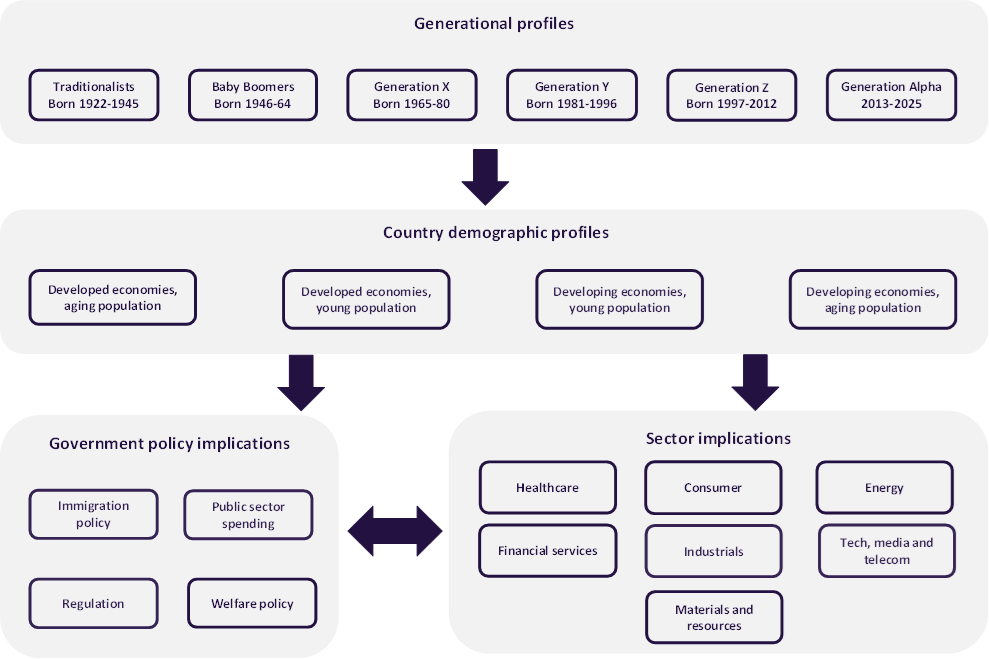
For more demographics framework insights, download a free report sample
Demographics Overview
| Report Pages | 44 |
| Regions Covered | Global |
| Key Trends | Technology Trends, Macroeconomic Trends, and Regulatory Trends |
| Demographics Framework | Generational Profiles, Country Demographic Profiles, Government Policy Implications, and Sector Implications |
Scope
This report:
- Provides an overview of the demographics theme.
- Outlines the current distribution of the world’s population and projections for future population growth.
- Identifies the key trends impacting the growth of the theme over the next 12 to 24 months, classified into three categories: technology trends, macroeconomic trends, and regulatory trends.
- Includes GlobalData’s Demographic framework, which maps out the different components driving demographic shift.
- Includes generational profiles for the six living generations, which includes key characteristics.
- Contains country demographic profiles with population forecasts up to 2025 for 7 major economies.
- Includes government policy implications, spanning immigration, public sector spending, welfare policy, and regulation.
- Outlines demographic impact across seven sectors and identifies companies that will be positively or negatively impacted for each sector.
- The report includes a company filings analysis for mentions of aging populations.
Reasons to buy
This report:
- Provides an overview of the demographics theme.
- Outlines the current distribution of the world’s population and projections for future population growth.
- Identifies the key trends impacting the growth of the theme over the next 12 to 24 months, classified into three categories: technology trends, macroeconomic trends, and regulatory trends.
- Includes GlobalData’s Demographic framework, which maps out the different components driving demographic shift.
- Includes generational profiles for the six living generations, which includes key characteristics.
- Contains country demographic profiles with population forecasts up to 2025 for 7 major economies.
- Includes government policy implications, spanning immigration, public sector spending, welfare policy, and regulation.
- Outlines demographic impact across seven sectors and identifies companies that will be positively or negatively impacted for each sector.
- The report includes a company filings analysis for mentions of aging populations.
Key Stakeholders
Table of Contents
Tables
Technology trends
Macroeconomic trends
Regulatory trends
Glossary
Further reading
Graphs
Players
Population structures
The distribution of the world’s population in 2022
Past and future projections of the world population 195-2100
Net and projected additions of the world population 1950-2099
Global fertility rates in 2020
Percentage change in GDP per capita growth with two degrees of warming
Intergenerational wealth transfer in perspective
GlobalData’s Demographics framework
Generational profiles
Country demographic profiles
Japan’s projected population pyramid in 2025
Germany’s projected population pyramid in 2025
Canada’s projected population pyramid in 2025
The US’s projected population pyramid in 2025
India’s projected population pyramid in 2025
Nigeria’s projected population pyramid in 2025
China’s projected population pyramid in 2025
Government policy implications
Sector implications
GlobalData’s breakdown of the consumer sector
Demographic winners and losers in the consumer sector
GlobalData’s breakdown of the energy sector
Demographic winners and losers in the energy sector
GlobalData’s breakdown of the financial services sector
Demographic winners and losers in the financial services sector
GlobalData’s breakdown of the healthcare sector
Demographic winners and losers in the healthcare sector
GlobalData’s breakdown of the industrials sector
Demographic winners and losers in the industrials sector
GlobalData’s breakdown of the materials and resources sector
Demographic winners and losers in the materials and resources sector
GlobalData’s breakdown of the tech, media, and telecom sector
Demographic winners and losers in the tech, media, and telecom sector
Mentions of aging populations in company filings between Jan 2018 to October 2022