Digital Banking Trend Analysis Market Overview
Digital banking has entered the mainstream across the globe. Digital banks have gradually become big enough to challenge conventional incumbents in markets including Brazil and South Korea. However, in other markets such as Hong Kong, digital banking is gradually commencing.
The digital banking trend analysis market research report provides an overview and analysis of the current state of play among digital-only banks across the world. To achieve this, the business models of 11 digital-only providers are analyzed and assessed based on their successes, failures, strengths, weaknesses, and prospects.
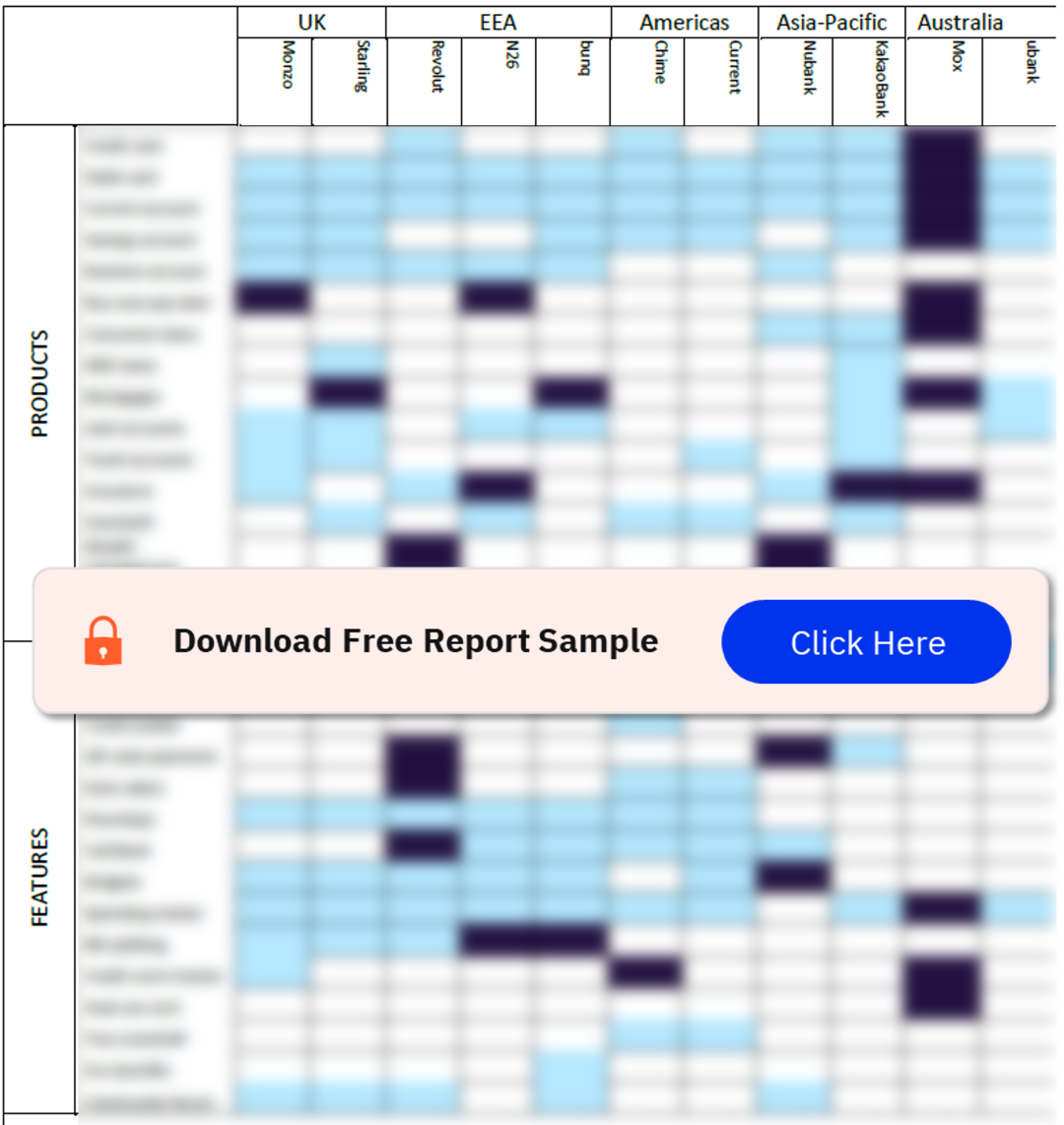
Products and Features Offered by Digital Banks Covered in this Report
Buy the Report for More Insights on Digital Banking Trend, Download A Free Sample
Alongside this, an analysis of the regional contexts these banks operate in is also included, with a time series of consumer attitudes towards digital banking provided for each region covered. The report is split into five separate sections to cover the UK, the EEA, the Americas, Asia-Pacific, and Australia separately.
| Key Regions | · The UK
· The EEA · The Americas · Asia-Pacific · Australia |
| Key Competitors | · Monzo
· Starling Bank · Revolut · N26 · Mox |
| Enquire & Decide | Discover the perfect solution for your business needs. Enquire now and let us help you make an informed decision before making a purchase. |
Digital Banking Critical Success Factors
- Many neobanks across the world have experienced rapid growth. On the other hand, banks that have followed a payment-based approach have struggled to balance monetization and customer acquisition.
- Many of the interchange fee- or subscription-based banks in this report have garnered a large user base. The prime example of this is the difference between Monzo and Starling in the UK. Despite having half the number of customers, Starling has twice the deposit holdings and has attained profitability (whereas Monzo has not).
- The banks that have had the most success have not necessarily been the banks with the largest portfolio of products. They have instead been the banks that have tailored their product offering and monetization strategy to market-specific pain points that need addressing.
Buy the Full Report for More Critical Success Factors Insights on Digital Banking, Download A Free Report
Digital Banking – Key Competitors
The key competitors in digital banking are Monzo, Starling Bank, Revolut, N26, bunq, Chime, Current, Nubank, KakaoBank, Mox, ubank, and others.
Monzo: Monzo has taken several decisions that have helped in the massive upscaling of the company’s marketing. In addition, Monzo has massively ratcheted up its lending. On top of this, instead of letting its deposits sit idle as it had done previously, Monzo has massively increased its investments in treasury assets. Monzo’s subscription model has also witnessed popularity in recent years.
Starling Bank: In July 2022, Starling Bank announced its first full year of profitability. This is a major milestone not just for the company but for neobanks more generally. The success of Starling is evidence that there exists a path to profitability for neobanks. Integral to understanding what this path looks like is understanding Starling’s commitment to a balance sheet approach to digital banking. Furthermore, Starling can and does proudly boast about the consistent level of support it receives from customers. Starling has won best current account at the British Banking Awards for five years in a row. The company’s popularity with customers is not without justification.
Revolut: Revolut is also notable for putting a far greater emphasis on wealth management than other neobanks. Cryptocurrencies have increasingly become the focal point of this strategy, with Revolut now offering the ability to trade over 40 cryptocurrencies. The company has even gone as far as to establish a “learn to earn” program whereby users can educate themselves on cryptocurrencies and earn up to GBP10 ($12.10) in DOT cryptocurrency tokens.
Buy the Full Report For more Competitor Insights on Digital Banking, Download A Sample Report
Key Highlights
- Digital challengers are increasingly providing loans and becoming less reliant on transaction fees. Starling Bank in the UK and bunq in the Netherlands are two examples of digital challengers that have introduced loan products over the past two years.
- In doing so, they have joined other banks such as KakaoBank in South Korea and ubank in Australia in adopting a more traditional balance sheet approach based on net interest income.
- Whereas a balance sheet approach is associated with profitability, a strategy based on aggressive customer acquisition is not. The two banks that have managed to generate profit – Starling Bank and KakaoBank – have largely managed to do so because of their lending activities.
- Other actors that have expanded aggressively in terms of market share (such as Revolut) are still struggling to make a profit.
Reasons to buy
- Gain insight into the strategies, product bundles, and messaging digital banks are trying in each market, with their associated strengths and weaknesses.
- Learn about threats to incumbents and newer digital challengers, as well as potential opportunities for acquisitions and partnerships.
- Understand the relative viability of different digital banking models across different contexts.
- Gain an awareness of the general trends affecting the digital banking space.
- Compare the performance and strategic direction of your firm against competitors.
Key Stakeholders
Table of Contents
Tables
List of Tables
Table 1: Products and features offered by the digital banks covered in this report
Graphs
List of Figures
Figure 1: UK consumers have an increasingly positive attitude towards digital banking but still seek banks that have branches and an established reputation
Figure 2: European consumers’ positive attitudes towards digital banks are becoming more pronounced over time, but so too is their preference for traditional non-digital services
Figure 3: bunq’s tiered account offering
Figure 4: Much like Europeans, consumers in the Americas have an increasingly favorable opinion of digital-only banking but their preference for traditional banking is growing increasingly pronounced
Figure 5: Consumers in Asia increasingly want a bank with an established reputation
Figure 6: KakaoBank’s product suite
Figure 7: Australian consumers have a strong preference for banks with an established reputation