
Product Insights
Digital Transformation in Banking – Thematic Research
Every sector is going digital. Due to the pandemic, consumer behavior began to outpace the channel capabilities of slow-moving incumbent banks, reinvigorating providers around digital transformation imperatives. However, there are clear tensions between tactical time-to-market priorities and the longer-term tech changes required to emancipate providers from legacy.
Institutions that focus on knowing their customer – not just from a regulatory perspective, but in terms of financial impact, behaviors, and prospects – will be best placed to succeed under conditions of expedited change. This will require the operational agility to recalibrate customer personas, risk models, and channel propositions.
The digital transformation in banking sector research report will help you to understand key technology, macroeconomic and political, and regulatory trends characterizing digital transformation efforts at incumbent banks.
Digital transformation in Banking: Key Trends
The key trends that are associated with the digital transformation theme can be classified into three categories: technology trends, macroeconomic & political trends, and regulatory trends.
- Technology trends – Some of the key technology trends impacting the digital transformation theme include a renewed focus on core system modernization to improve agility and time to market, a zero-scratch redesign of core decision-making processes to realize breakthrough cost reduction, and others.
- Macroeconomic & political trends – The key macroeconomic & political trends that will shape the digital transformation theme are heightened political and economic support for digital transformation, and declining private investment for new entrants creating a buyer’s market.
- Regulatory trends – Some of the key regulatory trends impacting the digital transformation theme include Tensions between the need for regulations to move more slowly and more quickly, Increased regulatory risk around expedited digitization, and others.
Digital transformation in Banking – Industry Analysis
In 2017, online was significantly more popular for a greater range of tasks than mobile is in 2020. Meanwhile, telephone banking, once a forgotten channel amid digitization, has made gains as branch usage has reduced. The preference for telephone banking has notably increased for more complex queries such as making a complaint or querying transactions, but it has risen for all other tasks too.
The digital transformation in the banking industry analysis also covers:
- Mergers and acquisitions
- Timeline
Digital transformation in Banking - Value Chain Analysis
GlobalData’s digital transformation value chain consists of core banking/legacy systems (transaction processing), digital banking platforms (front-end channels), API management/strategy (middleware), money management/data infrastructure, and niche fintech partners.
Middleware: APIs have become the great enablers of digital transformation. Rather than optimize business structures, processes, and technologies for anyone’s one-to-one partnership, public APIs enable banks to optimize for all possible partnerships. This brings economies of scale and scope to partnering.
Niche fintech partners: Partnerships have been critical to expanding access to new products and processes at pace. In a COVID context, one recent example is Tully, providing a free-to-consumer digital outsourcing service that registers consumer applications, validates eligibility for payment relief, and shares that information with relevant partners in the network.
Leading Global Banks Associated with the Digital transformation Theme
Some of the leading retail banks associated with the digital transformation theme are DBS, BBVA, and JPMorgan Chase.
Leading Credit Unions/Building Societies Associated with the Digital transformation Theme
Some of the leading credit unions/building societies making their mark within the digital transformation theme are USAA and Navy Federal.
Banking Sector Scorecard
At GlobalData, we use a scorecard approach to predict tomorrow’s leading companies within each sector. Our sector scorecards have three screens: a thematic screen, a valuation screen, and a risk screen. The banking sector scorecard has two screens:
- The thematic screen tells us who are the overall leaders in the 10 themes that matter most, based on our thematic engine.
- The valuation screen ranks our universe of companies within a sector based on selected valuation metrics.
Banking Sector Scorecard – Thematic Screen
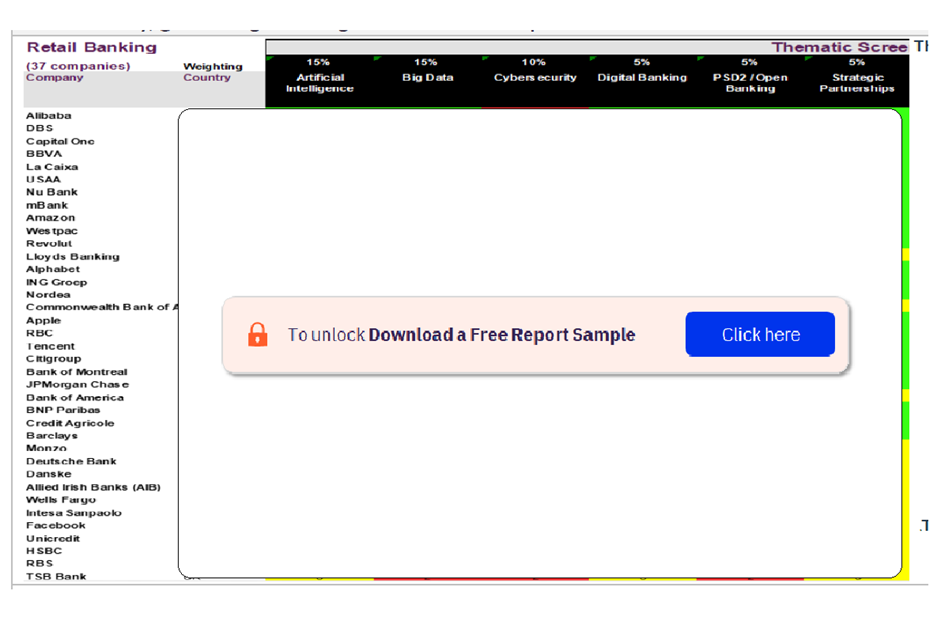
To know more about the sector scorecards, download a free report sample
Digital transformation in Banking Market Overview
| Report Pages | 42 |
| Regions Covered | Global |
| Key Trends | Technology Trends, Macroeconomic & Political Trends, and Regulatory Trends |
| Value Chains | Core Banking/Legacy Systems (Transaction Processing), Digital Banking Platforms (Front-End Channels), API Management/Strategy (Middleware), Money Management/Data Infrastructure, and Niche Fintech Partners |
| Key Global Banks | DBS, BBVA, and JPMorgan Chase |
| Key Credit Unions/Building Societies | USAA and Navy Federal |
Scope
- Banks’ channel migration efforts have not met expectations. Many commentators expected mobile to quickly displace all other channels, with attendant risks that consumer behavior could outpace banks’ channel capabilities. But this situation has not transpired.
- Banks that view digital transformation as building new capabilities – around cloud, API, big data, etc. – tend to score better in terms of customer satisfaction, cost reduction, and operational agility than those that have merely digitized existing analog processes.
- Leading institutions have prioritized core decision-making processes. Credit-related activities typically cut across front-office, risk management, and back-office procedures; integrating these actions into one straight-through process offers the biggest efficiency gains.
Reasons to buy
- Understand key technology, macroeconomic and political, and regulatory trends characterizing digital transformation efforts at incumbent banks.
- Access the latest consumer survey data on evolving channel behaviors, provider preferences, and product holdings.
- Identify leading digital transformation efforts based on cost/income and customer satisfaction metrics.
- Access firm-level/case study insight on successful digital transformation efforts by incumbents.
Key Stakeholders
Table of Contents
Discover More with a Free Sample
FAQs
-
Some of the key technology trends impacting the digital transformation theme include a renewed focus on core system modernization to improve agility and time to market, Zero-scratch redesign of core decision-making processes to realize breakthrough cost reduction, and others.
-
The key macroeconomic & political trends that will shape the digital transformation theme are heightened political and economic support for digital transformation, and declining private investment for new entrants creating a buyer’s market.
-
Some of the key regulatory trends impacting the digital transformation theme include Tensions between the need for regulations to move more slowly and more quickly, Increased regulatory risk around expedited digitization, and others.
-
GlobalData’s digital transformation value chain consists of core banking/legacy systems (transaction processing), digital banking platforms (front-end channels), API management/strategy (middleware), money management/data infrastructure, and niche fintech partners.
-
Some of the leading banks associated with the digital transformation theme are DBS, BBVA, and JPMorgan Chase.
-
Some of the leading credit unions/building societies making their mark within the digital transformation theme are USAA and Navy Federal.
What our clients have to say

Business Intelligence & Marketing Manager, SAL Heavy Lift
“The GlobalData platform is our go-to tool for intelligence services. GlobalData provides an easy way to access comprehensive intelligence data around multiple sectors, which essentially makes it a one-for-all intelligence platform, for tendering and approaching customers.
GlobalData is very customer orientated, with a high degree of personalised services, which benefits everyday use. The highly detailed project intelligence and forecast reports can be utilised across multiple departments and workflow scopes, from operational to strategic level, and often support strategic decisions. GlobalData Analytics and visualisation solutions has contributed positively when preparing management presentations and strategic papers.”

Market Analyst & Management, Liebherr-Werk
“COVID-19 has caused significant interference to our business and the COVID-19 intelligence from GlobalData has helped us reach better decisions around strategy. These two highlights have helped enormously to understand the projections into the future concerning our business units, we also utilise the project database to source new projects for Liebherr-Werk to use as an additional source to pitch for new business.”

Head of Key Accounts, Saab AB
Your daily news has saved me a lot of time and keeps me up-to-date with what is happening in the market, I like that you almost always have a link to the source origin. We also use your market data in our Strategic Business Process to support our business decisions. By having everything in one place on the Intelligence Center it has saved me a lot of time versus looking on different sources, the alert function also helps with this.

Marketing Intelligence Manager, Portugal Foods
Having used several other market research companies, I find that GlobalData manages to provide that ‘difficult-to-get’ market data that others can’t, as well as very diverse and complete consumer surveys.

Head of Customer Insight and Research, Standard Chartered
Our experience with GlobalData has been very good, from the platform itself to the people. I find that the analysts and the account team have a high level of customer focus and responsiveness and therefore I can always rely on. The platform is more holistic than other providers. It is convenient and almost like a one stop shop. The pricing suite is highly competitive and value for our organisation.
I like reports that inform new segments such as the analysis on generation Z, millennials, the impact of COVID 19 to our banking customers and their new channel habits. Secondly the specialist insight on affluent sector significantly increases our understanding about this group of customers. The combination of those give us depth and breadth of the evolving market.
I’m in the business of answering and helping people make decisions so with the intelligence center I can do that, effectively and efficiently. I can share quickly key insights that answer and satisfy our country stakeholders by giving them many quality studies and primary research about competitive landscape beyond the outlook of our bank. It helps me be seen as an advisory partner and that makes a big difference. A big benefit of our subscription is that no one holds the whole data and because it allows so many people, so many different parts of our organisation have access, it enables all teams to have the same level of knowledge and decision support.

Head of Consumer Sensory Insights, Givaudan
“I know that I can always rely on Globaldata’s work when I’m searching for the right consumer and market insights. I use Globaldata insights to understand the changing market & consumer landscape and help create better taste & wellbeing solutions for our customers in food, beverage and healthcare industries.
Globaldata has the right data and the reports are of very high quality compared to your competitors. Globaldata not only has overall market sizes & consumer insights on food & beverages but also provides insights at the ingredient & flavour level. That is key for B2B companies like Givaudan. This way we understand our customers’ business and also gain insight to our unique industry”

Senior Account Manager, TSYS
GlobalData provides a great range of information and reports on various sectors that is highly relevant, timely, easy to access and utilise. The reports and data dashboards help engagement with clients; they provide valuable industry and market insights that can enrich client conversations and can help in the shaping of value propositions. Moreover, using GlobalData products has helped increase my knowledge of the finance sector, the players within it, and the general threats and opportunities.
I find the consumer surveys that are carried out to be extremely beneficial and not something I have seen anywhere else. They provided an insightful view of why and which consumers take (or don’t) particular financial products. This can help shape conversations with clients to ensure they make the right strategic decisions for their business.
One of the challenges I have found is that data in the payments space is often piecemeal. With GD all of the data I need is in one place, but it also comes with additional market reports that provide useful extra context and information. Having the ability to set-up alerts on relevant movements in the industry, be it competitors or customers, and have them emailed directly to me, ensures I get early sight of industry activity and don’t have to search for news.

