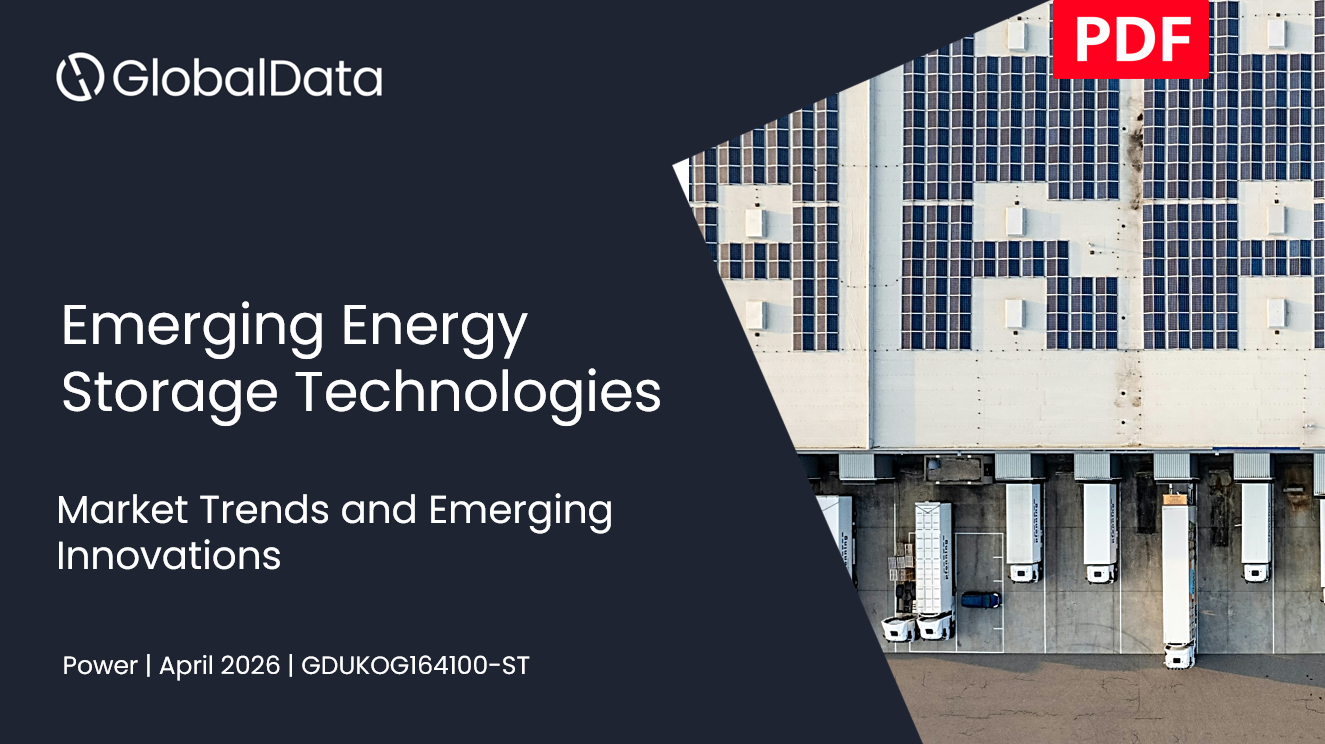
Emerging Energy Storage Technologies: Market Trends and Emerging Innovations
Powered by 
All the vital news, analysis, and commentary curated by our industry experts.

Explore global energy storage technologies trends, battery energy storage systems (BESS), long-duration storage, renewable integration, and regional capacity outlooks through 2035. Gain insight into global storage project pipelines, grid modernization, and emerging storage technologies with GlobalData analysis.Explore global energy storage technologies trends, battery energy storage systems (BESS), long-duration storage, renewable integration, and regional capacity outlooks through 2035. Gain insight into global storage project pipelines, grid modernization, and emerging storage technologies with GlobalData analysis.
Understand the Future of Global Energy Storage Technologies
Global power systems are entering a major transformation phase as electricity demand growth accelerates alongside rapid renewable energy deployment. Electrification across transport and industry is increasing pressure on power grids. In addition, expanding AI infrastructure and hyperscale data centers are emerging as major contributors to long-term electricity demand.
Data center power demand alone is expected to reach almost 1,500TWh by 2030. At the same time, renewables are projected to overtake thermal generation by 2034, accelerating the importance of energy storage technologies in maintaining grid stability and balancing intermittent renewable generation.
This report provides detailed analysis of global energy storage trends, capacity outlooks, regional deployment patterns, battery energy storage systems (BESS), and emerging long-duration storage technologies shaping the future of the global power sector.
Built on GlobalData’s proprietary energy industry intelligence, the report helps you evaluate storage project pipelines, technology innovation, regional growth opportunities, and market challenges influencing the energy transition.
Report Value Proposition – Why This Report Matters for You
As renewable penetration increases and global power demand continues to rise, energy storage is becoming a critical infrastructure component across modern electricity systems.
This report may help you:
- Understand the global outlook for energy storage deployment through 2035
- Identify growth opportunities across battery, electromechanical, electrochemical, and thermal storage technologies
- Assess how renewable energy expansion is influencing storage project activity
- Benchmark regional storage deployment trends and policy momentum
- Evaluate technology innovation beyond lithium-ion batteries
- Monitor the role of energy storage in supporting grid resilience and renewable integration
Moreover, the report combines market outlooks, technology analysis, and regional intelligence to support strategic planning, investment evaluation, and infrastructure development decisions.
Key Insights in the Global Energy Storage Market
- Global energy storage project capacity is expected to reach approximately ~1,683GW by 2030
- Battery energy storage systems (BESS) are projected to account for ~77% of total global energy storage capacity by 2030
- Asia-Pacific is expected to account for ~62% of global storage capacity by the end of the decade
- Global power demand is projected to grow at a CAGR of ~4% between 2025 and 2035
- Data center power demand is expected to approach almost 1,500TWh by 2030
- Solar PV and onshore wind are expected to account for 20% and 15% of total power generation by 2035
- Developers are increasingly exploring long-duration storage technologies to improve grid resilience and renewable integration
- Innovation is expanding across electromechanical, electrochemical, and thermal energy storage pathways
Scope
What You Will Learn
This report provides insight into:
- The evolving global power generation mix
- Energy storage capacity outlooks by region and technology
- Regional concentration of energy storage deployment
- Battery energy storage systems (BESS) market trends
- Emerging long-duration energy storage technologies
- Challenges linked to lithium-ion storage systems
- Grid balancing and renewable integration trends
- Project pipeline growth and execution risks
- Case studies of innovative storage technologies
In addition, the report examines how energy storage is becoming an increasingly important part of grid modernization and power system reliability strategies worldwide.
Target Buyers for This Report
This report may be valuable for:
- Utility companies
- Renewable energy developers
- Energy storage technology providers
- Grid infrastructure operators
- Power generation companies
- Battery manufacturers
- Investment and private equity firms
- Energy transition strategists
- Government and policy stakeholders
- Infrastructure consultants
How Companies Use This Report
Companies may use this report to evaluate storage technology opportunities, benchmark regional market activity, and assess infrastructure investment priorities.
For example:
- Renewable energy developers may use the report to evaluate storage technologies supporting solar and wind integration
- Grid operators may assess regional storage deployment trends to support grid balancing strategies
- Battery storage companies may benchmark BESS adoption and market growth opportunities
- Infrastructure investors may analyze storage project pipelines and regional capacity expansion trends
- Technology developers may evaluate opportunities in long-duration storage and alternative storage pathways
- Energy companies may use the report to assess how storage technologies support decarbonization and electrification goals
Key Highlights
Between 2025 and 2035, global power demand is projected to grow at a CAGR of ~4%, with data centers emerging as an increasingly significant source of additional demand.
A rapid pace of renewable installations continues to bolster the contribution of renewables to the overall power mix. Solar PV and onshore wind continue to represent the key drivers of this growth, with the two technologies accounting for 20% and 15%, respectively, of total power generation by 2035.
However, despite the increasingly global uptake of renewables, energy storage capacity remains regionally uneven, with Asia-Pacific dominating the market, and set to account for ~62% of global storage capacity by the end of the decade.
According to current project announcements, global energy storage capacity could reach approximately ~1,683GW by 2030, exceeding the IEA’s 1,500GW target by over 180GW. Although currently on track, this projection assumes a high level of project execution and therefore leaves limited room for project delays or cancellations.
Reasons to Buy
Benchmark Against Global Energy Storage Leaders
The report helps organizations benchmark storage deployment trends, regional capacity growth, and emerging technologies shaping the global market.
In addition, it provides visibility into the growing role of Asia-Pacific in storage expansion, while highlighting innovation trends across established and emerging storage solutions.
Built on Trusted GlobalData Energy Intelligence
Built on GlobalData’s proprietary energy sector database and market intelligence capabilities, this report combines technology analysis, capacity forecasts, and regional project tracking into a comprehensive strategic resource.
Trusted by Fortune 500 companies, utilities, infrastructure investors, and government stakeholders, GlobalData’s research is backed by analysts with deep expertise in energy transition technologies and global power markets.
Act Now to Navigate the Rapidly Expanding Energy Storage Market
As renewable deployment accelerates and electricity demand continues to rise, energy storage technologies are becoming increasingly important to grid stability, energy security, and infrastructure planning.
Whether you are evaluating storage technologies, identifying regional opportunities, tracking project pipelines, or benchmarking market developments, this report provides insights that can help support informed strategic decision-making in the evolving global energy landscape.
Beacon Power
Hydrostor
HiNa Battery Technology
Inlyte Energy
Meine Electric
GKN Hydrogen
H2MOF
Kraftblock
MGA Therm
Exowatt
Table of Contents
Table
Figures
Get in touch to find out about multi-purchase discounts
reportstore@globaldata.com
Tel +44 20 7947 2745
Sample Report
Emerging Energy Storage Technologies: Market Trends and Emerging Innovations was curated by the best experts in the industry and we are confident about its unique quality. However, we want you to make the most beneficial decision for your business, so we offer free sample pages to help you:
- Assess the relevance of the report
- Evaluate the quality of the report
- Justify the cost
Download your copy of the sample report and make an informed decision about whether the full report will provide you with the insights and information you need.


