
The Gastric and Gastroesophageal Junction Adenocarcinoma (G/GEJAC) market size across the 8MM was valued at $1.12 billion in 2019 and is forecast to grow at a CAGR of more than 15% during 2019-2029. Growth of the market will be driven by the recent expansions of Opdivo and Keytruda into the first-line metastatic setting, further expansions for multiple agents across the 8MM, and the launches of nine pipeline agents.
G/GEJAC Market Outlook, 2019 ( $ Billion)

To gain more information on the G/GEJAC market forecast, download a free report sample
G/GEJAC Market Drivers
The major drivers of growth in the G/GEJAC market across the 8MM over the forecast period include multiple label expansions for Bristol Myers Squibb’s (BMS’) Opdivo (nivolumab), increased adoption of expensive immunotherapies in the first-line and adjuvant settings, the approval and launch of premium-priced therapeutics in the 8MM, and the label expansions for Merck & Co.’s Keytruda (pembrolizumab) and AstraZeneca/Daiichi Sankyo’s Enhertu (trastuzumab deruxtecan) that will result in greater adoption of more expensive combinatorial regimens.
G/GEJAC Market Segmentation by Class
The key classes in the G/GEJAC market are Generic Chemotherapies, Branded Chemotherapies, Targeted Therapies, and Immunotherapies. In 2021, Targeted Therapies were the leading class.
G/GEJAC Market Analysis, by Class, 2021 (%)
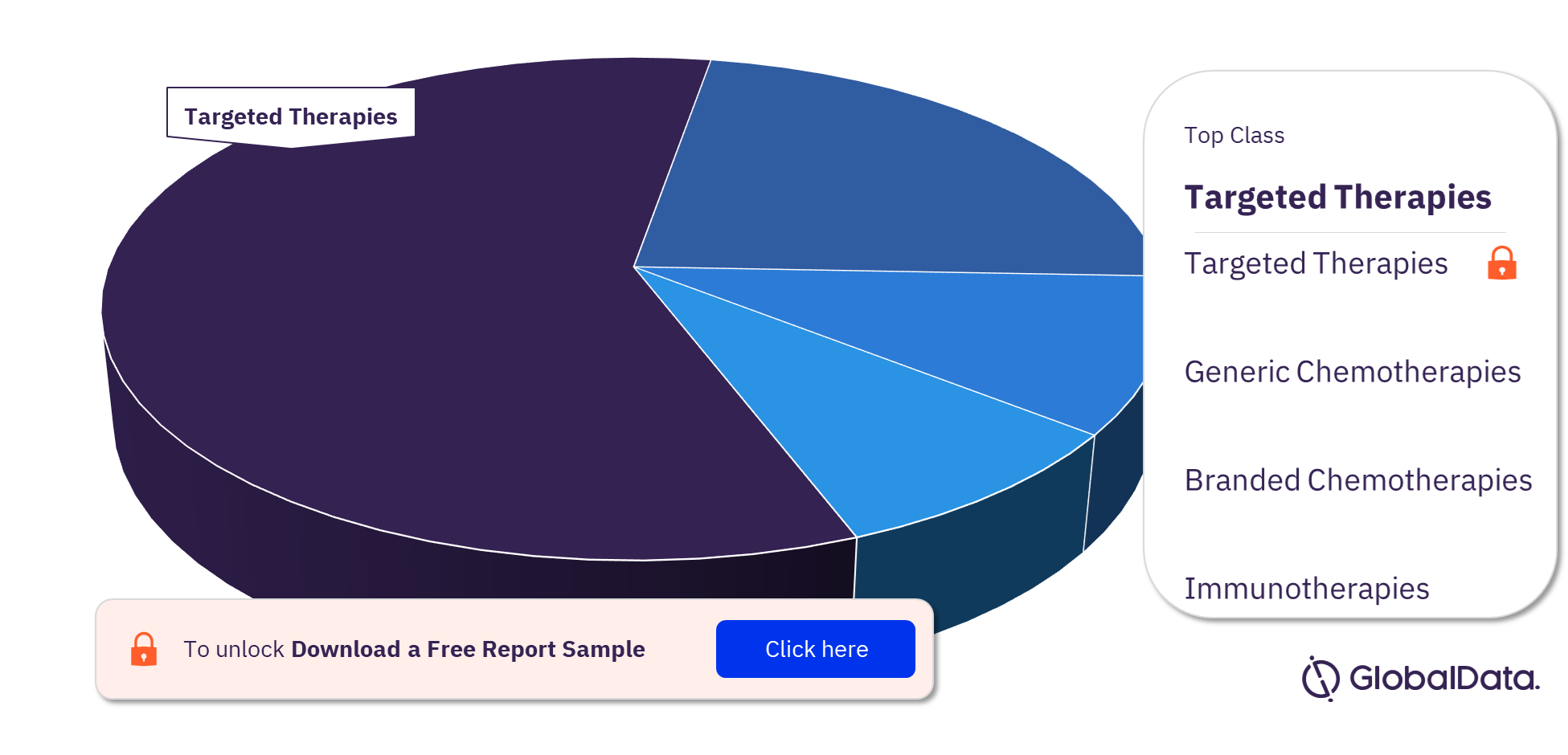
For more G/GEJAC class insights, download a free report sample
G/GEJAC Market - Competitive Landscape
Some of the leading players in the G/GEJAC market are Bristol Myers Squibb, Merck & Co, AstraZeneca, Daiichi Sankyo, F. Hoffmann-La Roche, Eli Lilly, BeiGene, Astellas, Zymeworks, and Seagen.
G/GEJAC Market Report Overview
| Market Size (2019) | $1.12 billion |
| CAGR (2019 – 2029) | >15% |
| Forecast period | 2020-2029 |
| Key Classes | Generic Chemotherapies, Branded Chemotherapies, Targeted Therapies, and Immunotherapies |
| Leading Players | Bristol Myers Squibb, Merck & Co, AstraZeneca, Daiichi Sankyo, F. Hoffmann-La Roche, Eli Lilly, BeiGene, Astellas, Zymeworks, and Seagen |
G/GEJAC Market Classes Outlook (Value, $ Billion, 2019-2029)
- Generic Chemotherapies
- Branded Chemotherapies
- Targeted Therapies
- Immunotherapies
Scope of Report
This report provides
- Overview of G/GEJAC including epidemiology, pathophysiology, symptoms, diagnosis, and treatment guidelines.
- Topline G/GEJAC market revenue, annual cost of therapy, and major pipeline product sales in the forecast period.
- Key topics including current treatment and pipeline therapies, unmet needs and opportunities, and the drivers and barriers affecting G/GEJAC therapeutics sales in the 8MM.
- Comprehensive data split across different phases, emerging novel trends under development, and detailed analysis of late-stage pipeline drugs (Phase II-III).
- Analysis of the current and future market competition in the global G/GEJAC therapeutics market. Insightful review of the key industry drivers and challenges. Each trend is independently researched to provide a qualitative analysis of its implications.
Reasons to buy
The report will enable you to:
- Develop and design your in-licensing and out-licensing strategies through a review of pipeline products and technologies, and by identifying the companies with the most robust pipeline.
- Develop business strategies by understanding the trends shaping and driving the global G/GEJAC therapeutics market.
- Drive revenues by understanding the key trends, innovative products and technologies, market segments, and companies likely to impact the global G/GEJAC market in the future.
- Formulate effective sales and marketing strategies by understanding the competitive landscape and by analyzing the performance of various competitors.
- Identify emerging players with potentially strong product portfolios and create effective counterstrategies to gain a competitive advantage.
- Organize your sales and marketing efforts by identifying the market categories and segments that present maximum opportunities for consolidations, investments, and strategic partnerships.
Key Stakeholders
Table of Contents
Tables
Table 1: G/GEJAC: Key Metrics in the 8MM
Table 2: Stage Definitions for Gastric Cancer
Table 3: Risk Factors for Gastric Cancer
Table 4: Treatment Guidelines for G/GEJAC
Table 5: Generic Chemotherapy Regimens Indicated for Gastric Cancer
Table 6: Top 10 Deals by Value, 2018–21
Table 7: G/GEJAC Market – Global Drivers and Barriers, 2019–29
Table 8: Key Events Impacting Sales for G/GEJAC in the US, 2019–29
Table 9: G/GEJAC Market – Drivers and Barriers in the US, 2019–29
Table 10: Key Events Impacting Sales for G/GEJAC in the 5EU, 2019–29
Table 11: G/GEJAC Market – Drivers and Barriers in the 5EU, 2019–29
Table 12: Key Events Impacting Sales for G/GEJAC in Japan, 2019–29
Table 13: G/GEJAC Market – Drivers and Barriers in Japan, 2019–29
Table 14: Key Events Impacting Sales for G/GEJAC in South Korea, 2019–29
Table 15: G/GEJAC Market – Drivers and Barriers in South Korea, 2019–2029
Table 16: High-Prescribing Physicians (non-KOLs) Surveyed, By Country
Graphs
Figure 1: Global Sales Forecast by Country for G/GEJAC in 2019 and 2029
Figure 2: Analysis of the Company Portfolio Gap in G/GEJAC During the Forecast Period
Figure 3: Competitive Assessment of the Late-Stage Pipeline Agents that GlobalData Expects to be Licensed for the Treatment of G/GEJAC in the Adjuvant/Neoadjuvant Setting During the Forecast Period
Figure 4: Competitive Assessment of the Late-Stage Pipeline Agents that GlobalData Expects to be Licensed for the Treatment of G/GEJAC in the HER2-Positive Setting During the Forecast Period
Figure 5: Competitive Assessment of the Late-Stage Pipeline Agents that GlobalData Expects to be Licensed for the Treatment of G/GEJAC in the HER2-Negative Setting During the Forecast Period
Figure 6: 8MM, Diagnosed Incidence of Gastric Cancer, Men, Ages ≥20 Years, 2009–2029, Cases Per 100,000 Population
Figure 7: 8MM, Diagnosed Incidence of Gastric Cancer, Women, Ages ≥20 Years, 2009–2029, Cases Per 100,000 Population
Figure 8: Sources Used and Not Used for Diagnosed Incident Cases of Gastric Cancer
Figure 9: Sources Used for Diagnosed Incident Cases of Gastric Cancer by Stage at Diagnosis
Figure 10: Sources Used for Five-Year Diagnosed Prevalent Cases of Gastric Cancer
Figure 11: Sources Used for Diagnosed Incident Cases of Gastric Cancer with HER2 Overexpression
Figure 12: Sources Used for Diagnosed Incident Cases of Gastric Cancer with PD-L1 Expression
Figure 13: Sources Used for Diagnosed Incident Cases of Gastric Cancer with MSI
Figure 14: Sources Used for Diagnosed Incident Cases of Gastric Cancer with NTRK Gene Fusions
Figure 15: Sources Used for Diagnosed Incident Cases of GEJ Cancer
Figure 16: Sources Used for Diagnosed Incident Cases of Gastric Cancer, excluding GEJ Cancer
Figure 17: Sources Used for Diagnosed Incident Cases of Gastric Adenocarcinoma
Figure 18: 8MM, Diagnosed Incident Cases of Gastric Cancer, Men and Women, Ages ≥20 Years, 2019
Figure 19: 8MM, Age-Specific Diagnosed Incident Cases of Gastric Cancer, Men and Women, Ages ≥20 Years, 2019
Figure 20: 8MM, Sex-Specific Diagnosed Incident Cases of Gastric Cancer, Men and Women, Ages ≥20 Years, 2019, N
Figure 21: 8MM, Five-Year Diagnosed Prevalent Cases of Gastric Cancer, Men and Women, Ages ≥20 Years, 2019
Figure 22: 8MM, Diagnosed Incident Cases of Gastric Cancer by Stage at Diagnosis, Men and Women, Ages ≥20 Years, 2019
Figure 23: 8MM, Diagnosed Incident Cases of Gastric Cancer with HER2 Overexpression, Men and Women, Ages ≥20 Years, 2019
Figure 24: 8MM, Diagnosed Incident Cases of Gastric Cancer with PD-L1 Expression, Men and Women, Ages ≥20 Years, 2019
Figure 25: 8MM, Diagnosed Incident Cases of Gastric Cancer with MSI, Men and Women, Ages ≥20 Years, 2019
Figure 26: 8MM, Diagnosed Incident Cases of Gastric Cancer with NTRK Gene Fusions, Men and Women, Ages ≥20 Years, 2019
Figure 27: 8MM, Diagnosed Incident Cases of GEJ Cancer, Men and Women, Ages ≥20 Years, 2019
Figure 28: 8MM, Diagnosed Incident Cases of Gastric Cancer, Excluding GEJ Cancer, Men and Women, Ages ≥20 Years, 2019
Figure 29: 8MM, Diagnosed Incident Cases of Gastric Adenocarcinoma, Men and Women, Ages ≥20 Years, 2019
Figure 30: Treatment for G/GEJAC Patients Based on HER2 Status
Figure 31: Unmet Needs and Opportunities in G/GEJAC
Figure 32: Overview of the Development Pipeline in G/GEJAC
Figure 33: Key Late-Stage Trials for the Promising Pipeline Agents that GlobalData Expects to Be Licensed for G/GEJAC in the 8MM During the Forecast Period
Figure 34: Competitive Assessment of the Marketed and Pipeline Drugs Benchmarked Against the SOC, Chemotherapy/Chemoradiation, in the Neoadjuvant/Adjuvant Setting
Figure 35: Competitive Assessment of the Marketed and Pipeline Drugs Benchmarked Against the SOC, Herceptin, in the HER2-Positive Metastatic Setting
Figure 36: Competitive Assessment of the Marketed and Pipeline Drugs Benchmarked Against the SOC, Chemotherapy, in the HER2-Negative Metastatic Setting
Figure 37: Analysis of the Company Portfolio Gap in G/GEJAC During the Forecast Period
Figure 38: Global (8MM) Sales Forecast by Country for G/GEJAC in 20191 and 2029
Figure 39: Sales Forecast by Class for G/GEJAC in the US in 2019 and 2029
Figure 40: Sales Forecast by Class for G/GEJAC in the 5EU in 2019 and 2021
Figure 41: Sales Forecast by Class for G/GEJAC in Japan in 2019 and 2029
Figure 42: Sales Forecast by Class for G/GEJAC in South Korea in 2019 and 2029







