
Gig Economy in Insurance Market Overview
The gig economy has been a key trend across a range of industries in recent years, but it has been significantly boosted by two recent events: COVID-19 and now the cost-of-living crisis. Economic difficulties in 2022 saw an upsurge in people taking up extra hours in the gig economy to top up income and help pay for rising monthly bills.
The gig economy in insurance report helps to identify leaders in insurance provider for the gig economy. The report will also assist to understand how competitors are looking to break into the market and identify opportunities in a growing market where insurance provision can be made simpler for the customer.
Gig economy in Insurance Trends
The main trends shaping the gig economy in insurance theme over the next 12 to 24 months are technology trends, macroeconomic trends, and regulatory trends.
Technology Trends: The key technology trends shaping the gig economy in insurance are the increasing use of AI, cybersecurity, and big data among others.
Macroeconomic Trends: The key macroeconomic trends shaping the gig economy in insurance are rising inflation and the cost-of-living crisis, the impact of COVID-19, ESG factors, and rapid urbanization among others.
Regulatory Trends: The key regulatory trends shaping the gig economy in insurance are concerns regarding carbon emissions, labor rights, and data privacy.
For more insights on the trends shaping the gig economy in insurance, download a free report sample
Gig Economy in Insurance Industry Analysis
The gig economy is an incredibly difficult market to size due to the varied nature of skills and jobs within the trend. Mastercard data suggests the gig economy was worth $204 billion in 2018. It found that transport-based services (such as ride-sharing) made up 58% of this value. Since Mastercard’s study, the COVID-19 pandemic and cost-of-living crises have significantly changed the landscape.
The impact of the gig economy on insurance was not immediately obvious, and as a result, many leading insurers were slow to act. The sharp rise in the number of people working freelance and completing short-term jobs did create a large insurance gap. However, startups such as Zego and Dinghy emerging in the space by offering cheap, digital, and flexible individual commercial packages that can be switched off and on. This essentially sparked the rise of the gig economy as a key insurance theme as the industry woke up to the potential size of the growing market. The gig economy in the insurance industry analysis also covers:
- Market size and growth forecasts
- Use cases
- M&A
- Company filings trends
- Patent trends
- Social media trends
- Timeline
For more insights on the analysis of gig economy in insurance, download a free report sample
Gig Economy in Insurance Industry Value Chain
GlobalData splits the insurance value chain across these main areas within the insurance process: product development, marketing and distribution, underwriting and risk profiling, claims management, and customer service.
Customer service: Customer service remains an integral part of the insurance value chain. Companies are increasingly focusing on eliminating customer pain points throughout the user experience. In this respect, embedding insurance in the platforms gig economy workers use – for example, Deliveroo’s and Uber’s list of approved insurers – makes setting up the necessary insurance as easy as possible.
Gig Economy in Insurance Industry Value Chain

For more insights on the value chain of gig economy in insurance, download a free report sample
Gig economy in Insurance – Competitive landscape
The key public players in the gig economy in insurance are Allianz, Allstate, Aon, and AXA among others.
The key private players in the gig economy in insurance are Alan, Cover Genius, and Coverhero among others.
For more insights on key players in the gig economy in insurance, download a free report sample
Gig Economy in Insurance Sector Scorecard
At GlobalData, we use a scorecard approach to predict tomorrow’s leading companies within each sector. Our gig economy sector scorecard has three screens: a thematic screen, a valuation screen, and a risk screen.
- The thematic screen ranks companies based on overall leadership in the 10 themes that matter most to their industry, generating a leading indicator of future performance.
- The valuation screen ranks our universe of companies within a sector based on selected valuation metrics.
- The risk screen ranks companies within a particular sector based on overall investment risk.
Gig Economy Sector Scorecard – Thematic Screen
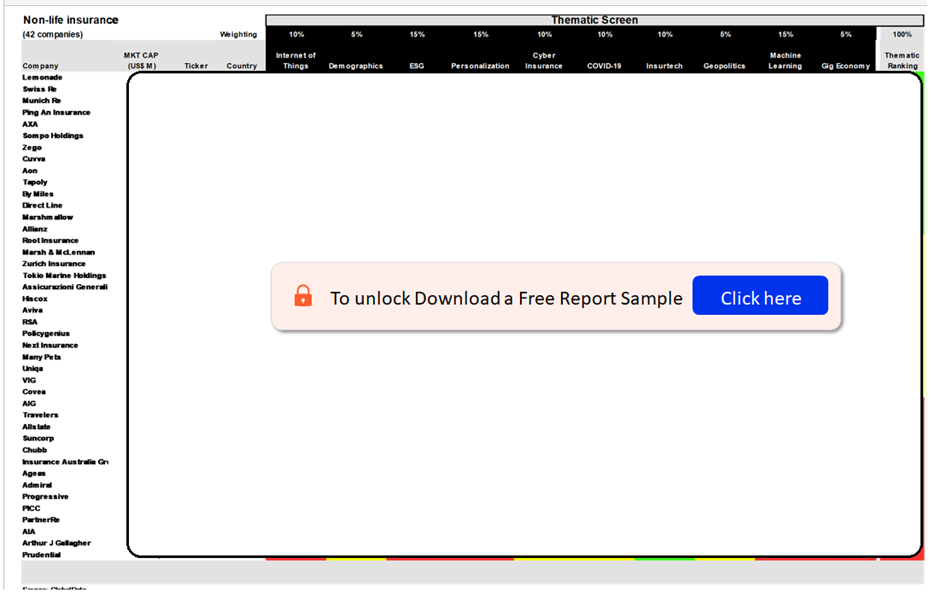
To know more about the gig economy sector scorecards, download a free report sample
Gig Economy in Insurance Consumer Trends Report Overview
| Report Pages | 57 |
| Key Trend | Technology Trends, Macroeconomic Trends, and Regulatory Trends |
| Key Value Chain Components | Product Development, Marketing and Distribution, Underwriting and Risk Profiling, Claims Management, and Customer Service |
| Key Public Players | Allianz, Allstate, Aon, and AXA |
| Key Private Players | Alan, Cover Genius, and Coverhero |
Key Highlights
- GlobalData’s 2022 Financial Services Consumer Survey found that among the 40 geographies covered, an average of around 10% of consumers are part-time workers.
- More than 14% of UK adults intended to take up a second job in the gig economy in the immediate future according to GlobalData’s 2022 UK Insurance Consumer Survey
- Allianz, Zurich, and AXA are gig economy leaders among the traditional players, while Zego is the standout among startups.
Reasons to buy
- Benchmark yourself against the rest of the market.
- Ensure you remain competitive as new innovations and insurance models begin to enter the market.
- Be prepared for how regulation will impact the gig economy in insurance theme over the next few years.








