
Empower your strategies with our Likelihood of Approval and Phase Transition Success Rate Model – Iodine I 131 Apamistamab in Multiple Myeloma (Kahler Disease) report and make more profitable business decisions.
This report provides you with the data that allows you to track and predict the specific likelihood of approval (LOA) and phase transition success rate (PTSR) of a drug using GlobalData’s proprietary machine learning algorithms developed using over 10 years of historical data.
Iodine I 131 Apamistamab in Multiple Myeloma (Kahler Disease) Drug Details:
Iomab-B, a radioimmunoconjugate (BC8-I-131 construct) is under development for the treatment of relapsed and refractory follicular lymphoma, chronic lymphocytic leukemia, high-grade B-cell lymphoma, diffuse large B-cell lymphoma, relapsed and refractory B-cell acute lymphoblastic leukemia and chronic myeloid leukemia (CML), acute myelocytic leukemia (AML), acute lymphoblastic leukemia, relapsed and/or refractory elderly acute myeloid leukemia, chronic myelomonocytic leukemia, sickle cell disease, multiple myeloma and refractory anemia with ringed sideroblasts and for prevention of lymphodepletion during CAR-T therapy. It is administered parenterally through intravenous route. The drug is a radionuclide drug conjugate (RDC) which consists of monoclonal antibody apamistamab and the beta emitting radioisotope I131 (I-131). It acts by targeting CD45 and is developed by using Alpha Particle Immunotherapy, Antibody Warhead Enabling (AWE) Technology platform. It was also under development for Hodgkin lymphoma, relapsed/refractory B-non-Hodgkin lymphoma (B-NHL), T-non-Hodgkin lymphoma(T-NHL) and mantle cell lymphoma.It was also under development for Myelodysplastic Syndrome, Refractory Anemia With Excess Blasts, Refractory Anemia With Ringed Sideroblasts, Leukemia, Myeloproliferative Disorders and cytopenia.
Report Coverage
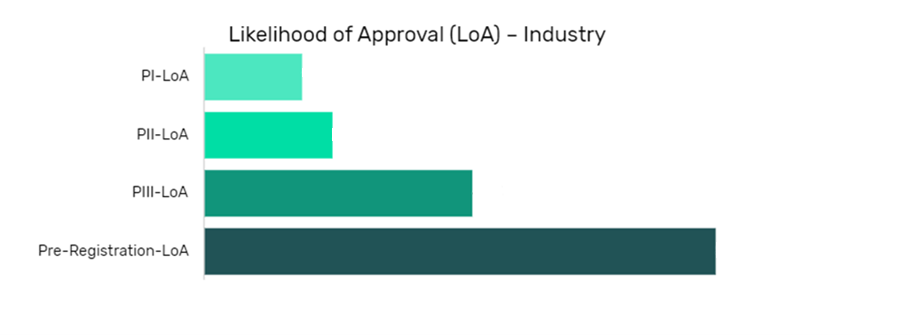
The data is segmented by drug name per indication and shows the current likelihood of approval for the drug compared to the indication benchmark and the industry benchmark.
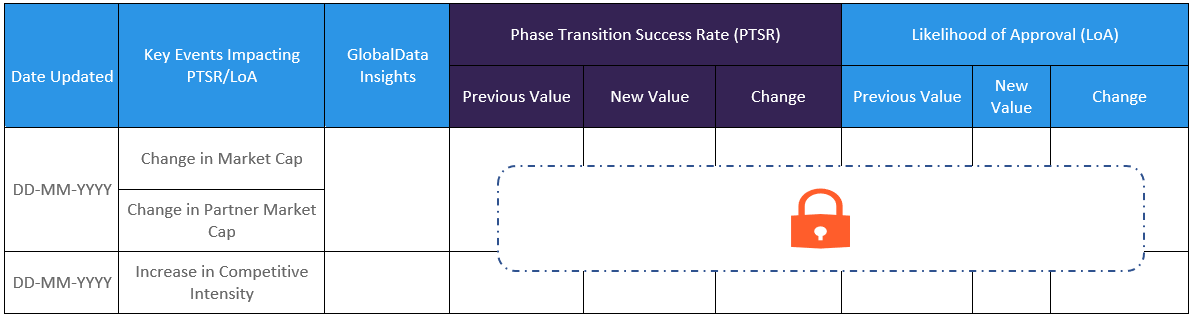
The Likelihood of Approval data is updated regularly based on events that take place which impact the clinical development process and regulatory considerations. GlobalData’s proprietary machine learning models consider these events in real time, to produce quantitative changes to the LOA and PTSR along with qualitative reasoning why the likelihood of approval has changed.
Scope of Report
- Drug Details: Drug name, Drug type, Intervention type
- Administration Pathway
- Therapeutic Areas
- Key Manufacturers
- Drug Development Status
Reasons to buy
- Precise Likelihood of Approval and Phase Transition Success Rates: Our machine learning and proprietary models provide accurate predictions, helping you gauge the potential success of a drug in the regulatory process.
- Competitive Strategy Planning: Access information on LOA and PTSR for competitors’ drugs, allowing you to plan your clinical development, commercialisation and marketing strategies
- Event-driven Updates: Track event-driven changes in LOA and PTSR benchmarked against indication LOA/PTSR. Get the latest insights to adapt your strategies promptly!
- Well-informed Investment Decisions: This data helps you navigate the dynamic landscape of drug development and regulatory considerations.







