
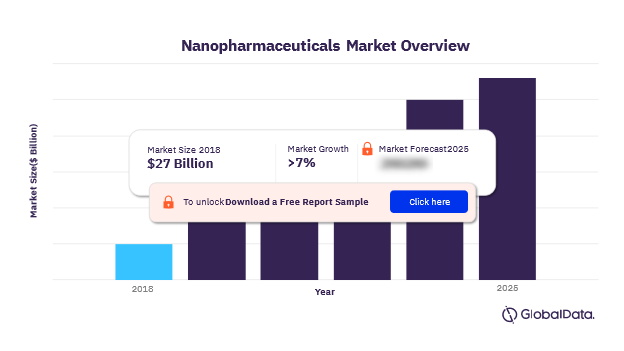
The global nanopharmaceuticals market size was US$27 billion in 2018 and is expected to grow at CAGR of more than 7% between 2018 and 2025. Nanomedicine is the application of nanotechnology for the diagnosis, prevention, and treatment of disease. It encompasses different applications including drug delivery systems, therapeutic use, imaging, diagnostics, biomaterials, and active implants.
The nanopharmaceuticals market research report will assist in developing business strategies by understanding how nanotechnology is being used in healthcare today and how this technology is expected to affect the healthcare sector in the future. The report will also help in identifying emerging industry trends to gain a competitive advantage.
For more insights on the nanopharmaceuticals market forecast, download a free report sample
Nanopharmaceuticals Market - Key Trends
The key trends that are impacting the nanopharmaceuticals market can be classified into three categories: technology trends, macroeconomic trends, and regulatory trends.
- Technology Trends – The key technology trends impacting the nanopharmaceuticals market are the use of nanomaterials in personalized/ precision medicine, and as carriers for RNAi-based therapies, development of smart nanocarriers, and nano-radio enhancers. It also includes the increasing use of immunoconjugates in nanomedicine, use of theranostic nanoparticles in cancer, and new routes of administration among others.
- Macroeconomic Trends – The key macroeconomic trends that will shape the nanopharmaceuticals market are the aging population and rise of chronic diseases, antibiotic resistance, reimbursement and cost-benefit considerations, government investment in nanomedicine and increasing M&A activities among others.
- Regulatory Trends – The key regulatory trends impacting the nanopharmaceuticals market include the lack of specific regulatory guidelines for nanomedicines, and regulation of follow-on nano-pharmaceuticals.
Nanopharmaceuticals - Industry Analysis
The global nanopharmaceuticals market size was US$27 billion in 2018 and is expected to grow at a CAGR of more than 7% between 2018 and 2025. The polymer- and nanocrystal-based nanopharmaceuticals held the largest revenue share in 2018.
The analysis of the nanopharmaceuticals industry also covers:
- Marketed nanopharmaceuticals
- Pipeline nanopharmaceuticals
- Mergers, acquisitions, and strategic alliances
- Timeline
- Case studies
Nanopharmaceuticals Market - Value Chain Analysis
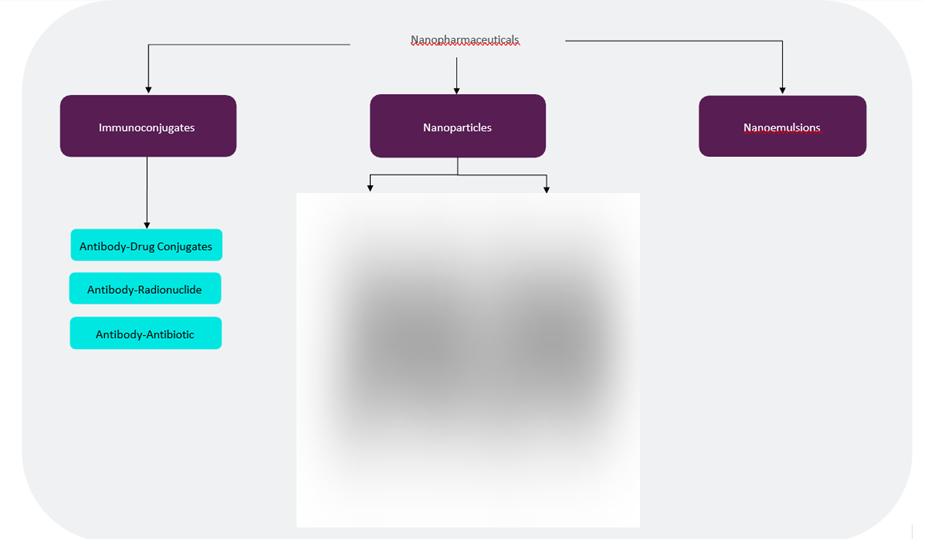
The Nanopharmaceuticals industry value chain can be split into immunoconjugates, nanoparticles, and nanoemulsions.
Immunoconjugates: Immunoconjugates are targeted medicines that deliver a toxic payload to tumor cells via a linker attached to a mAb that binds to a specific target antigen expressed on cancer cells. The key layers under Immunoconjugates are Antibody-Drug Conjugates, Antibody-Radionuclide, and Antibody-Antibiotic.
Nanopharmaceuticals Market Value Chain Analysis
To know more about the nanopharmaceuticals market value chain, download a free report sample
Leading Public Companies in the Nanopharmaceuticals Market
The leading public companies in the nanopharmaceuticals market are Actinium Pharmaceuticals Inc, Alnylam Pharmaceuticals Inc., Amgen Inc, Aurinia Pharmaceuticals Inc, AstraZeneca, Bausch Health Companies Inc, Biogen, Ipsen SA, Merck & Co Inc, Pfizer Inc, and Sanofi among others.
The leading private companies in the nanopharmaceuticals market are Horizon Pharmaceuticals Inc, Janssen Pharmaceuticals Inc, Nanospectra Biosciences Inc, Ocugen Inc, Pharmacosmos AS, and Rakuten Medical Inc among others.
Nanopharmaceuticals Market Overview
| Report Pages | 96 |
| Regions Covered | Global |
| Market Size (2018) | $27 billion |
| CAGR (2018-2025) | >7% |
| Key Trends | Technology Trends, Macroeconomic Trends, and Regulatory Trends |
| Value Chains | Immunoconjugates, Nanoparticles, and Nanoemulsions |
| Leading Public Companies | Actinium Pharmaceuticals Inc, Alnylam Pharmaceuticals Inc., Amgen Inc, Aurinia Pharmaceuticals Inc, AstraZeneca, Bausch Health Companies Inc, Biogen, Ipsen SA, Merck & Co Inc, Pfizer Inc, and Sanofi |
| Leading Private Companies | Horizon Pharmaceuticals Inc, Janssen Pharmaceuticals Inc, Nanospectra Biosciences Inc, Ocugen Inc, Pharmacosmos AS, and Rakuten Medical Inc |
Key Highlights
The Nanopharmaceuticals report provides an assessment of the key industry trends impacting how nanopharmaceuticals are being used in healthcare today, including technological, regulatory, and macroeconomic themes.
Components of the report include:
- Key Industry Players – the big players in the nanopharmaceuticals industry and where they sit in the value chain.
- Trends in the nanopharmaceuticals space – key trends impacting the use of nanopharmaceuticals classified into technology, macroeconomic, and regulatory themes.
- Industry Analysis – the market value of marketed and pipeline nanopharmaceuticals to 2025, as well as a breakdown of nanopharmaceuticals by branded or generic product, phase of development, type of company, and route of administration. Key M&A and licensing agreements in the nanopharmaceuticals space are also included, as well as case studies showing examples of the different types of nanopharmaceuticals and their application.
- Value Chain – Leaders and challengers by nanopharmaceuticals type
Reasons to buy
The report will help you to:
- Develop business strategies by understanding how nanotechnology is being used in healthcare today and how this technology is expected to affect the healthcare sector in the future.
- Stay up to date on the industry’s big players in nanopharmaceuticals and where they sit in the value chain.
- Identify emerging industry trends to gain a competitive advantage.
- Identify pipeline targets for M&A and licensing opportunities.
Table of Contents
Tables
Table 1: Technology/Scientific Trends
Table 2: Macroeconomic Trends
Table 3: Regulatory Trends
Table 4: M&As in the Nanopharmaceutical Industry
Table 5: Strategic Alliances in the Nanopharmaceutical Industry
Table 6: Approved Liposomal Nanopharmaceuticals in the US and Europe
Table 7: Polymeric Nanopharmaceuticals in Development
Table 8: Approved Nanocrystal Nanopharmaceuticals in the US and Europe
Table 9: Nanocrystal Nanopharmaceuticals in Development
Table 10: Approved Protein-based Nanopharmaceuticals in the US and Europe
Table 11: Lipid Nanopharmaceuticals Approved in the US and Europe
Table 12: Lipid Nanopharmaceuticals in Development
Table 13: Micelle-Based Nanopharmaceuticals Approved in the US and Europe
Table 14: Micelle-Based Nanopharmaceuticals in Development
Table 15: Dendrimer-Based Nanopharmaceuticals Approved in the US and Europe
Table 16: Dendrimer-Based Nanopharmaceuticals in Development
Table 17: Inorganic Nanopharmaceuticals in Development
Table 18: Approved Immunoconjugates in the US and Europe
Table 19: Immunoconjugates in Development
Table 20: Nanoemulsions Approved in the US and Europe
Table 21: Nanoemulsions in Development
Table 22: Public Companies
Table 23: Private Companies
Graphs
Figure 1: The Leaders and Challengers in the Nanopharmaceutical Value Chain
Figure 2: Pharma Executives Do Not Expect Nanomedicine to Have a High Impact on the Industry in 2020
Figure 3: Market Forecast by Nanopharmaceutical Type, 2018–2025
Figure 4: 2025 Market Value by Nanopharmaceutical Type
Figure 5: 2025 Market Value by Branded or Generic/Biosimilar Nanopharmaceuticals
Figure 6: Approved Nanopharmaceuticals in the US and Europe by Type and Therapy Area
Figure 7: Route of Administration of Marketed Nanopharmaceuticals
Figure 8: Nanopharmaceuticals in Development by Type, Therapy Area, and Route of Administration
Figure 9: Nanopharmaceuticals by Current Development Stage, and Estimated 2025 Market Revenue by Current Development Stage
Figure 10: Nanopharmaceuticals in Development by Company Type and Molecule Type
Figure 11: Timeline
Figure 12: Diasome’s Nanoscale, Frisbee-shaped HDV Carrier
Figure 13: PharmaCyte’s Cell-in-a-Box Technology
Figure 14: Traditional Suspension of Eye Drops Versus Kala Pharmaceuticals’ MPP Technology
Figure 15: Oasmia Pharmaceuticals’ XR17 Micellar Technology Platform
Figure 16: Arbutus Biopharma’s LNP Technology, Which Was Used to Develop Alnylam’s Onpattro
Figure 17: Structure of DEP Docetaxel (left), and Pharmacokinetics of DEP Docetaxel Versus Conventional Docetaxel (right)
Figure 18: Nanobiotix’s Hensify Technology
Figure 19: Daiichi Sankyo’s Enhertu Is an ADC Delivering Cytotoxic Drug to Target Cancer Cells
Figure 20: The Nanopharmaceutical Value Chain
Figure 21: The Liposomal Nanopharmaceutical Value Chain
Figure 22: The Polymeric Nanopharmaceutical Value Chain
Figure 23: The Nanocrystal Nanopharmaceutical Value Chain
Figure 24: The Protein-Based Nanopharmaceutical Value Chain
Figure 25: The Lipid Nanopharmaceutical Value Chain
Figure 26: The Micelle Nanopharmaceutical Value Chain
Figure 27: The Dendrimer Nanopharmaceutical Value Chain
Figure 28: The Inorganic Nanopharmaceutical Value Chain
Figure 29: The Immunoconjugate Value Chain
Figure 30: The Nanoemulsion Value Chain
Figure 31: Five-Step Approach for Generating a Sector Scorecard







