Neuroendocrine Tumors – Epidemiology Forecast to 2030
Powered by 
All the vital news, analysis, and commentary curated by our industry experts.

The burden of diagnosed neuroendocrine tumors (NETs) is expected to increase at an annual growth rate (AGR) of 2.37% from an estimated 108,000 cases in 2020 to 133,000 in 2030 in the eight major markets (8MM*). This report reveals that the increase is attributed to the underlying demographic changes in the respective markets, and improvement in imaging tools used in diagnosis.
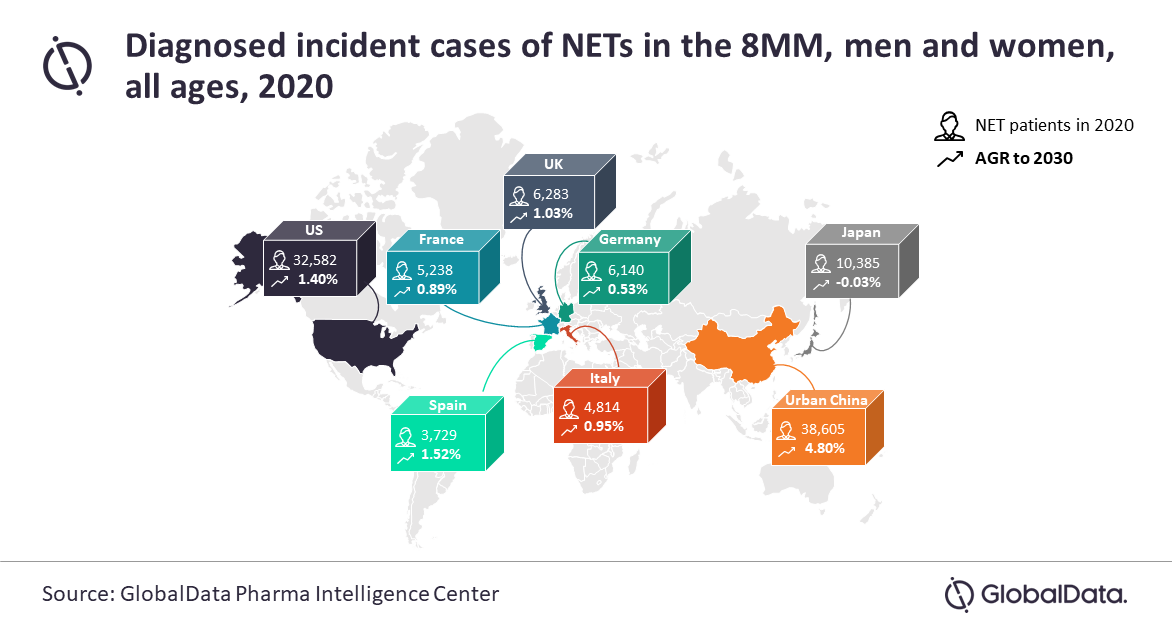
In the 8MM, China accounts for approximately 36% of all diagnosed incident cases due to its large population. In the five European markets (5EU), the UK accounts for the highest number of diagnosed incident cases of NETs with approximately 6,200 cases and 24% of all 5EU diagnosed incident cases of NETs.
Ana Fernandez Menjivar, MSc DLSHTM, Senior Epidemiologist at GlobalData, comments: “An increase in the diagnosed incidence of NETs has been reported worldwide. The reason for this rise is not completely understood, but is most likely due to increased physician awareness, improvements in diagnostic imaging tests used and increased use of these tools. Incidental diagnosis is also a factor as NETs may be diagnosed during routine screenings for an unrelated caused such a colonoscopy, MRI or endoscopy.
“An increase in incidental diagnosis could lead to more NET cases being diagnosed at earlier stages and identification of less aggressive indolent tumors that may not have been diagnosed otherwise.”
*8MM: The US, 5EU (France, Germany, Italy, Spain, the UK), Japan, and urban China.
Scope
NETs are cancers that begin in the cells that release hormones into the bloodstream. NETs can occur anywhere in the body. Most develop slowly and may not cause symptoms in the early stages. The symptoms associated with NETs vary depending on where in the body they originate. Gastrointestinal (GI) NETs may cause diarrhea, constipation, or stomach pains, and lung NETs may cause wheezing or a persistent cough. Other symptoms include flushing, cramps, low blood sugar, or heart problems. The exact cause of NETs is not known, but they develop when neuroendocrine cells develop mutations in the DNA.
To forecast the diagnosed incident cases of NETs, and five-year diagnosed prevalent cases of NETs in the 8MM, GlobalData epidemiologists conducted a thorough literature review to find country-specific sources that provided data for the above-mentioned segmentations of the general population in the 8MM. In order to improve the accuracy of the forecast GlobalData epidemiologists used studies that provided data based on uniform diagnostic codes and disease definition for these parameters across the 8MM.
In the 8MM, GlobalData epidemiologists forecast that the diagnosed incident cases of NETs will increase from 107,776 cases in 2020 to 133,312 cases in 2030, at an Annual Growth Rate (AGR) of 2.37%. Urban China will have the highest number of NET cases among the 8MM throughout the forecast period, while Spain will have the lowest. In the 8MM, GlobalData epidemiologists forecast that the five-year diagnosed prevalent cases of NETs will increase from 372,035 cases in 2020 to 465,410 cases in 2030, at an AGR of 2.51%.
- The Neuroendocrine Tumors (NET) Epidemiology Report and Epidemiology Model provide an overview of the risk factors and global trends of NETs in the 8MM (US, France, Germany, Italy, Spain, UK, Japan, and urban China). It includes a 10-year epidemiological forecast for the diagnosed incident cases of NETs, based on country-specific studies published in peer-reviewed journals. The diagnosed incident cases of NETs are further segmented by sex, age, type, stage at diagnosis, grade and differentiation. GlobalData epidemiologists also provide diagnosed incident cases of paraganglioma and pheochromocytoma. The forecast also includes five-year diagnosed prevalent cases of NETs in the 8MM for the forecast period.
- The neuroendocrine tumors epidemiology report and model were written and developed by Masters- and PhD-level epidemiologists.
- The Epidemiology Report is in-depth, high quality, transparent and market-driven, providing expert analysis of disease trends in the 8MM.
- The Epidemiology Model is easy to navigate, interactive with dashboards, and epidemiology-based with transparent and consistent methodologies. Moreover, the model supports data presented in the report and showcases disease trends over a 10-year forecast period using reputable sources.
Reasons to Buy
The Neuroendocrine Tumors Epidemiology Report and Model will allow you to:
Develop business strategies by understanding the trends shaping and driving the global hyperparathyroidism market.
Quantify patient populations in the global neuroendocrine tumors market to improve product design, pricing, and launch plans.
Organize sales and marketing efforts by identifying the age groups, sex and type of NET that present the best opportunities for therapeutics in each of the markets covered.
Understand the population of paraganglioma and pheochromocytoma cases.
Table of Contents
Table
Figures
Frequently asked questions
Get in touch to find out about multi-purchase discounts
reportstore@globaldata.com
Tel +44 20 7947 2745
Sample Report
Neuroendocrine Tumors – Epidemiology Forecast to 2030 was curated by the best experts in the industry and we are confident about its unique quality. However, we want you to make the most beneficial decision for your business, so we offer free sample pages to help you:
- Assess the relevance of the report
- Evaluate the quality of the report
- Justify the cost
Download your copy of the sample report and make an informed decision about whether the full report will provide you with the insights and information you need.


Related reports
View more Oncology reports