Likelihood of Approval and Phase Transition Success Rate Model – Niraparib in Uterine Cancer
Powered by 
Unlock hidden opportunities in the LoA industry

Empower your strategies with our Likelihood of Approval and Phase Transition Success Rate Model – Niraparib in Uterine Cancer report and make more profitable business decisions.
This report provides you with the data that allows you to track and predict the specific likelihood of approval (LOA) and phase transition success rate (PTSR) of a drug using GlobalData’s proprietary machine learning algorithms developed using over 10 years of historical data.
Niraparib in Uterine Cancer Drug Details:
Niraparib (MK-4827, Zejula) is an anti-neoplastic agent. It is formulated as hard gelatin capsules, tablets and film coated tablets for oral route of administration. Zejula is indicated for the treatment of adult patients with recurrent epithelial ovarian, fallopian tube, and primary peritoneal cancer who are in complete or partial response to platinum-based chemotherapy and also indicated for the treatment of adult patients with advanced ovarian, fallopian tube, or primary peritoneal cancer who have been treated with three or more prior chemotherapy regimens and whose cancer is associated with homologous-recombination deficient (HRD) positive status defined by either a deleterious or suspected deleterious BRCA mutation, genomic instability and who have progressed more than six months after response to the last platinum-based chemotherapy.It is under development for the treatment of advanced rectal cancer, recurrent glioblastoma, high-grade neuroendocrine carcinoma, advanced non-small cell lung cancer, recurrent and metastatic nasopharyngeal carcinoma, metastatic castration-sensitive prostate cancer (mCSPC), recurrent and metastatic head and neck squamous cell carcinoma, oral cavity cancer, oropharyngeal cancer, laryngeal cancer, hypopharyngeal cancer, recurrent glioblastoma, solid tumor, ovarian cancer, fallopian tube cancer, prostate cancer, pancreatic cancer, peritoneal cancer, recurrent glioma, metastatic colorectal cancer, melanoma, advanced or metastatic solid tumors, metastatic invasive carcinoma of the cervix, gastroesophageal Junction and proximal gastric adenocarcinoma, uterine serous carcinoma, metastatic pancreatic cancer, recurrent epithelial ovarian, fallopian tube, metastatic pancreatic ductal adenocarcinoma, primary peritoneal cancer, solid tumors, small cell lung cancer, metastatic castration-resistant prostate cancer (CRPC), squamous non-small cell lung cancer, endometrial cancers, soft tissue sarcoma with at least one line of prior chemotherapy, refractory osteosarcoma, neuroblastoma, adrenocortical carcinoma, Ewing’s sarcoma rhabdomyosarcoma, mesothelioma, renal cell carcinoma, cholangiocarcinoma, pancreatic cancer and HER2+ breast cancer. It is a new molecular entity (NME).It was under development for the treatment of mantle cell lymphoma, breast cancer, astrocytoma, adenocarcinoma of the gastroesophageal junction, gastric adenocarcinoma, oligodendroglioma, metastatic urothelial cancer, esophageal cancer, recurrent glioblastoma, uveal melanoma, HR positive and HER2 negative recurrent gBRCA positive breast cancer, metastatic triple negative breast cancer, and metastatic biliary tract cancer.
Report Coverage
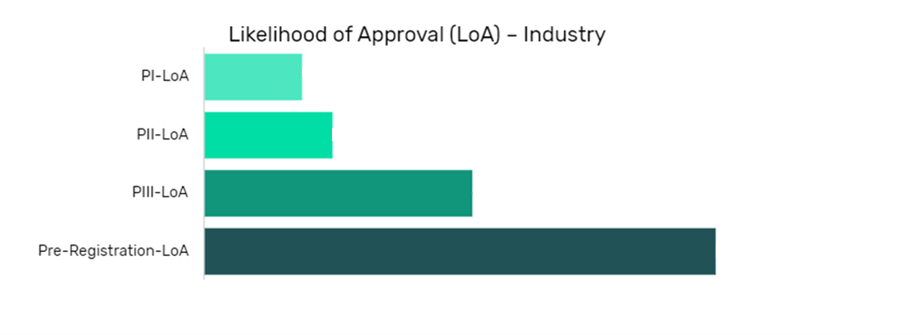
The data is segmented by drug name per indication and shows the current likelihood of approval for the drug compared to the indication benchmark and the industry benchmark.
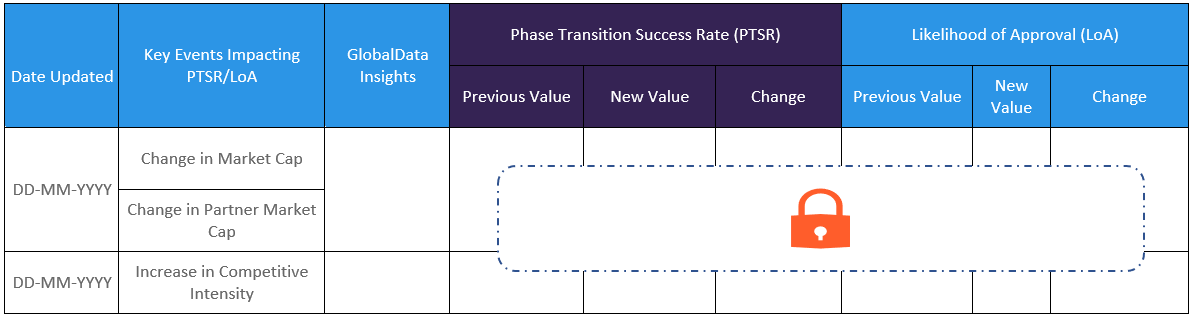
The Likelihood of Approval data is updated regularly based on events that take place which impact the clinical development process and regulatory considerations. GlobalData’s proprietary machine learning models consider these events in real time, to produce quantitative changes to the LOA and PTSR along with qualitative reasoning why the likelihood of approval has changed.
| Quick View – LOA Data | |||||
| Report Segments |
|
||||
| Drug Name |
|
||||
| Administration Pathway |
|
||||
| Therapeutic Areas | |||||
| Key Manufacturers |
|
||||
| Drug Development Status |
|
||||
Reasons to Buy
- Precise Likelihood of Approval and Phase Transition Success Rates: Our machine learning and proprietary models provide accurate predictions, helping you gauge the potential success of a drug in the regulatory process.
- Competitive Strategy Planning: Access information on LOA and PTSR for competitors’ drugs, allowing you to plan your clinical development, commercialisation and marketing strategies
- Event-driven Updates: Track event-driven changes in LOA and PTSR benchmarked against indication LOA/PTSR. Get the latest insights to adapt your strategies promptly!
- Well-informed Investment Decisions: This data helps you navigate the dynamic landscape of drug development and regulatory considerations.
Scope
- Drug Details: Drug name, Drug type, Intervention type
- Administration Pathway
- Therapeutic Areas
- Key Manufacturers
- Drug Development Status
This is an on-demand report that will be delivered upon request. The report will be delivered within 2 business days of the purchase, excluding weekends and holidays. Certain sections of the report may be removed or altered based on data availability and relevance.
Get in touch to find out about multi-purchase discounts
reportstore@globaldata.com
Tel +44 20 7947 2745
Sample Report
Likelihood of Approval and Phase Transition Success Rate Model – Niraparib in Uterine Cancer was curated by the best experts in the industry and we are confident about its unique quality. However, we want you to make the most beneficial decision for your business, so we offer free sample pages to help you:
- Assess the relevance of the report
- Evaluate the quality of the report
- Justify the cost
Download your copy of the sample report and make an informed decision about whether the full report will provide you with the insights and information you need.


Related reports
View more Pharmaceuticals reports