
Oil and Gas Emissions Reduction Market Report Overview
The oil and gas sector is responsible for about half of all energy-related emissions. The vast majority are from sold products or scope 3 emissions. Among direct, scope 1 and 2 emissions, the largest portion comes from upstream and downstream operations. Emissions can occur at all stages of the O&G value chain.
To address upstream emissions, common strategies include using renewable energy or carbon capture. On the downstream side, low-carbon hydrogen, electrification of heat processes, utilization of waste heat, and utilization of carbon for fuels can be used. Product emissions can be reduced by reducing the production of fossil fuels, producing renewable fuels like low carbon hydrogen or biofuels, carbon offsets, or carbon capture. The nine most active O&G companies in the energy transition have reported reductions in absolute emissions and emissions intensity in recent years. Carbon pricing is an effective emissions reduction measure that has been endorsed by most major O&G companies.
| Emission categories | Direct Emission (Scope 1) and Indirect Emission (Scope 2 and 3) |
| Emission reduction strategies | Upstream, Downstream, and Scope 3/Product Emissions |
| Key countries | The US, the UK, EU, Norway, Saudi Arabia, Canada, and the UAE |
| Leading companies | Equinor, Repsol, Shell, ExxonMobil, TotalEnergies, BP, Chevron, ConocoPhillips, and Eni |
| Enquire & Decide | Discover the perfect solution for your business needs. Enquire now and let us help you make an informed decision before making a purchase. |
Defining Emission Categories
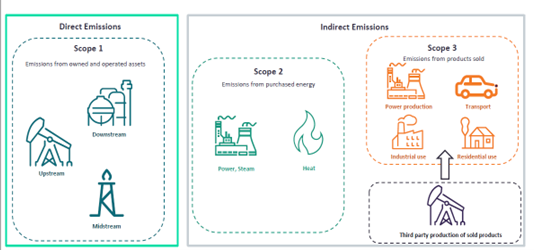
Buy the full report to know more about emission categories, download a free report sample
Common Emission Reduction Strategies
Upstream
Powering offshore platforms using cleaner grid power or on-site renewables, like offshore wind farms.
Downstream
Using blue or green hydrogen in refineries and adopting electrification for some heat processes.
Scope 3/Product Emissions
Decreasing oil and gas sales via divestment of assets or decreasing production.
Buy the full report to know more about common emission reduction strategies, download a free report sample
Emission Reduction Strategies by Country
The US aims to reduce GHG emissions by half by 2030 compared to 2005 levels and reach net zero by 2050. The Biden Administration has implemented a social cost of carbon, but it is currently facing legal challenges in the US court system. The cost is used to guide policy, including oil and gas leases, and federal spending decisions by incorporating the cost of negative externalities associated with carbon emissions. In addition, 11 states use a social cost of carbon to guide similar decisions at the state level.
Aside from the US, the other countries discussed in the report for emission reduction strategies in the oil and gas sector are the UK, EU, Norway, Saudi Arabia, Canada, and the UAE.
Buy the full report to know more about targets and strategies of leading O&G companies, download a free report sample
Leading Companies in Energy Transition
Some of the leading companies in energy transition are Equinor, Repsol, Shell, ExxonMobil, TotalEnergies, BP, Chevron, ConocoPhillips, and Eni.
To know more about targets and strategies of leading O&G companies, download a free report sample
Scope of Report
Global oil and gas sector CO2 emissions in 2019
Future CO2 emissions from global oil and gas remaining lifetime of reserves
Emissions reduction targets and strategies of 9 selected oil and gas majors
Global emissions reduction strategies
Reasons to buy
- Obtain the most up-to-date information on emissions reduction strategies in major oil and gas producing nations and companies.
- Understand the origins of different emissions throughout the oil and gas value chain.
- Assess your competitor’s emissions reduction strategies and develop the most effective plan of action based on the trends in their absolute emissions and emissions intensities.
- Develop an understanding of the global carbon pricing scene.
Key Stakeholders
Table of Contents
Tables
Table 1: Emissions reduction policies by country
Table 2: Emissions targets of 9 selected oil and gas majors
Graphs
Figure 1: Energy-related GHG Emissions(%), 2021 4
Figure 2: US O&G Emissions by Segment(%), 2020 4
Figure 3: Oil and gas value chain 5
Figure 4: Emissions categories 6
Figure 5: Average emissions by scope of 16 top oil and gas companies(%) 7
Figure 6: Targets of top 28 oil and gas companies, 2022 7
Figure 7: Global Oil and Gas Sector CO2 Emissions(Gt CO2), 2019 8
Figure 8: Future CO2 emissions from global O&G remaining lifetime of reserves(Gt CO2) 8
Figure 9: Net Methane Abatement Cost by Technology($/MMBtu) 10
Figure 10: Emission reduction strategies by sector 11
Figure 11: Map of carbon pricing schemes worldwide 13
Figure 12: Internal Carbon Prices Among Oil & Gas Majors($/ton) 14
Figure 13: ExxonMobil’s Absolute Scope 1 Emissions(Mt-CO2e) and Upstream Emission Intensity(t-CO2e/100 tons production), 2016-2020 18
Figure 14: BP’s Absolute Scope 1 Emissions(Mt-CO2e) and Emission Intensity(g-CO2e/MJ), 2017-2021 19
Figure 15: ConocoPhillips’ Absolute Scope 1 Emissions(Mt-CO2e) and Emission Intensity(kg-CO2e/boe), 2016-2020 20
Figure 16: Chevron’s Absolute Scope 1 Emissions(Mt-CO2e) and Upstream Emission Intensity(kg-CO2e/boe), 2017-2021 21
Figure 17: Eni’s Absolute Scope 1 Emissions(Mt-CO2e) and Carbon Intensity(t-CO2e/kboe), 2016-2020 22
Figure 18: Equinor’s Absolute Scope 1 Emissions(Mt-CO2e) and Upstream Carbon Intensity(kg-CO2e/boe), 2016-2021 23
Figure 19: Repsol’s Absolute Scope 1 Emissions(Mt-CO2e) and Upstream Emission Intensity(t-CO2e/kboe), 2016-2021 24
Figure 20: Shell’s Absolute Scope 1 Emissions(Mt-CO2e) and Net Carbon Intensity(g-CO2e/MJ)), 2017-2021 25
Figure 21: TotalEnergies’ Absolute Scope 1 Emissions(Mt-CO2e) and Upstream Emission Intensity(kg-CO2e/boe), 2015-2020 26







