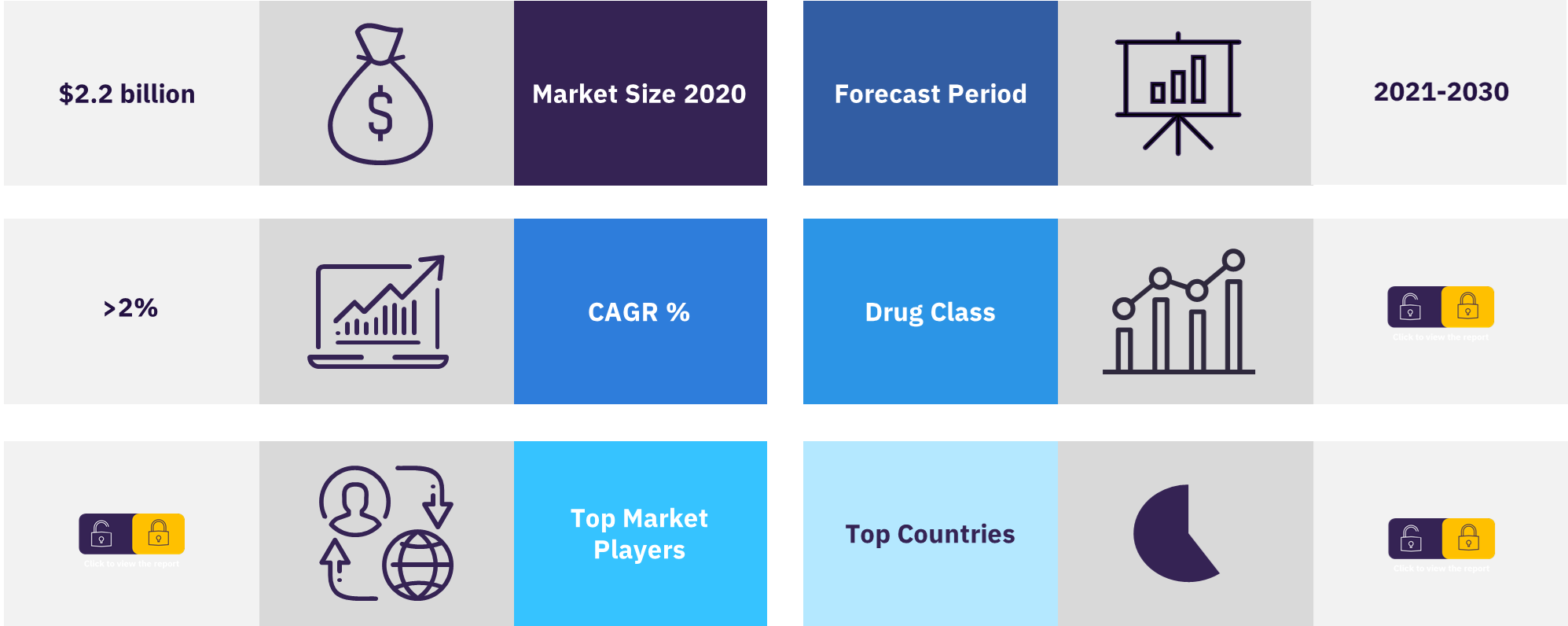
The overactive bladder (OAB) market sales have been valued at $2.2 billion in 2020 across the eight major markets (8MM) covered in this report- the US, 5EU (France, Germany, Italy, Spain, and the UK), Japan and China. The market is projected to grow at a CAGR of more than 2% during the period 2021-2030. The US accounted for the largest market with global sales in 2020, equating to a market share of more than 45%. This largely reflects the large prevalence population in the US and the high cost of drug therapy in this market. Myrbetriq is currently the leading OAB therapy with global sales in 2020, equating to a market share of more than 50%.
The considerable growth expected during the mid-to-late forecast period reflects a continued trend for increased OAB prevalence, as well as the anticipated launch of several pipeline agents. As previously discussed, the late-stage pipeline is scarce with no products in Phase III development or the Pre-registration stage of development although there are a limited number of products in Phase II development.
Overview of the overactive bladder market
For more insights on this report, download a free report sample
What are the market dynamics in the OAB drug market?
The major drivers of market growth over the forecast period are the continued uptake of the beta-3 agonist Gemtesa (marketed as Beova in Japan) in Japan and the US and the potential launch of this product in China, The potential launch of pipeline agents in the mid-to-late forecast period. These include Bayer’s P2X purinoceptor 3 (P2RX3) antagonist Eliapixant in the global market, Urovant Sciences’ gene therapy URO-902 in the US market, and Taiho Pharmaceuticals’ neurite outgrowth enhancer TAC 302 in the Japanese market. All these products employ novel mechanisms of action and are currently in Phase II development and increase in the prevalence of OAB over the forecast period owing to trends such as aging populations and rising obesity, leading to an increase in the population of diagnosed prevalent cases.
Generic sales erosion of VESIcare, Myrbetriq, and Toviaz due to recent and upcoming patent expirations in key markets, including the US. The scarcity of the late-stage pipeline. In particular, the lack of drugs in Phase III development or the pre-registration stages of development will restrict market growth over the early-to-mid forecast period. Moreover, factors that contribute to low rates of diagnosis and treatment are expected to persist over the forecast period. These include stigma and misinformation surrounding OAB, which deters patients from seeking medical help, as well as poor persistence and adherence to drug therapy. The major barriers to market growth over the forecast period are the factors which contribute to low rates of diagnosis and treatment are expected to persist over the forecast period. These include stigma and misinformation surrounding OAB, which deters patients from seeking medical help, as well as poor persistence and adherence to drug therapy.
What are the diagnosed incident cases of OAB in the 8MM?
In 2020, China accounted for more than 60% of the total prevalent cases of OAB in the 8MM, with 222,928,413 cases, while the US accounted for more than 15% of the total prevalent cases of overactive bladder with 68,942,473 cases. There were more than 15% of the total prevalent cases in the 5EU, while Japan had more than 4% of cases. In the 8MM, the total prevalent cases of OAB will grow by more than 10% over the forecast period at an Annual Growth Rate (AGR) of more than 1%, from 363,318,429 cases in 2020. Of the 8MM, China is expected to have the highest AGR of more than 1%. Spain had the lowest number of total prevalent cases of OAB in 2020. Any change in the total prevalent cases of OAB is attributable to changing population demographics in the 8MM.
Diagnosed incident cases of OAB in the 8MM, by country
For more regional insights, download a free report sample
Which are the major players in the OAB drug market?
The major players in the market are Allergan, Astellas, Pfizer, Urovant Sciences, Bayer, Taiho Pharmaceuticals and Kyorin Pharmaceutical.
OAB drug market, by key players
For more insights on key players, download a free report sample
Market report scope
| Market size (Year – 2020) | $2.2 billion |
| Growth rate (CAGR) | >2% |
| Base year | 2020 |
| Forecast Period | 2021-2030 |
| Key Countries | The US, 5EU (France, Germany, Italy, Spain, and the UK) |
| Key Players | Allergan, Astellas, Pfizer, Urovant Sciences, Bayer, Taiho Pharmaceuticals and Kyorin Pharmaceuticals |
Scope
This report provides an in-depth analysis of the following:
- Overview of OAB, including classification, epidemiology, etiology, pathophysiology, diagnosis, and disease management.
- Topline OAB therapeutics market revenue for 2020-2030 (includes the annual cost of therapy and anticipated sales for major late-stage pipeline drugs).
- Key topics covered include current treatment options, clinical trials landscape, unmet needs and opportunities, R&D strategies, drivers and barriers of market growth, current and future players, and market outlook.
- Pipeline analysis: Emerging novel trends under development, and detailed analysis of late-stage pipeline drugs.
- Analysis of the current and future market competition in the global OAB drug market. Insightful review of the key industry drivers, constraints, and challenges. Each trend is independently researched to provide a qualitative analysis of its implications.
Reasons to buy
The report will enable you to:
- Develop and design your in-licensing and out-licensing strategies through a review of pipeline products and technologies, and by identifying the companies with the most promising pipeline assets.
- Develop business strategies by understanding the trends shaping and driving the global OAB drug market.
- Drive revenues by understanding the key trends, innovative products and technologies, market segments, and companies likely to impact the global OAB drug market in the future.
- Formulate effective sales and marketing strategies by understanding the competitive landscape and by analyzing the performance of various competitors.
- Identify emerging players with potentially strong product portfolios and create effective counterstrategies to gain a competitive advantage.
- Organize your sales and marketing efforts by identifying the market categories and segments that present maximum opportunities for consolidations, investments, and strategic partnerships.
Key Stakeholders
Table of Contents
Tables
Table 1: Overactive Bladder: Key Metrics in the 8MM
Table 2: Risk Factors and Comorbidities for Overactive Bladder
Table 3: Total Prevalent Cases of OAB by Comorbidity
Table 4: Diagnosed Prevalent Cases of OAB by Comorbidity
Table 5: Treatment Guidelines for Overactive Bladder
Table 6: Astellas’ Overactive Bladder Portfolio Assessment, 2021
Table 7: Pfizer’s Overactive Bladder Portfolio Assessment, 2021
Table 8: Urovant’s Overactive Bladder Portfolio Assessment, 2021
Table 9: Bayer’s Overactive Bladder Portfolio Assessment, 2021
Table 10: Taiho’s Overactive Bladder Portfolio Assessment, 2021
Table 11: Allergan’s Overactive Bladder Portfolio Assessment, 2021
Table 12: Kyorin Pharmaceutical’s Overactive Bladder Portfolio Assessment, 2021
Table 13: Overactive Bladder Market – Global Drivers and Barriers, 2020–2030
Table 14: Key Events Impacting Sales for OAB in the US, 2020–2030
Table 15: OAB Market – Drivers and Barriers in the US, 2020–2030
Table 16: Key Events Impacting Sales for OAB in the 5EU, 2020–2030
Table 17: OAB Market – Drivers and Barriers in the 5EU, 2020–2030
Table 18: Key Events Impacting Sales for Overactive Bladder in Japan, 2020–2030
Table 19: Overactive Bladder Market – Drivers and Barriers in Japan, 2020–2030
Table 20: Key Events Impacting Sales for OAB in China, 2020–2030
Table 21: Overactive Bladder Market – Drivers and Barriers in China, 2020–2030
Table 22: High-Prescribing Physicians (non-KOLs) Surveyed, By Country
Graphs
Figure 1: Global Sales Forecast by Country for Overactive Bladder in 2020 and 2030
Figure 2: 8MM, Total Prevalence of OAB, Men and Women, %, Ages ≥5 Years, 2020
Figure 3: 8MM, Diagnosed Prevalence of Overactive Bladder, Men and Women, %, Ages ≥5 Years, 2020
Figure 4: 8MM, Sources Used and Not Used to Forecast the Total Prevalent Cases of OAB
Figure 5: 8MM, Sources Used to Forecast the Total Prevalent Cases of OAB by Presentation
Figure 6: 8MM, Sources Used to Forecast the Total Prevalent Cases of OAB by Comorbidity
Figure 7: 8MM, Total Prevalent Cases of Overactive Bladder, N, Both Sexes, Ages ≥5 Years, 2020
Figure 8: 8MM, Total Prevalent Cases of OAB by Age, N, Both Sexes, 2020
Figure 9: 8MM, Total Prevalent Cases of OAB by Sex, N, Ages ≥5 Years, 2020
Figure 10: 8MM, Total Prevalent Cases of OAB by Presentation, N, Both Sexes, Ages ≥5 Years, 2020
Figure 11: 8MM, Diagnosed Prevalent Cases of OAB, N, Both Sexes, Ages ≥5 Years, 2020
Figure 12: 8MM, Diagnosed Prevalent Cases of OAB by Age, N, Both Sexes, 2020
Figure 13: 8MM, Diagnosed Prevalent Cases of OAB by Sex, N, Ages ≥5 Years, 2020
Figure 14: 8MM, Diagnosed Prevalent Cases of OAB by Presentation, N, Both Sexes, Ages ≥5 Years, 2020
Figure 15: Overactive Bladder Treatment Algorithm
Figure 16: Unmet Needs and Opportunities in OAB
Figure 17: Overview of the Development Pipeline in OAB
Figure 18: Key Late-Stage Trials for the Late-Stage Pipeline Agents that Have Potential to be Licensed for OAB in the 8MM During the Forecast Period
Figure 19: Competitive Assessment of the Pipeline Drugs in the Second-line Therapy Setting Benchmarked Against the SOC, Myrbetriq
Figure 20: Competitive Assessment of the Pipeline Drugs in the Third-Line Therapy Setting Benchmarked Against the SOC, Botox
Figure 21: Global (8MM) Sales Forecast by Country for Overactive Bladder in 2020 and 2030
Figure 22: Sales Forecast by Drug Class for Overactive Bladder in the US in 2020 and 2030
Figure 23: Sales Forecast by Drug Class for Overactive Bladder in the 5EU in 2020 and 2030
Figure 24: Sales Forecast by Drug Class for Overactive Bladder in Japan in 2020 and 2030
Figure 25: Sales Forecast by Drug Class for Overactive Bladder in China in 2020 and 2030