

Product Insights
Likelihood of Approval and Phase Transition Success Rate Model – Poly-ICLC in Prostate Cancer
Empower your strategies with our Likelihood of Approval and Phase Transition Success Rate Model – Poly-ICLC in Prostate Cancer report and make more profitable business decisions.
This report provides you with the data that allows you to track and predict the specific likelihood of approval (LOA) and phase transition success rate (PTSR) of a drug using GlobalData’s proprietary machine learning algorithms developed using over 10 years of historical data.
Poly-ICLC in Prostate Cancer Drug Details:
Poly-ICLC (Hiltonol) is under development for the treatment of colorectal cancer, pancreatic ductal adenocarcinoma, melanoma, squamous head and neck cancer, human papillomavirus (HPV)-associated HNSCC, sarcoma, malignant pleural mesothelioma, lymphomas including cutaneous T-cell lymphoma, B-cell lymphoma, merkel cell carcinoma, metastatic adenocarcinoma of pancreas, MMR-p colorectal cancer, metastatic pancreatic cancer, colon cancer, prostate cancer, epithelial ovarian cancer, fallopian tube cancer and primary peritoneal cancer (first line therapy), recurrent or metastatic breast cancer, non-small cell lung cancer, solid tumors, bladder cancer, kidney cancer, pediatric diffuse intrinsic pontine gliomaand low-grade glioma. It is administered intramuscularly, intradermally, intratumorally and subcutaneously. The drug candidate is a synthetic complex of carboxymethylcellulose, polyinosinic-polycytidylic acid and poly-L-lysine double-stranded RNA. Poly-ICLC is a viral mimic and broad activator of innate immunity. Poly ICLC may stimulate the release of cytotoxic cytokines and by inducing interferon-gamma production, may increase the tumoricidal activities of various immunohematopoietic cells. It activates the oligoadenylate synthetase (OAS) and the p68 protein kinase. It is also acts as TLR3 agonist. The drug was also under development for the treatment of brain tumor, anaplastic astrocytoma, anaplastic oligoastrocytoma, oligodendroglioma, glioblastoma multiforme, poxviridae infections, west nile virus infections, japanese encephalitis, dengue fever, yellow fever, st louis encephalitis, murray valley, orthopox virus infections, banzai viruses, smallpox, severe acute respiratory syndrome (SARS), acute myeloid leukemia, myelodysplastic syndrome, chronic myelomonocytic leukemia (CMML) and influenza.
Report Coverage
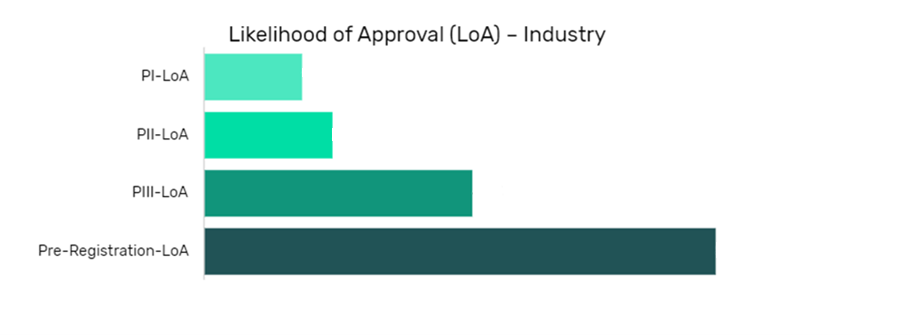
The data is segmented by drug name per indication and shows the current likelihood of approval for the drug compared to the indication benchmark and the industry benchmark.
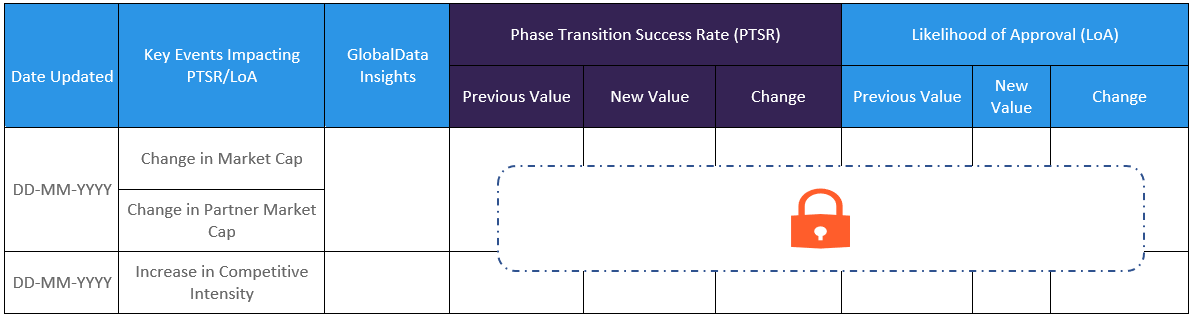
The Likelihood of Approval data is updated regularly based on events that take place which impact the clinical development process and regulatory considerations. GlobalData’s proprietary machine learning models consider these events in real time, to produce quantitative changes to the LOA and PTSR along with qualitative reasoning why the likelihood of approval has changed.
Scope of Report
- Drug Details: Drug name, Drug type, Intervention type
- Administration Pathway
- Therapeutic Areas
- Key Manufacturers
- Drug Development Status
Reasons to buy
- Precise Likelihood of Approval and Phase Transition Success Rates: Our machine learning and proprietary models provide accurate predictions, helping you gauge the potential success of a drug in the regulatory process.
- Competitive Strategy Planning: Access information on LOA and PTSR for competitors’ drugs, allowing you to plan your clinical development, commercialisation and marketing strategies
- Event-driven Updates: Track event-driven changes in LOA and PTSR benchmarked against indication LOA/PTSR. Get the latest insights to adapt your strategies promptly!
- Well-informed Investment Decisions: This data helps you navigate the dynamic landscape of drug development and regulatory considerations.
Key Stakeholders
Discover More with a Free Sample
What our clients have to say

Business Intelligence & Marketing Manager, SAL Heavy Lift
“The GlobalData platform is our go-to tool for intelligence services. GlobalData provides an easy way to access comprehensive intelligence data around multiple sectors, which essentially makes it a one-for-all intelligence platform, for tendering and approaching customers.
GlobalData is very customer orientated, with a high degree of personalised services, which benefits everyday use. The highly detailed project intelligence and forecast reports can be utilised across multiple departments and workflow scopes, from operational to strategic level, and often support strategic decisions. GlobalData Analytics and visualisation solutions has contributed positively when preparing management presentations and strategic papers.”

Market Analyst & Management, Liebherr-Werk
“COVID-19 has caused significant interference to our business and the COVID-19 intelligence from GlobalData has helped us reach better decisions around strategy. These two highlights have helped enormously to understand the projections into the future concerning our business units, we also utilise the project database to source new projects for Liebherr-Werk to use as an additional source to pitch for new business.”

Head of Key Accounts, Saab AB
Your daily news has saved me a lot of time and keeps me up-to-date with what is happening in the market, I like that you almost always have a link to the source origin. We also use your market data in our Strategic Business Process to support our business decisions. By having everything in one place on the Intelligence Center it has saved me a lot of time versus looking on different sources, the alert function also helps with this.

Marketing Intelligence Manager, Portugal Foods
Having used several other market research companies, I find that GlobalData manages to provide that ‘difficult-to-get’ market data that others can’t, as well as very diverse and complete consumer surveys.

Head of Customer Insight and Research, Standard Chartered
Our experience with GlobalData has been very good, from the platform itself to the people. I find that the analysts and the account team have a high level of customer focus and responsiveness and therefore I can always rely on. The platform is more holistic than other providers. It is convenient and almost like a one stop shop. The pricing suite is highly competitive and value for our organisation.
I like reports that inform new segments such as the analysis on generation Z, millennials, the impact of COVID 19 to our banking customers and their new channel habits. Secondly the specialist insight on affluent sector significantly increases our understanding about this group of customers. The combination of those give us depth and breadth of the evolving market.
I’m in the business of answering and helping people make decisions so with the intelligence center I can do that, effectively and efficiently. I can share quickly key insights that answer and satisfy our country stakeholders by giving them many quality studies and primary research about competitive landscape beyond the outlook of our bank. It helps me be seen as an advisory partner and that makes a big difference. A big benefit of our subscription is that no one holds the whole data and because it allows so many people, so many different parts of our organisation have access, it enables all teams to have the same level of knowledge and decision support.

Head of Consumer Sensory Insights, Givaudan
“I know that I can always rely on Globaldata’s work when I’m searching for the right consumer and market insights. I use Globaldata insights to understand the changing market & consumer landscape and help create better taste & wellbeing solutions for our customers in food, beverage and healthcare industries.
Globaldata has the right data and the reports are of very high quality compared to your competitors. Globaldata not only has overall market sizes & consumer insights on food & beverages but also provides insights at the ingredient & flavour level. That is key for B2B companies like Givaudan. This way we understand our customers’ business and also gain insight to our unique industry”

Senior Account Manager, TSYS
GlobalData provides a great range of information and reports on various sectors that is highly relevant, timely, easy to access and utilise. The reports and data dashboards help engagement with clients; they provide valuable industry and market insights that can enrich client conversations and can help in the shaping of value propositions. Moreover, using GlobalData products has helped increase my knowledge of the finance sector, the players within it, and the general threats and opportunities.
I find the consumer surveys that are carried out to be extremely beneficial and not something I have seen anywhere else. They provided an insightful view of why and which consumers take (or don’t) particular financial products. This can help shape conversations with clients to ensure they make the right strategic decisions for their business.
One of the challenges I have found is that data in the payments space is often piecemeal. With GD all of the data I need is in one place, but it also comes with additional market reports that provide useful extra context and information. Having the ability to set-up alerts on relevant movements in the industry, be it competitors or customers, and have them emailed directly to me, ensures I get early sight of industry activity and don’t have to search for news.