
Empower your strategies with our Likelihood of Approval and Phase Transition Success Rate Model – Ruxolitinib Phosphate in Breast Hyperplasia report and make more profitable business decisions.
This report provides you with the data that allows you to track and predict the specific likelihood of approval (LOA) and phase transition success rate (PTSR) of a drug using GlobalData’s proprietary machine learning algorithms developed using over 10 years of historical data.
Ruxolitinib Phosphate in Breast Hyperplasia Drug Details:
Ruxolitinib (INCB18424, Jakafi, Jakavi) is an anti neoplastic, immunomodulating and anti inflammatory agent. It is formulated as tablets for oral administration. Ruxolitinib is indicated for patients with intermediate or high-risk myelofibrosis, including primary myelofibrosis, post-polycythemia vera myelofibrosis, post-essential thrombocythemia myelofibrosis. It is also indicated for the treatment of adult patients with polycythaemia vera who are resistant to or intolerant of hydroxyurea. Ruxolitinib is indicated as emergency use for the treatment of COVID-19. Jakavi is indicated for the treatment of patients aged 12 years and older with acute graft versus host disease or chronic graft versus host disease who have inadequate response to corticosteroids or other systemic therapies.Ruxolitinib phosphate is under development for the treatment of vitiligo, cancer anorexia-cachexia syndrome, discoid lupus erythematosus (DLE), metastatic advanced cutaneous squamous cell carcinoma, idiopathic hypereosinophilic syndrome, atopic dermatitis, prurigo nodularis, hemophagocytic lymphohistiocytosis, COVID-19 patients with defined hyperinflammation and primary eosinophilic disorders, polycythemia vera, relapsed/refractory multiple myeloma, Hodgkin lymphoma, relapsed/refractory acute lymphocytic leukemia (ALL), chronic lymphocytic leukemia (CLL), chronic myelomonocytic leukemia (CMML), chronic myelocytic leukemia (CML), bronchiolitis obliterans syndrome, myelodysplastic syndrome, acute myelocytic leukemia (AML), Myelofibrosis, Hematopoietic Stem Cell Transplantation and Graft Versus Host Disease (GVHD), essential thrombocythemia, head and neck squamous cell carcinoma including oral cavity cancer, oropharngeal cancer, hypopharyngeal cancer and laryngeal cancer, CLL as first line therapy and breast biopsy showing ADH (atypical ductal hyperplasia), ALH (atypical lobular hyperplasia), LCIS (lobular carcinoma in situ), or DCIS (ductal carcinoma in situ), inflammatory triple negative breast cancer, plaque psoriasis, chronic active Epstein-Barr virus infection (CAEBV), Lichen sclerosus, chronic hand eczema, unspecified dermatological disorders (cutaneous lichen planus), hidradenitis suppurativa, seborrheic dermatitisand Coronavirus infections and cytokine storm. It is administered through cutaneous route.It was also under development for diffuse large B-cell lymphoma, early myelofibrosis, cachexia, metastatic prostate cancer, peripheral T-cell lymphomas (PTCL), rheumatoid arthritis, metastatic colorectal cancer and metastatic adenocarcinoma of the pancreas, non-small cell lung cancer, metastatic HER2 negative breast cancer, lung adenocarcinoma, adenocarcinoma, metastatic colorectal cancer, acute respiratory distress syndrome, chronic hand eczema and thalassemia.
Report Coverage
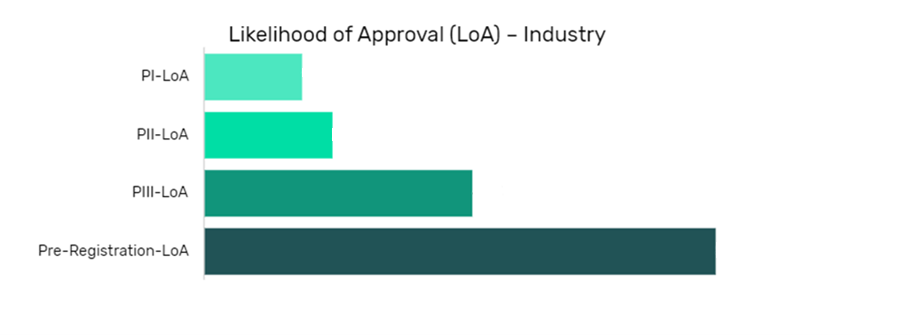
The data is segmented by drug name per indication and shows the current likelihood of approval for the drug compared to the indication benchmark and the industry benchmark.
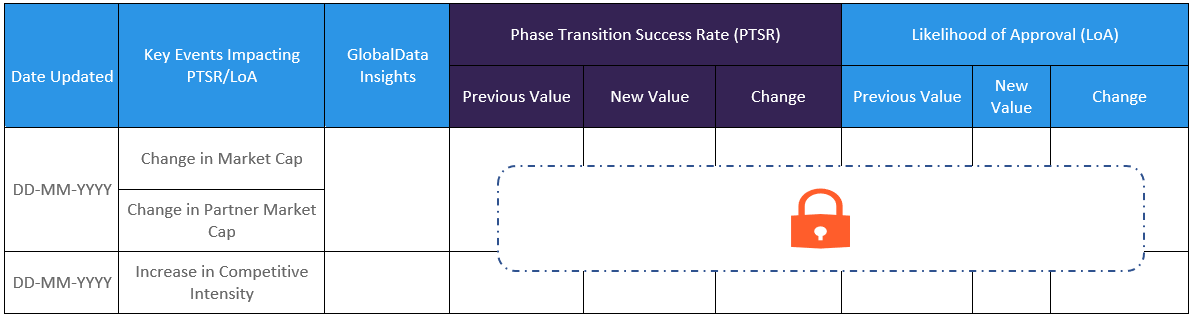
The Likelihood of Approval data is updated regularly based on events that take place which impact the clinical development process and regulatory considerations. GlobalData’s proprietary machine learning models consider these events in real time, to produce quantitative changes to the LOA and PTSR along with qualitative reasoning why the likelihood of approval has changed.
Scope of Report
- Drug Details: Drug name, Drug type, Intervention type
- Administration Pathway
- Therapeutic Areas
- Key Manufacturers
- Drug Development Status
Reasons to buy
- Precise Likelihood of Approval and Phase Transition Success Rates: Our machine learning and proprietary models provide accurate predictions, helping you gauge the potential success of a drug in the regulatory process.
- Competitive Strategy Planning: Access information on LOA and PTSR for competitors’ drugs, allowing you to plan your clinical development, commercialisation and marketing strategies
- Event-driven Updates: Track event-driven changes in LOA and PTSR benchmarked against indication LOA/PTSR. Get the latest insights to adapt your strategies promptly!
- Well-informed Investment Decisions: This data helps you navigate the dynamic landscape of drug development and regulatory considerations.







