
Empower your strategies with our Likelihood of Approval and Phase Transition Success Rate Model – Sargramostim in Alzheimer’s Disease report and make more profitable business decisions.
This report provides you with the data that allows you to track and predict the specific likelihood of approval (LOA) and phase transition success rate (PTSR) of a drug using GlobalData’s proprietary machine learning algorithms developed using over 10 years of historical data.
Sargramostim in Alzheimer’s Disease Drug Details:
Sargramostim (Leukine, Interberin) is a recombinant granulocyte macrophage colony-stimulating factor (rhu GM-CSF). It is formulated as injection for subcutaneous, intravascular or intravenous route of administration. It is indicated for the treatment of acute myelogenous leukemia (AML) patients following the induction chemotherapy, It is also used in mobilization and after autologous peripheral blood progentior cells transplantation as well as for myeloid reconstitution following the autologous and allogeneic bone marrow transplantation, for the treatment of patients who have undergone allogeneic or autologous bone marrow transplantation (BMT) in whom engraftment is delayed or has failed and it indicated to increase survival in adult and pediatric patients from birth to 17 years of age acutely exposed to myelosuppressive doses of radiation (Hematopoietic Syndrome of Acute Radiation Syndrome [H-ARS]).Sargramostim is under development for non-small cell lung cancer, solid tumor, mild cognitive impairment due to Alzheimer’s disease, and pulmonary alveolar proteinosis in Japan and metastatic melanoma in the US. It is also under development for the treatment of non-tuberculous mycobacterial disease, autoimmune pulmonary alveolar proteinosis, acute respiratory failure associated with COVID-19, down syndrome, myelosuppressive effects of HD exposure and T cell replete HLA-mismatched haploidentical stem cell transplant recipients who are receiving post-transplant cyclophosphamide. It was also under development for the treatment of Crohn’s disease, HER-2 positive breast cancer, solid tumor and Parkinson’s disease.
Report Coverage
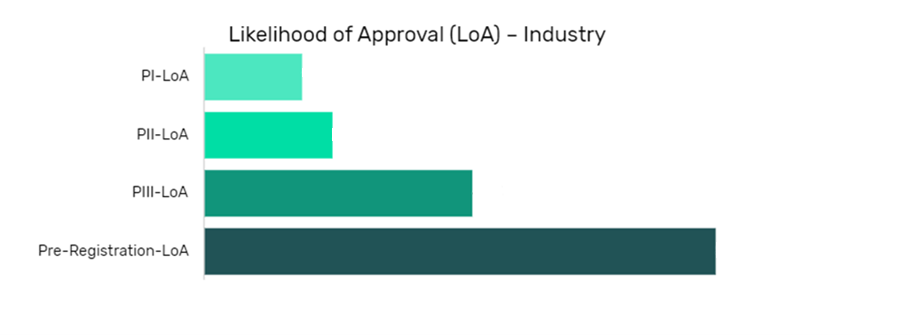
The data is segmented by drug name per indication and shows the current likelihood of approval for the drug compared to the indication benchmark and the industry benchmark.
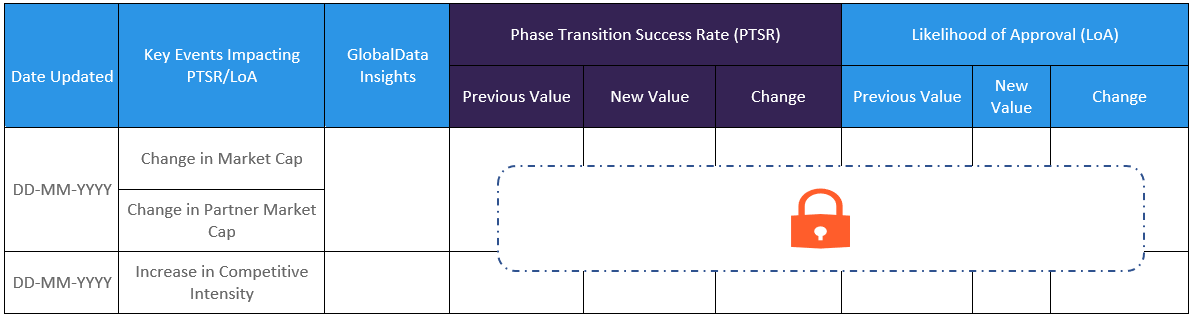
The Likelihood of Approval data is updated regularly based on events that take place which impact the clinical development process and regulatory considerations. GlobalData’s proprietary machine learning models consider these events in real time, to produce quantitative changes to the LOA and PTSR along with qualitative reasoning why the likelihood of approval has changed.
Scope of Report
- Drug Details: Drug name, Drug type, Intervention type
- Administration Pathway
- Therapeutic Areas
- Key Manufacturers
- Drug Development Status
Reasons to buy
- Precise Likelihood of Approval and Phase Transition Success Rates: Our machine learning and proprietary models provide accurate predictions, helping you gauge the potential success of a drug in the regulatory process.
- Competitive Strategy Planning: Access information on LOA and PTSR for competitors’ drugs, allowing you to plan your clinical development, commercialisation and marketing strategies
- Event-driven Updates: Track event-driven changes in LOA and PTSR benchmarked against indication LOA/PTSR. Get the latest insights to adapt your strategies promptly!
- Well-informed Investment Decisions: This data helps you navigate the dynamic landscape of drug development and regulatory considerations.







