Deep Dive into the Semis-AI-ESG Trinity Thematic Report Overview
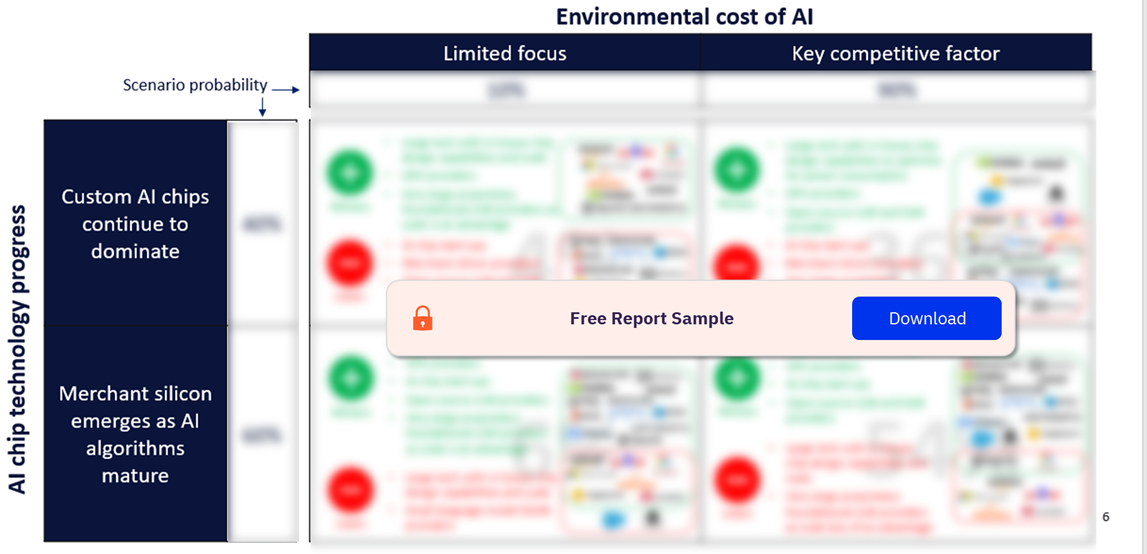
Big Tech vendors with in-house custom chip design capabilities have the early advantage in AI. However, this advantage will eventually vanish as AI algorithms mature and stabilize, there will be a business case for special purpose logic (SPL), or merchant AI silicon (i.e., commercial AI chips) emerges, which may be less than five years away.
Winners and Losers
Buy the Full Report for More Winners and Losers Insights into Semis-AI-ESG Trinity
Download a Free Sample Report
The environmental cost of AI is becoming a competitive factor. With the continuation of this development, the sector will shift away from increasingly larger models and the optimization of AI chips for raw processing performance. Instead, it will focus on smaller models, including small language models (SLMs), somehow reducing the scale advantage of LLM vendors providing extremely large models, and focusing on performance to power. As a result, open-source LLMs would become a more compelling option, as a model’s sheer size and training would not be a barrier to entry any longer, democratizing access to competitive AI technology.
The ‘Deep Dive into the Semis-AI-ESG Trinity’ thematic intelligence report looks at the relationship between AI, semiconductors, and environmental, social, and governance (ESG).
Buy the Full Report for More Insights on the Semis-AI-ESG Trinity
Download a Free Sample Report
Scope of Report
This Deep Dive report looks at the relationship between AI, semiconductors, and environmental, social, and governance (ESG). The environmental cost of AI is becoming a competitive factor. If this development unfolds, the sector will shift away from increasingly larger models and the optimization of AI chips for raw processing performance. Instead, it would focus on smaller models, including small language models (SLMs), somehow reducing the scale advantage of LLM vendors providing extremely large models, and focusing on performance to power. As a result, open-source LLMs would become a more compelling option, as a model’s sheer size and training would not be a barrier to entry any longer, democratizing access to competitive AI technology.
Key Highlights
AI technology is evolving rapidly from three perspectives: software, hardware, and regulations. This makes both architectural and financial commitments highly risky. Hardware processing improvements are not keeping up with the increase in AI model sizes. So, barring a semiconductor breakthrough, demand for raw compute capacity in data centers is bound to dramatically increase, increasing AI’s contribution to carbon emissions.
As the carbon footprint impact of large language models (LLMs) becomes more transparent, organizations must consider it when selecting an AI delivery model and in real-time orchestration of AI-enabled services. Scope 3 emissions guidance will be needed, and AI vendors must step up disclosures. It is expected that LLM’s ESG compliance will become a competitive factor.
Buy the Full Report for More Insights on the Semis-AI-ESG Trinity
Reasons to buy
- Understand the long-term scenarios for the AI market.
- Discover the likely winners and losers in each of these scenarios.
- Get recommendations for adopting generative AI in your organization.