Smart Supply Chain in Retail and Apparel Market Overview
The COVID-19 pandemic, geopolitical tensions, and climate change have made digitization in the supply chain in retail essential to control production delays and logistic failures and foresee demand with the help of data analytics. Smart supply chain management allows retailers to take calculative decisions in forecasting consumer demand and current supplies to mitigate stock shortages and run a smoother logistics process. The involvement of smart tech such as robotics, the Internet of Things (IoT), warehouse management systems (WMS), and GPS necessitates the need for experts in each field, triggering huge investments. Automation helped retailers address labor constraints and safety concerns, which was clearly visible during the COVID-19 pandemic. Delivery methods using drones and other autonomous road vehicles help retailers provide fast and error-free deliveries and reduce overhead costs.
The Smart Supply Chain in Retail and Apparel Market report provides detailed insight into the theme of the smart supply chain, specifically focusing on its impact on the retail and apparel sectors. The report provides an overview of smart supply chain and its components, the leading companies, the timeline of developments in smart supply chain and use cases. The report also details the relevant technology, macroeconomic and retail trends.
Smart Supply Chain in Retail and Apparel Trends
The main trends shaping the smart supply chain theme over the next 12 to 24 months are classified into three categories: technology trends, retail trends, and macroeconomic trends.
Technology trends: The key technology trends impacting the smart supply chain theme are robotic process automation (RPA), automation, RFID, delivery innovation, and instore technologies.
Retail trends: Some of the key retail trends impacting the smart supply chain theme are convenience, demand for rapid delivery, and frictionless stores.
Macroeconomic trends: Factors such as the supply chain crisis, Russia-Ukraine crisis, and sustainability are some of the macroeconomic trends expected to impact market growth.
For more insights on the smart supply chain in retail and apparel trends, download a free sample report
Smart Supply Chain in Retail and Apparel Value Chain
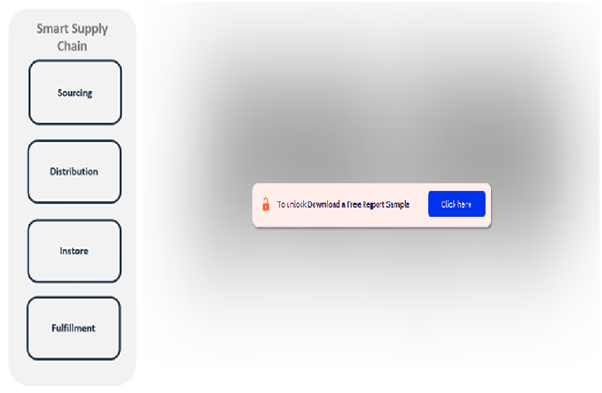
To meet consumers’ expectations of seamless multichannel perfection, retailers are connecting digital and physical channels to build a smarter supply network that interconnects information, services, and goods. The key components in the smart supply chain in retail and apparel sector are sourcing, distribution, instore, and fulfillment.
Sourcing: Procurement and production are the two main parameters of sourcing. Retailers are using machine learning and predictive analytics during the procurement process in applications such as demand forecasting and order placement. By leveraging artificial intelligence, retailers can turn raw data collected from sources like the IoT or sensors into actionable insights, helping them to increase the speed, efficiency, and accuracy of the whole procurement process.
Furthermore, to meet future demand in uncertain times, retailers are building more flexibility into their supply chains instead of solely aiming to reduce costs. By using machine learning in conjunction with analytics, retailers can now have a more accurate and realistic idea of their production targets; therefore, they are collaborating with both software and hardware companies to produce AI-powered robots that are programmed to recognize and make decisions independently, which would traditionally require human-level proficiency in production.
Smart Supply Chain in Retail and Apparel Value Chain
For more insights on the smart supply chain in retail and apparel value chain, download a free sample report
Smart Supply Chain in Retail and Apparel Companies
The key companies making a mark within the smart supply chain theme are Alibaba, Amazon, Decathlon, H&M, IKEA, Nike, Ocado, UNIQLO, Walmart, and Zara among others.
Alibaba: Alibaba’s supply network arm, the Cainiao network has upgraded its traditional warehouses to smart warehouses, rolled out several distribution centers, and introduced smart lockers to ease its supply chain operations. The retailer’s warehouses use smart technologies to provide logistics services, like its AI-driven smart order consolidation techniques to combine multiple parcels for a single address into one package. Alibaba also invested in blockchain technology to improve supply chain integrity.
For more insights on the smart supply chain in retail and apparel companies, download a free sample report
Retail Sector Scorecard
The retail sector scorecard comprises of three screens including a thematic screen, a valuation screen, and a risk screen.
Retail Sector Scorecard – Thematic Screen
For more insights on the smart supply chain in retail and apparel sector scorecard, download a free sample
Smart Supply Chain in Retail and Apparel Outlook
| Page Count | 37 |
| Value Chain Components | Sourcing, Distribution, Instore, and Fulfillment |
| Key Trends | Technology, Retail, and Macroeconomic |
| Key Companies | Alibaba, Amazon, Decathlon, H&M, IKEA, Nike, Ocado, UNIQLO, Walmart, and Zara |
Reasons to buy
- Understand the themes ecosystem will get you ahead of the curve.”
- Understand the important themes in 2022 and beyond, allowing you to grasp a wider view of changes in consumer behaviour and how it will impact your markets.
- Explore how emerging themes in retail are allowing industry leaders to evolve, so you can better position yourself for long-term success.
- An easy-to-use framework for tracking themes across all companies in all sectors.
- Companies who invest in the right themes become success stories; those who miss the big themes end up as failures.