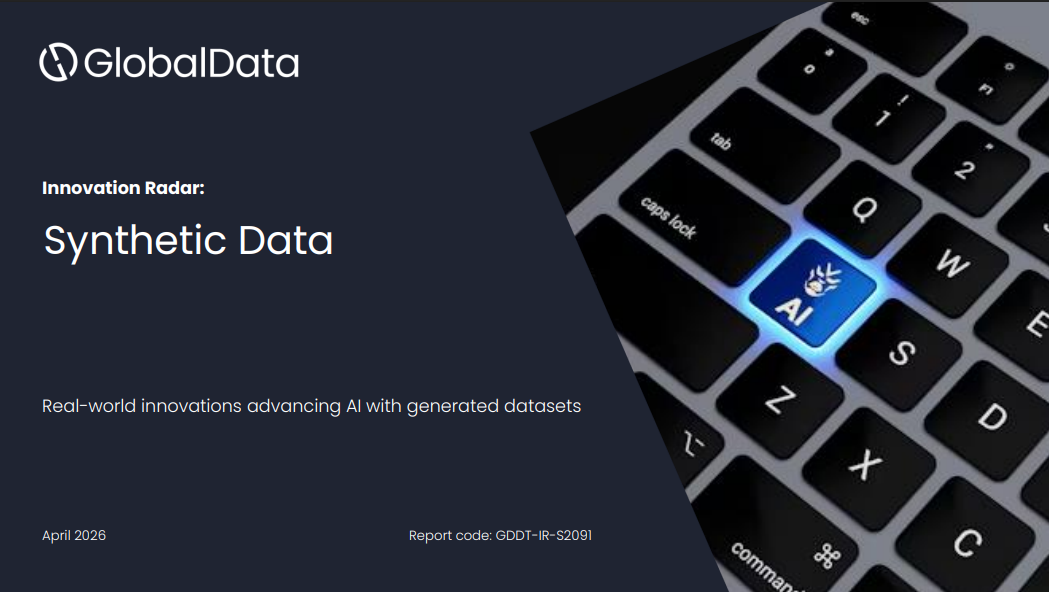
Synthetic Data: Market Trends and Innovations
Powered by 
All the vital news, analysis, and commentary curated by our industry experts.

Explore synthetic data trends, AI training use cases, generation technologies, enterprise adoption, market dynamics, innovation and key barriers shaping the synthetic data landscape.
Synthetic data is changing how enterprises approach AI data generation, training, testing, and validation. Instead of relying only on costly and difficult-to-source real-world data, organizations can use synthetic datasets to create additional training coverage, generate labels, address data gaps, and simulate scenarios that may be difficult to capture in the real world. Synthetic Data: Market Trends and Innovations report provides an analysis of synthetic data technology, enterprise adoption, market dynamics, innovation, and emerging applications across the AI development lifecycle.
It examines how synthetic data is being used across generative AI, large language models (LLMs), computer vision, robotics, autonomous systems, analytics, and other AI applications. Moreover, the report assesses the market signals shaping the technology. These include investment activity, patent activity, hiring trends, enterprise demand, and product innovation. As AI deployment expands, access to relevant, representative, and usable training data remains a significant consideration. Therefore, understanding where synthetic data can add value and where its limitations remain is increasingly relevant to AI, data, technology, and innovation leaders.
Why Synthetic Data Matters for Enterprise AI
AI development increasingly depends on the availability of large, diverse, high-quality datasets. However, real-world data can be expensive to collect, difficult to label, incomplete, or restricted by privacy and regulatory requirements. Synthetic data may help address some of these challenges. For example, organizations can generate additional examples where real-world datasets have limited coverage. They can also simulate rare or safety-critical scenarios that may be difficult to capture through conventional data collection.
As a result, synthetic data can support AI teams looking to:
- Expand training datasets
- Improve representation of underrepresented scenarios
- Generate automatically labeled data
- Test AI models against controlled scenarios
- Simulate edge cases
- Support computer vision and robotics development
- Augment limited real-world datasets
- Explore privacy-conscious approaches to AI development
However, synthetic data does not automatically solve data-quality challenges. Statistical fidelity, bias, validation, evaluation methodologies, and integration with existing ML pipelines remain important considerations.
Scope
This report examines signals indicating how synthetic data is progressing from an emerging AI technology toward broader enterprise adoption. It analyzes investment, patents, hiring, and innovation activity to identify areas of momentum across the synthetic data ecosystem. The analysis includes activity from companies operating across AI, cloud computing, semiconductors, software, automotive technology, robotics, and professional services.
For example, the report examines investment activity involving Wayve, including funding from Microsoft, SoftBank, and NVIDIA. It also considers patent activity involving organizations such as Samsung Electronics, NVIDIA, and Sony, alongside hiring signals from companies including Apple, NVIDIA, and Accenture. These signals provide context for understanding where organizations are developing capabilities and investing in synthetic data-related technologies.
Synthetic Data Technology Landscape and Key Innovations
The report explores how technology providers are developing synthetic data capabilities across different parts of the AI stack. It examines innovations spanning synthetic data platforms, generative AI, enterprise analytics, LLM development, computer vision, robotics, and simulation. Examples discussed include technologies and solutions from organizations such as AWS, NVIDIA, Databricks, and AGIBOT.
The analysis helps you understand how vendors are approaching synthetic data generation and where capabilities are developing across different AI use cases. Rather than focusing only on individual products, the report considers the broader synthetic data technology landscape and the market forces shaping innovation.
Synthetic Data Adoption: Opportunities and Challenges
The business case for synthetic data depends on more than the ability to generate large datasets. Enterprises also need to consider whether generated data is sufficiently representative of real-world conditions. They must assess potential bias, establish appropriate validation methods, and determine how synthetic datasets integrate with existing machine learning infrastructure. The report therefore examines both synthetic data opportunities and adoption barriers.
Key considerations include:
- Statistical fidelity
- Data quality
- Bias propagation
- Dataset validation
- Evaluation standards
- ML pipeline integration
- Tooling and infrastructure
- Enterprise implementation requirements
This balanced view can help technology and data leaders assess where synthetic data may provide value while recognizing the practical considerations involved in deployment.
Key Highlights
Synthetic Data as a Programmable AI Layer:
Synthetic data is shifting AI development from passive data collection to on-demand dataset generation for training, testing, validation, and deployment.
Broader and Better Training Coverage:
Synthetic datasets help expand limited real-world data, balance underrepresented classes, generate labels automatically, and simulate rare or safety-critical scenarios.
Three Core Generation Approaches:
The report examines statistical synthesis, generative AI models, and simulation environments as the main technologies used to create synthetic datasets.
Coverage Across Key Data Modalities:
Synthetic data supports tabular, time-series, text, image, video, and sensor-fusion datasets across enterprise analytics, NLP, computer vision, robotics, and autonomous systems.
Rising Enterprise Adoption Signals:
Deal activity, patent publications, and hiring trends indicate growing enterprise momentum around synthetic data between 2022 and 2025.
Adoption Barriers Remain:
The report identifies constraints around statistical fidelity, evaluation standards, ML pipeline integration, bias propagation, and tooling gaps.
Reasons to Buy
This report may be particularly relevant to:
- Chief Technology Officers (CTOs)
- Chief Data Officers (CDOs)
- Chief AI Officers and AI leaders
- VPs and Heads of Artificial Intelligence
- VPs and Heads of Data Science
- Machine Learning leaders
- Data and Analytics leaders
- Enterprise architects
- Digital transformation leaders
- Technology strategy teams
- Innovation and R&D teams
- AI product managers
- Product strategy teams
- Corporate strategy teams
- Competitive intelligence teams
- Technology investment teams
- Venture capital and private equity investors
- AI and machine learning technology vendors
How Companies Can Use This Synthetic Data Report
The report is designed to support practical decisions across AI, data, technology, innovation, and strategy functions.
- AI and machine learning teams: You can use the analysis to understand emerging synthetic data approaches and identify applications across training, testing, validation, and model development.
- Data and analytics leaders: The report can help you assess where synthetic datasets may complement existing data strategies. It can also support discussions around data availability, augmentation, and privacy-conscious development.
- Technology and digital leaders: You can use the market and innovation analysis to understand how synthetic data fits into the wider enterprise AI technology landscape.
- Product and innovation teams: The report provides insight into emerging applications, vendor activity, investment signals, and technology developments. Therefore, it can support technology scouting and innovation planning.
- Strategy and corporate development teams: Investment, patent, hiring, and innovation signals can help you assess the direction of the synthetic data ecosystem. This may support market assessment, partnership discussions, and competitive intelligence.
- AI technology vendors: The analysis can provide context on enterprise demand, competing technology approaches, application areas, and innovation activity.
Synthetic Data Applications Across AI and Machine Learning
Synthetic data has applications across several areas of AI development.
- Generative AI and LLMs: Synthetic text and other generated datasets can support model development, testing, and evaluation. They may also help organizations explore specific scenarios where suitable real-world training data is limited.
- Computer Vision: Synthetic images and video can provide controlled training environments. This can be particularly relevant when teams need to generate specific objects, environments, conditions, or edge cases.
- Robotics and Autonomous Systems: Simulation can allow AI systems to encounter scenarios that may be expensive, dangerous, or impractical to reproduce in the physical world.
- Enterprise Analytics: Synthetic tabular and time-series data can support testing, experimentation, development, and certain privacy-conscious data workflows.
- AI Testing and Validation: Synthetic datasets can help teams create controlled test cases. This may support model evaluation across scenarios that are difficult to observe consistently in production data.
Benchmark Synthetic Data Innovation Against Global Leaders
Understanding the synthetic data market requires more than tracking individual technologies. You also need to understand who is investing, innovating, hiring, and developing intellectual property across the ecosystem. The report uses investment, patent, hiring, and innovation signals to provide a broader view of market activity.
As a result, you can use the analysis to benchmark synthetic data developments against activity from major global technology companies and other organizations. This can help you identify areas of increasing activity, compare technology approaches, and assess where synthetic data capabilities are developing across the wider AI landscape.
Get the Synthetic Data Market Analysis You Need for AI Strategy
Synthetic data is becoming increasingly relevant as organizations look for scalable approaches to AI data generation, model development, testing, and validation. However, adoption involves important technical and operational considerations. This report can help you understand both sides of the market: the opportunities created by synthetic data and the barriers that may affect enterprise adoption.
If synthetic data is relevant to your AI, data, technology, or innovation strategy, use the report to assess the market while these capabilities continue to develop. Access the Synthetic Data Trend Analysis to understand the technologies, companies, applications, market signals, and adoption challenges shaping the synthetic data ecosystem.
Advex
Agibot
Amazon Web Services
Axxon AI
Databricks
Gretel
Hugging Face
IBM
Ipsos
MOSTLY AI
Neurolabs
NVIDIA
Onix
Parallel Domain
Rockfish Data
RTI International
Sandbox AQ
Savanta
SmartOne.ai
Synthesis AI
Syntho
Tether
Toluna
Tonic.ai
Table of Contents
Get in touch to find out about multi-purchase discounts
reportstore@globaldata.com
Tel +44 20 7947 2745
Sample Report
Synthetic Data: Market Trends and Innovations was curated by the best experts in the industry and we are confident about its unique quality. However, we want you to make the most beneficial decision for your business, so we offer free sample pages to help you:
- Assess the relevance of the report
- Evaluate the quality of the report
- Justify the cost
Download your copy of the sample report and make an informed decision about whether the full report will provide you with the insights and information you need.


Related reports
View more Technology reports

