
Empower your strategies with our Likelihood of Approval and Phase Transition Success Rate Model – Talimogene Laherparepvec in Kaposi Sarcoma report and make more profitable business decisions.
This report provides you with the data that allows you to track and predict the specific likelihood of approval (LOA) and phase transition success rate (PTSR) of a drug using GlobalData’s proprietary machine learning algorithms developed using over 10 years of historical data.
Talimogene Laherparepvec in Kaposi Sarcoma Drug Details:
Talimogene laherparepvec (Imlygic) is a recombinant herpes simplex type-1 virus (HSV), acts as immunostimulating and antineoplastic agent. It is formulated as injectable suspension and solution for intralesional route of administration. Imlygic is a genetically modified oncolytic viral therapy indicated for the local treatment of unresectable cutaneous, subcutaneous, and nodal lesions in patients with melanoma recurrent after initial surgery. Imlygic has not been shown to improve overall survival or have an effect on visceral metastases.It is under development for the treatment of Kaposi sarcoma, cutaneous angiosarcoma, pleomorphic liposarcoma, locally advanced basal cell carcinoma,HER2 negative breast cancer, hepatocellular carcinoma, pancreatic cancer including metastatic pancreatic adenocarcinoma, non-small cell lung cancer, renal cell carcinoma, gastroesophageal cancer, pancreatic ductal adenocarcinoma, Merkel cell carcinoma, metastatic recurrent squamous cell carcinoma of head and neck of the oral cavity, cutaneous squamous cell carcinoma, metastatic colorectal cancer with liver metastasis, metastatic breast cancer and other rare skin tumors, oropharynx, hypopharynx, or larynx, soft tissue sarcoma as second and third line therapy, and other solid tumors including inflammatory breast cancer. It is under development for undifferentiated pleomorphic sarcoma, myxofibrosarcoma, and malignant peripheral nerve sheath tumor (MPNST) as adjuvant therapy. It is administered through intravesical, intratumor, intrapleural and intralesional route. It was also under development for triple negative breast cancer, malignant pleural effusion, non-muscle invasive transitional cell carcinoma (second line therapy), refractory T cell and NK cell lymphomas (cutaneous T-cell lymphomas (CTCL), mycosis fungoides (MF), Sezary syndrome (SS), peripheral T-cell lymphoma (PTCL), ALK-positive and ALK-negative anaplastic large cell lymphoma (ALCL)), extramammary Paget Disease, cutaneous squamous cell carcinoma, non-melanomatous skin cancer.
Report Coverage
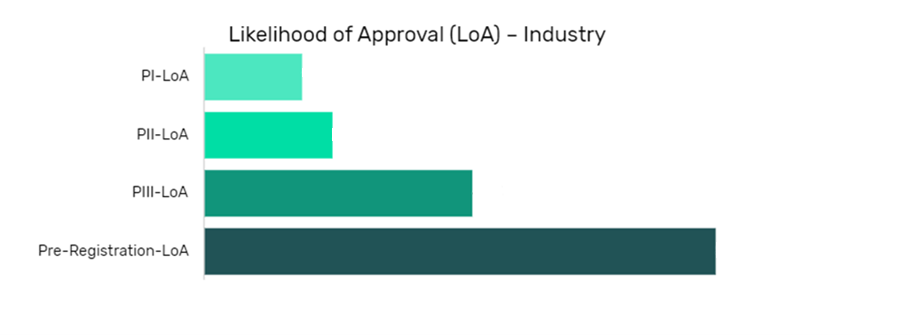
The data is segmented by drug name per indication and shows the current likelihood of approval for the drug compared to the indication benchmark and the industry benchmark.
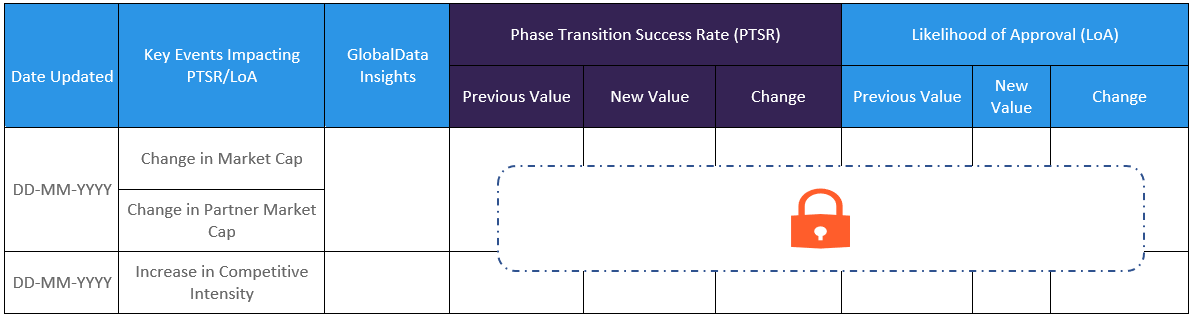
The Likelihood of Approval data is updated regularly based on events that take place which impact the clinical development process and regulatory considerations. GlobalData’s proprietary machine learning models consider these events in real time, to produce quantitative changes to the LOA and PTSR along with qualitative reasoning why the likelihood of approval has changed.
Scope of Report
- Drug Details: Drug name, Drug type, Intervention type
- Administration Pathway
- Therapeutic Areas
- Key Manufacturers
- Drug Development Status
Reasons to buy
- Precise Likelihood of Approval and Phase Transition Success Rates: Our machine learning and proprietary models provide accurate predictions, helping you gauge the potential success of a drug in the regulatory process.
- Competitive Strategy Planning: Access information on LOA and PTSR for competitors’ drugs, allowing you to plan your clinical development, commercialisation and marketing strategies
- Event-driven Updates: Track event-driven changes in LOA and PTSR benchmarked against indication LOA/PTSR. Get the latest insights to adapt your strategies promptly!
- Well-informed Investment Decisions: This data helps you navigate the dynamic landscape of drug development and regulatory considerations.







