Tech Trends in Retail Bundle Report Overview
The COVID-19 pandemic resulted in a boost in eCommerce and online shopping. Consequentially, this caused a change in consumer behavior. They have become more accustomed to buying from online stores rather than visiting physical stores. Retailers saw the necessity to adapt to the situation and hence technology has become an integral part of the retail sector now.
As a part of this bundle, you will gain access to in-depth insights available in the following reports:
- Thematic Research: Delivery Innovation in Retail
- Thematic Research: Direct-to-Consumer in Retail
- Thematic Research: Internet of Things in Retail and Apparel
- Thematic Research: Online Payments in Retail
Report 1: Delivery Innovation in Retail – Thematic Research
Across both food and non-food sectors, younger consumers mostly avail online delivery as they generally shop more frequently for lower basket sizes. The delivery of purchased products from stores to consumers has led to logistical complications with the introduction of third-party partners and a range of required data analytics tools to make deliveries as efficient as possible. As competition in the retail industry intensifies, many retailers are introducing innovative delivery solutions in a bid to differentiate themselves from the competition. Warehouse automation has been a prominent way for retailers to streamline their supply chains. Numerous retailers are also adopting the latest technologies such as robotics, as it requires minimal human intervention and offers fast and error-free deliveries.
Retail Value Chain

To know more about delivery innovation in retail, download a free report sample
Report 2: Direct-to-Consumer in Retail – Thematic Research
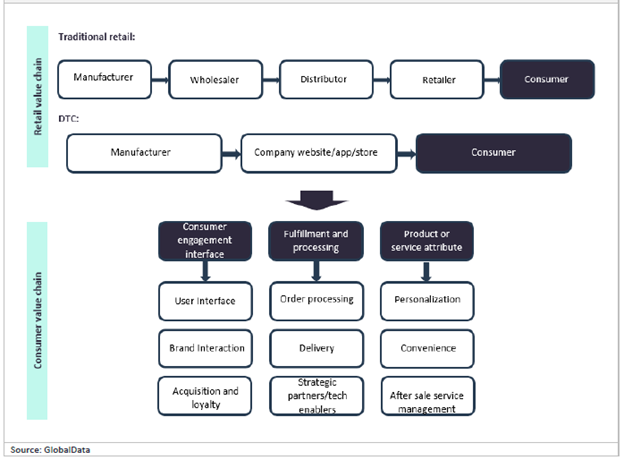
The Direct-To-Consumer model is a relatively new concept in retail that initially gained popularity among retailers selling easy-to-ship product categories such as skincare, makeup, and fashion, but was later adopted by retailers that sell big-ticket items such as furniture. This model has many advantages, including less dependence on third parties, fewer contract negotiations, fewer limitations on branding and fulfillment, the ability to collect valuable consumer data, the prevention of counterfeiting, and a better end-to-end understanding of the customer journey. Using the DTC model also helps retailers improve their product margins and have greater control over their brand image and consumers’ shopping experience.
DTC Value Chain
To know more about direct-to-consumer in retail, download a free report sample
Report 3: Internet of Things in Retail and Apparel – Thematic Research
Following the COVID-19 outbreak, many retailers used the Internet of Things (IoT) to capitalize on the shift to online shopping. The pandemic accelerated the roll-out of interactive web pages, apps, and new creative product launches to maintain customer interest and improve retention. Ambient commerce is also growing steadily. It strategically combines the physical space associated with traditional retail with technology and gives typical shopping experiences a digital twist. Customers are likely to appreciate this following their prolonged exposure to eCommerce because of the pandemic.
IoT Value Chain Analysis, by App Layer

To know more about IoT in the retail and apparel industry, download a free report sample
Report 4: Online Payments in Retail – Thematic Research
COVID-19 has significantly accelerated the shift of consumers and retailers alike towards online payments and the trend is expected to remain even after the crisis resides. Offering frictionless payment methods increases the convenience and speed of completion for shoppers while for retailers, it reduces the possibility of a purchase being abandoned. New smart technologies continue to disrupt payments, allowing consumers to purchase items with little or no effort. Moreover, mobile commerce (m-commerce) is growing at a rapid rate and is especially popular among millennials and Gen Z consumers.
Retail Online Sales

To know more about online payments in the retail industry, download a free report sample