Thailand Baby Food Market Report Overview
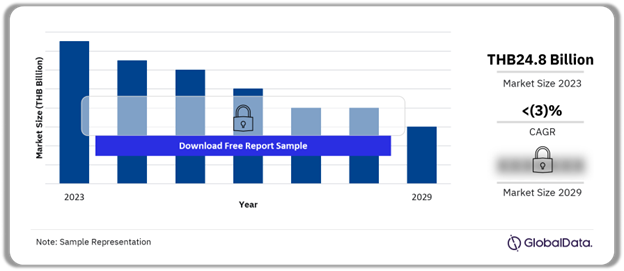
The baby food sales in Thailand were worth THB24.8 billion ($714 million) in 2023. The Thailand baby food market value sales will decline at a negative CAGR of more than 3% during 2023-2029.
Thailand Baby Food Market Outlook, 2023-2029 (THB Billion)
Buy Full Report for More Insights on the Thailand Baby Food Market Forecast
The Thailand baby food market insights cover current and future trends that will influence the baby food industry. This report collates multiple data sources to offer a comprehensive baby food sector overview in Thailand from 2017 to 2029.
| Market Size (2023) | THB24.8 billion |
| CAGR (2023-2029) | <(3)% |
| Historical Period | 2017-2022 |
| Forecast Period | 2023-2029 |
| Key Categories | · Baby Milks
· Baby Cereals & Dry Meals · Baby Wet Meals & Other · Baby Finger Food |
| Key Distribution Channels | · Hypermarkets and Supermarkets
· Convenience Stores · Drugstores & Pharmacies |
| Leading Manufacturers | · Nestlé
· Danone · Mead Johnson (Reckitt Benckiser) · Abbott Laboratories · The Kraft Heinz Company |
| Enquire & Decide | Discover the perfect solution for your business needs. Enquire now and let us help you make an informed decision before making a purchase. |
Thailand Baby Food Market Trends
A significant percentage of Thailand consumers purchase baby care, or childcare products based on recommendations from a virtual assistant (for example, using artificial intelligence). This trend will likely continue in the future, supported by the growing consumer preference for technology-based solutions.
Furthermore, Thai respondents find authentic and sustainable claims very appealing. To capitalize on these trends, manufacturers should focus on introducing easy-to-use, convenient, and time-saving products
Buy the Full Report for Thailand Baby Food Market Trends Analysis,
Thailand Baby Food Market Segmentation by Categories
The baby milk category led the Thailand baby food market sales in 2023
The key categories in the Thailand baby food market are:
- Baby Milks
- Baby Wet Meals & Other
- Baby Cereals & Dry Meals
- Baby Finger Food
The value sales of the Thailand baby milk category increased significantly from 2017-2023. However, the category is expected to decline in 2029. Milks are increasingly promoted based on their ingredients and the benefits claimed by manufacturers. Among special formula milks, features such as lactose-free and hypoallergenic (HA) formula are gaining traction.
Buy Full Report for Categorical Thailand Baby Food Market Outlook
Thailand Baby Food Market Segmentation by Distribution Channels
Hypermarkets & supermarkets was the leading distribution channel for baby food in 2023
The key distribution channels in the Thailand baby food market are:
- Hypermarkets and Supermarkets
- Convenience Stores
- Drugstores & Pharmacies
Hypermarkets and supermarkets emerged as the most preferred distribution channel with the highest value sales in 2023.
Buy the Full Report for Distribution Channel Insights Thailand Baby Food Market
Thailand Baby Food Market - Competitive Landscape
In 2023, Nestlé garnered the largest Thailand baby food market value
The leading baby food manufacturers in Thailand are:
- Nestlé
- Danone
- Mead Johnson (Reckitt Benckiser)
- Abbott Laboratories
- The Kraft Heinz Company
Nestlé dominated the Thailand baby food market with key brands including NAN Gold Pro, NAN Gold HA among others. Danone, Mead Johnson (Reckitt Benckiser), and others.
Buy the Full Report to Know More About Thailand’s Baby Food Manufacturers
Segments Covered in the Report
Thailand Baby Food Categories Outlook (Value, THB Billion, 2017-2029)
- Baby Milks
- Baby Wet Meals & Other
- Baby Cereals & Dry Meals
- Baby Finger Food
Thailand Baby Food Distribution Channel Outlook (Value, THB Billion, 2017-2029)
- Hypermarkets and Supermarkets
- Convenience Stores
- Drugstores & Pharmacies
Scope of Report
This report provides:
- This report brings together multiple data sources to provide a comprehensive overview of the baby food sector in Thailand, as part of GlobalData’s global coverage of the sector. It includes an analysis of the following:
- Market environment: The report provides a comparative analysis of the value and volume shares of Thailand against the Asia-Pacific and global baby food sectors. Additionally, the per capita consumption (PCC)* of and per capita expenditure (PCE)* on baby food in Thailand are compared at regional and global levels.
- Background: Provides an overview of births, consumer trends, socio-demographic trends, working women population, and regulations in the Thai baby food sector.
- Category coverage and competitive landscape: The report offers an overview of growth at a sector level and provides an analysis of three categories: baby milks, baby cereals & dry meals, and baby wet meals & others. These categories are analyzed by value, volume, and CAGR for the 2017–29 period. The analysis also includes the PCC of and PCE on baby food in Thailand, by category. The report provides an analysis of leading manufacturers and brands in the Thai baby food sector in 2023 and their market shares in each category.
- Production and trade: The report provides an analysis of imports and exports in the Thai baby food sector.
- Distribution channel: Provides analysis on the leading distribution channels at both sector and category level in 2023.
- Economic background: The report also provides an outlook on macroeconomic indicators in Thailand, with a detailed summary of the economy and labor market.
Key Highlights
Value sales of baby milks grew from THB21.6 billion ($635.8 million) in 2017 to THB23.1 billion ($664.9 million) in 2023, registering a CAGR of 1.2% during this period.
Volumes of baby cereals & dry meals decreased from 2.77 million kg in 2017 to 1.94 million kg in 2023, at a negative CAGR of 5.7%.
Value sales of the baby wet meals & others category rose from THB626 million ($18.4 million) in 2017 to THB693.8 million ($19.9 million) in 2023, at a CAGR of 1.7%.
Reasons to buy
- Evaluate important changes in consumer behavior and identify profitable markets and areas for product innovation.
- Analyse current and forecast behavior trends in each category to identify the best opportunities to exploit.
- Detailed understanding of consumption by individual product categories in order to align your sales and marketing efforts with the latest trends in the market.
- Investigates which categories are performing the best and how this is changing market dynamics.
Key Stakeholders
Table of Contents
Tables
Birth & population trends, 2008-28
Live births by region, 2012-21
Live births by age of mother, 2000, 2006, 2010-14, and 2016-19
Number of women of childbearing age, by age group, 2010, 2015, 2017, 2019, and 2021
Female employment trends, 2010-15, 2017, and 2020 21
Female employment trends, 2010-15, 2017, and 2020 21
Female labor force participation rates by age, 2015-22
Working women by type of work, 2012, 2015, and 2019-20
Breastfeeding trends, Thailand, 2012
Early breastfeeding initiation, 2012
Types of breastfeeding by region, 2009
Infant and young child feeding (IYCF) practices in 2015
Median duration breastfeeding among children aged 0-35 months, Thailand, 2012
Leading categories (value and volume), 2022
Baby food: manufacturer shares, value & volume, %, 2016-22
Baby food: manufacturer shares by category, %, 2022
Baby milks: SKUs by pack type, 2022
Baby milks: SKUs by pack size, 2022
Baby milks: brand price positioning analysis, 2022
Baby milks: manufacturer shares, value & volume, %, 2016-22
Baby milks: manufacturer & brand shares, value %, 2016-22
Baby milks: manufacturer & brand shares, volume %, 2016-22
Baby cereals & dry meals: SKUs by pack type, 2022
Baby cereals & dry meals: SKUs by pack size, 2022
Baby cereals & dry meals: brand price positioning analysis, 2022
Baby cereals & dry meals: manufacturer shares, value & volume, %, 2016-22
Baby cereals & dry meals: manufacturer & brand shares, value %, 2016-22
Baby cereals & dry meals: manufacturer & brand shares, volume %, 2016-22
Baby wet meals & other: SKUs by pack type, 2022
Baby wet meals & other: SKUs by pack size, 2022
Baby wet meals & other: brand price positioning analysis, 2022
Baby wet meals & other: manufacturer shares, value & volume, %, 2016-22
Baby wet meals & other: manufacturer & brand shares, value %, 2016-22
Baby wet meals & other: manufacturer & brand shares, volume %, 2016-22
Baby milks & cereals: trends in imports, 2014-21
Imports of baby milks & cereals by country of origin, 2019-21
Other baby food: trends in imports, 2014-21
Imports of other baby food by country of origin, 2019-21
Baby milks & cereals: trends in exports, 2014-21
Exports of baby milks & cereals by country of destination, 2019-21
Other baby food: trends in exports, 2014-21
Exports of other baby food by country of destination, 2019-21
Change in distribution share, 2016-22
Baby food: sales by outlet type, % value, 2016-22
Baby food: sales by type of food & outlet type, % value, 2022
Category definitions
Terminology definitions
Baby population, number of babies (’000), 2008-28
Baby food: market value, current prices ($ million), 2016-22
Baby food: market value, constant prices, 2016-22
Baby food: market volume, million kg, 2016-22
Baby food: per capita expenditure, current prices ($), 2016-22
Baby food: per capita expenditure, constant prices, 2016-22
Baby food: per capita consumption, kg, 2016-22
Baby milks: category segmentation, value & volume, 2016-22
Baby food: market value forecasts, current prices ($ million), 2022-28
Baby food: market value forecasts, constant prices, 2022-28
Baby food: market volume forecasts, million kg, 2022-28
Baby food: per capita expenditure forecasts, current prices ($), 2022-28
Baby food: per capita expenditure forecasts, constant prices, 2022-28
Baby food: per capita consumption forecasts, kg, 2022-28
Exchange rates: LCU per $, 2016-22
Exchange rates: LCU per $, 2023-28
SKUs allocation by product type
Graphs
Market Assessment and Forecasts to
Thailand’s value and volume shares in the global and Asia-Pacific baby food sectors, 2022-27
Thailand compared with the other top countries in terms of market share, growth, and competitive landscape
PCC* comparison – Thailand, Asia-Pacific, and global, 2017-27
PCE* comparison – Thailand, Asia-Pacific, and global, 2017-27
Thailand: In light of the rising cost of living, how have your shopping habits changed for baby care and child care products?
Thailand: How would you describe your spend on the following products in the last three months? For “baby food”, for “baby milk”
Thailand: Which of the following features do you actively look for when making a purchase?
Baby food: sector size (value), 2016-22
Baby food: sector size (volume), 2016-22
Market size and growth analysis by value and volume, baby food sector, 2016-28
Baby food: manufacturer shares, value %, 2022
Baby food: manufacturer shares, volume %, 2022
Baby food: manufacturer shares by category, % value, 2022
Market size and growth analysis by value and volume, baby milks category, 2016-28
Baby milks: per capita expenditure & consumption, 2016-22
Baby milks: per capita expenditure & consumption by age group, 2016-22
Baby milks: segmentation, value, and volume, 2016-22
Market size and growth analysis by value and volume, baby cereals & dry meals category, 2016-28
Baby cereals & dry meals: per capita expenditure & consumption, 2016-22
Market size and growth analysis by value and volume, baby wet meals & other category, 2016-28
Baby wet meals & other: per capita expenditure & consumption, 2016-22
Share of key distribution channels (in value terms) – baby food, 2022
Key distribution channel share by category (in value terms), 2022
GDP at current prices (THB trillion)
Real GDP growth rate (%)
Consumer price inflation (%)
Unemployment rate (%)