
The bio/pharmaceutical industry is experiencing a shortage of viral vectors, a component needed to produce gene therapies and gene-modified cell therapies, as well as certain COVID-19 vaccines that require a viral vector, notably those from AstraZeneca and Johnson & Johnson (J&J). This report reveals that viral vector production is limited by insufficient manufacturing capacity, an inefficient manufacturing process, and the requirement for complex specialist facilities.
There are 14 therapies/vaccines that use a viral vector (gene therapies, gene-modified cell therapies, and recombinant vector vaccines) marketed in the EU, Japan, US, and/or UK (post-Brexit).
Fiona Barry, Associate Editor of GlobalData PharmSource, comments: “We predict that this number will soar in the near future. We anticipate that over 100 more gene therapies and gene-modified cell therapies will be approved over approximately the next six years. These therapies will all need viral vectors and will exacerbate the manufacturing shortage.
“A second and more immediate stress on the viral vector supply chain is their use in some COVID-19 vaccines, specifically recombinant vector vaccines. AstraZeneca’s and Johnson & Johnson’s vaccines, as well as some COVID-19 vaccines in use in Russia and China, are of this molecule type.”
Barry continues: “The pharmaceutical industry is working to solve this shortage through scaling up facilities and developing more efficient processes. Top contract manufacturing organisations are investing in more sites, and the industry is working on increasing the efficiency of viral vector production by improving upstream and downstream processes.”
Although these were not the first COVID-19 vaccines to reach the public—mRNA vaccines made by Pfizer/BioNTech and Moderna were first to be administered in North America and Europe under Emergency Use Authorizations (EUAs) or equivalent temporary authorizations—there is a significant need for other vaccine types too. Governments have in aggregate placed orders of approximately 900 million doses for AstraZeneca’s and J&J’s COVID-19 vaccines.
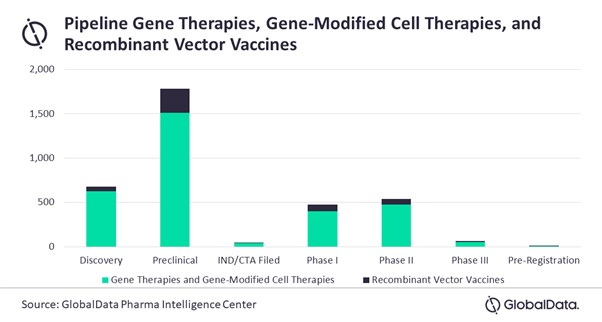
On top of the already approved drugs, there are more than 3,000 gene therapies, gene-modified cell therapies, and recombinant vector vaccines in the development pipeline.
Pipeline Gene Therapies, Gene-Modified Cell Therapies, and Recombinant Vector Vaccines
Barry adds: “Regulatory changes would also ease the viral vector bottleneck. If agencies approve standardized viral platforms that could be used interchangeably by therapy developers, this would speed up development, approval, and technology transfer to CMOs.”
Scope of Report
This report is the companion to GlobalData’s Gene Therapy Market Opportunity for CMOs – 2019 Edition and Cell Therapy Market Opportunity for CMOs – 2018 Edition reports, which described the demand and supply for contract manufacturing in the gene and cell therapy markets. This latest report examines the approvals and manufacturing outlook for three drug molecule types that all require viral vectors in their production: gene therapies, gene-modified cell therapies, and recombinant vector vaccines. The report is critical for benchmarking the CMO industry’s capacity to manufacture these vital vaccines and drugs and forecasting future approvals.
This 62-page report gives important, expert insight you won’t find in any other source. 22 figures and 15 tables throughout the report illustrate major points and trends. This report is required reading for:
• CMO executives who must have deep understanding of the vaccine, cell therapy, and gene therapy marketplace to make strategic planning and investment decisions about viral vector manufacturing.
• Sourcing and procurement executives who must understand crucial components of the supply base in order to make decisions about supplier selection and management.
• Private Equity investors that need a deeper understanding of the market to identify and value potential investment targets.
Reasons to buy
Detailed view of the geographic distribution of viral vector contract manufacturing facilities worldwide and the proportion belonging to dedicated CMOs and excess capacity manufacturers
Leader and disruptor companies in the viral vector space
Analysis of pipeline and marketed gene therapies, cell therapies, and recombinant vector vaccines, by geography, development stage, and clinical trials
A detailed model forecasting future gene therapy, cell therapy, and recombinant vector vaccine approvals, and associated manufacturing volumes
Contract manufacturing agreements for the active pharmaceutical ingredient (API) component of these vaccines and therapies
Key Stakeholders
Table of Contents
Tables
Table 1: Trends in Gene Therapy, Gene-Modified Cell Therapy, and Recombinant Vector Vaccines
Table 2: Marketed Gene Therapies, Gene-Modified Cell Therapies, and Recombinant Vector Vaccines
Table 3: Predicted Gene Therapy and Gene-Modified Cell Therapy Approvals
Table 4: Model for Zolgensma and Luxturna Viral Vector Clinical Requirements, 2025
Table 5: Model for Yearly Commercial Gene and Gene-Modified Cell Therapy Viral Vector Requirements
Table 6: Model for Yearly Clinical Gene Therapy and Gene-Modified Cell Therapy Viral Vector Requirements
Table 7: Combined J&J and AstraZeneca COVID-19 Vaccine Dose Demand
Table 8: Model for AAV (HEK293 mammalian cells) Bioreactor Capacity
Table 9: Model for Lentiviral Bioreactor Capacity
Table 10: Model for Adenovirus Bioreactor Capacity
Table 11: Annual Viral Vector Bioreactor Volumes for Gene Therapies and Recombinant Vector Vaccines
Table 12: Bioreactor Needs for Viral Vector Production for Gene Therapies and Recombinant Vector Vaccines
Table 13: Viral Vector Contract Manufacturing Sites and Their Methods of Transfection
Table 14: CMOs with Gene Therapy, Gene-Modified Cell Therapy, or Recombinant Vector Vaccine API Contracts, 2014–2020
Table 15: Further Reading
Graphs
Figure 1: Leaders and Disruptors: Top Players in Manufacturing
Figure 2: Pipeline Therapies and Vaccines
Figure 3: Transfection Methods Used by Pipeline Gene Therapies and Gene-Modified Cell Therapies
Figure 4: Gene Therapy and Gene-Modified Cell Therapies Trial Starts, 2014–2020
Figure 5: Recombinant Vector Vaccine Trial Starts, 2014–2020
Figure 6: Phase I Trial Starts, 2014–2020
Figure 7: Phase II Trial Starts, 2014–2020
Figure 8: Phase III Trial Starts, 2014–2020
Figure 9: Top Sponsors for Gene Therapy and Gene-Modified Cell Therapy Trials, 2014–2020
Figure 10: Top Sponsors for Recombinant Vector Vaccine Clinical Trials, 2014–2020
Figure 11: Top Therapy Areas for Gene Therapy and Gene-Modified Cell Therapy Clinical Trials, 2014–2020
Figure 12: Top Indications for Gene Therapy and Gene-Modified Cell Therapy Clinical Trials, 2014–2020
Figure 13: Top Indications for Recombinant Vector Vaccine Clinical Trials, 2014–2020
Figure 14: Luxturna Global Sales Forecast ($M)
Figure 15: Zolgensma Global Sales Forecast ($M)