

Italy’s economic issues and political divisions pose a challenge to its long-term defense spending increases and acquisition programs. Despite the government’s policy goals of reaching NATO’s 2% spending target, Italy’s defense budget is projected to remain in the mid-1% range during this decade, says GlobalData, a leading data and analytics company.
GlobalData’s latest report, “Italy Defense Market 2024-2029” reveals that Italy’s defense budget is set to reach $27.8 billion in 2029, up from $25.7 billion in 2020. The acquisition budget, which was $3.9 billion in 2020, will rise significantly to $6.6 billion by 2029. The personnel spend, which is estimated at $18.8 billion in 2024, will remain relatively stable at $18.5 billion by the end of the forecast period.
Wilson Jones, Defense Analyst at GlobalData, comments: “Italy’s acquisition budget has the most substantial growth of any sector of the country’s defense spending over the historic and forecast period. In real terms, the acquisition budget is set to almost double from 2012-29, highlighting Italy’s reinvestment in new military platforms. This is consistent with Italian programs for shipbuilding, combat jet acquisition, and the modernization of the Army’s mechanized brigades with new armored vehicles.”
As a share of the overall budget, acquisitions are anticipated to be 23.6% by 2029. Personnel spending is the largest segment of Italy’s defense budget for all years, never dropping below 60%. This is driven by the country’s relatively large armed forces of over 200,000 uniformed personnel. Italy also has a particularly large navy, as can be expected with its position in the Mediterranean Sea.
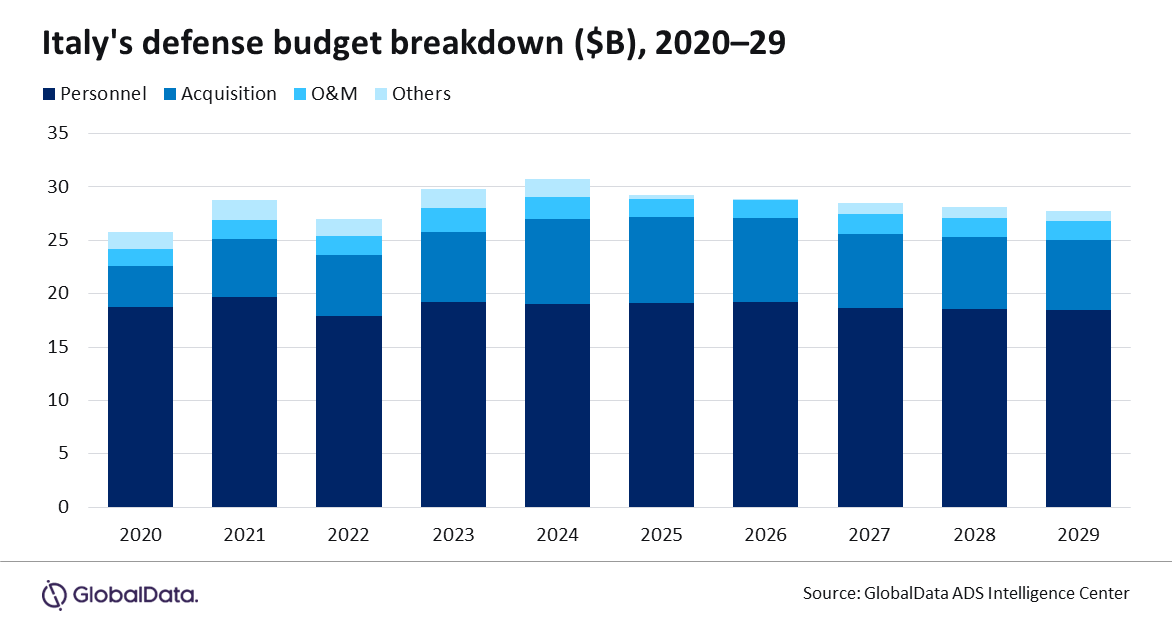
Despite the rise in acquisitions and high personnel spend, Italy’s overall defense spending remains low. Spending on operations and maintenance (O&M) is set to fall significantly. The O&M budget includes spending towards military exercises, deployments abroad, contribution to coalition operations and command and control. One of the largest areas of this sector is sea patrols for anti-piracy, maritime security, guarding the tense MENA and Black Sea regions, and sea trials of new vessels in the fleet.
Jones continues: “However, this is expected to fall despite Italy’s broadening commitments to NATO in the wake of the war in Ukraine, and naval activity in the Mediterranean will likely remain high for the foreseeable future. This investment in equipment relative to spending on operating said equipment may have negative effects on Italian military readiness.”
Jones concludes: “While the Italian government has committed itself to NATO’s 2% defense spending target, challenges remain in making this goal a reality. Italian politics are fractious, where party infighting, resignations, institutional gridlock, and the emergence of new parties are common. This lack of institutional direction severely hampers Italy’s ability to reach long term defense goals. While Italy is successfully acquiring major new platforms, it remains to be seen how this equipment will be deployed effectively.”
