

Spain’s political divisions are a major challenge to its long-term defense spending increases and acquisition programs. The Spanish government’s original goal was to reach NATO’s 2% spending target before 2030. While this is unlikely, at the current rate of growth, Spain’s defense budget is projected to rise to 1.54% of GDP by 2029, up significantly from 0.74% of GDP in 2020. The country is expected to reach the 2% GDP goal by the early 2030s, according to GlobalData, a leading data and analytics company.
GlobalData’s latest report, “Spain Defense Market 2024-2029” reveals that the country’s defense budget is set to reach $27.3 billion in 2029, up from $10.3 billion in 2020. The acquisition budget, which was $3.3 billion in 2020, will rise significantly to $17.0 billion by 2029. The personnel spend, which is estimated at $5.7 billion in 2024, will grow moderately to $7.8 billion by the end of the forecast period.
Wilson Jones, Defense Analyst at GlobalData, comments: “Spain’s historic military spending was stagnant and only began increasing in 2020. Following rising Russian aggression in Eastern Europe, and especially after the 2022 invasion of Ukraine, the Spanish government recommitted to raise its military spending. The country’s most recent general election occurred in July 2023 and was extremely close, resulting in a temporary pause on defense spending increases.”
The election result led to a months-long process to form the eventual government under Prime Minister Pedro Sanchez in November 2023. Due to this complicated process of forming the government, no new budget could be passed for the 2024 financial year. The new government elected to repeat its 2023 budget for the 2024 year, which carried over to defense spending as well, further delaying Spain’s pathway to 2% GDP spending. However, it is anticipated that the 2025 budget will include increases to cover any losses in the interim year.
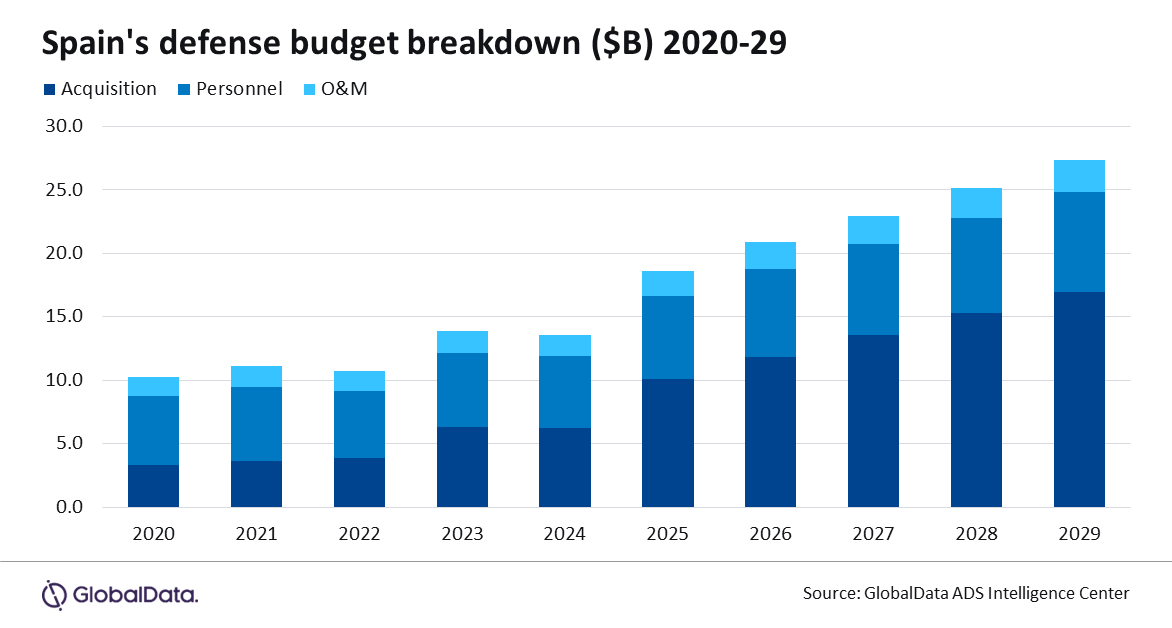
Jones continues: “Despite the major rise in acquisitions and moderate rise in personnel spend, Spain’s overall defense spending remains low. Spending on operations and maintenance (O&M) is only set to grow to $2.4 billion. Although spending on new platforms is high, it is also essential to train and prepare crews in their operation, especially under adverse conditions. This may negatively affect Spanish military readiness and combat effectiveness.”
Jones concludes: “The Spanish government is committed to NATO’s 2% defense spending target and has adopted budgets that could meaningfully bring it towards this goal. While challenges remain, including political gridlock that prevents fund allocation, major parties and the Spanish people are united in this goal. This is clearly seen in Spain’s acquisition of major new platforms. These programs not only expand Spain’s power projection and ensure spending increases, but also provide a boon to the economy and retain skilled jobs in Spain.”
