

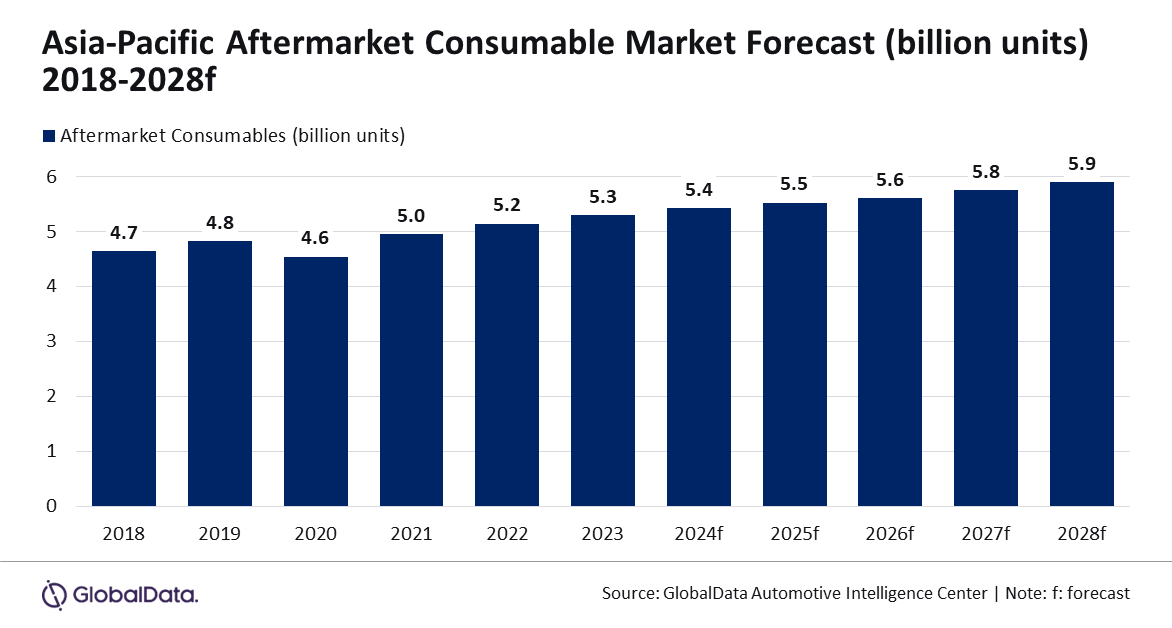
The Asia-Pacific (APAC) region, being the most populous globally, has a large vehicle fleet, and the introduction of stringent emission standards across the region is driving demand for aftermarket consumables. By accelerating the need for timely replacement of service parts to ensure compliance with environmental standards, these regulatory measures are positively influencing the aftermarket consumables market. Against this backdrop, the APAC automotive aftermarket consumables market is forecast to record a compound annual growth rate (CAGR) of 2.1% over 2023–28, according to GlobalData, a leading data and analytics company.
GlobalData’s latest report, “Global Sector Overview & Forecast: Aftermarket Consumables Q3 2024” reveals that the automotive aftermarket consumables market, including service parts and consumables, was at 5.3 billion units in 2023 and is forecast to reach 5.9 billion units by 2028 in the APAC region.
Madhuchhanda Palit, Automotive Analyst at GlobalData, comments: “Stringent emission standards and strict compliance regulations across APAC countries are key drivers of the aftermarket consumables market. While consumers may delay replacements, the need to obtain pollution certificates—such as the Pollution Under Control Certificate (PUC) in India and China Compulsory Certification (CCC)—compels timely replacement of parts like engine oil, filters, and diesel components. Failing to replace these parts can lead to engine malfunctions, increased emissions, and pollutants like black carbon (soot), carbon monoxide, CO2, and volatile organic compounds, contributing to air pollution.”
Factors such as increasing population, industrial developments, and high traffic affect the air quality of a particular area, which in turn do contribute to a reduction in the lifespan of service parts, and early replacement might be necessary for vehicles driven in a city environment compared to a rural environment. For example, in areas with more air pollution, cabin filters get dust clogged quicker compared to areas marked within healthy levels of air quality.
Palit adds: “Polluted air quality impacts the aftermarket consumables market positively; the more hazardous the air quality index is of a city, the more service part replacements might be required, leading to growth in the aftermarket consumables market volume.”
Additionally, the demographics of a country also tend to affect the demand for particular aftermarket components. For instance, there is more demand for antifreeze of engines in cities located in the mountains such as Shillong in India, and other places generally in winter times, whereas the opposite happens for high-temperature places, with a rise in the demand for engine coolants.
Palit concludes: “The APAC aftermarket consumables market is set for steady growth, fueled by stringent emission regulations, environmental factors, and regional demand variations. As vehicle ownership rises and innovation in service parts accelerates, the market is expected to continue to expand, offering opportunities for both manufacturers and consumers in the coming years.”
