

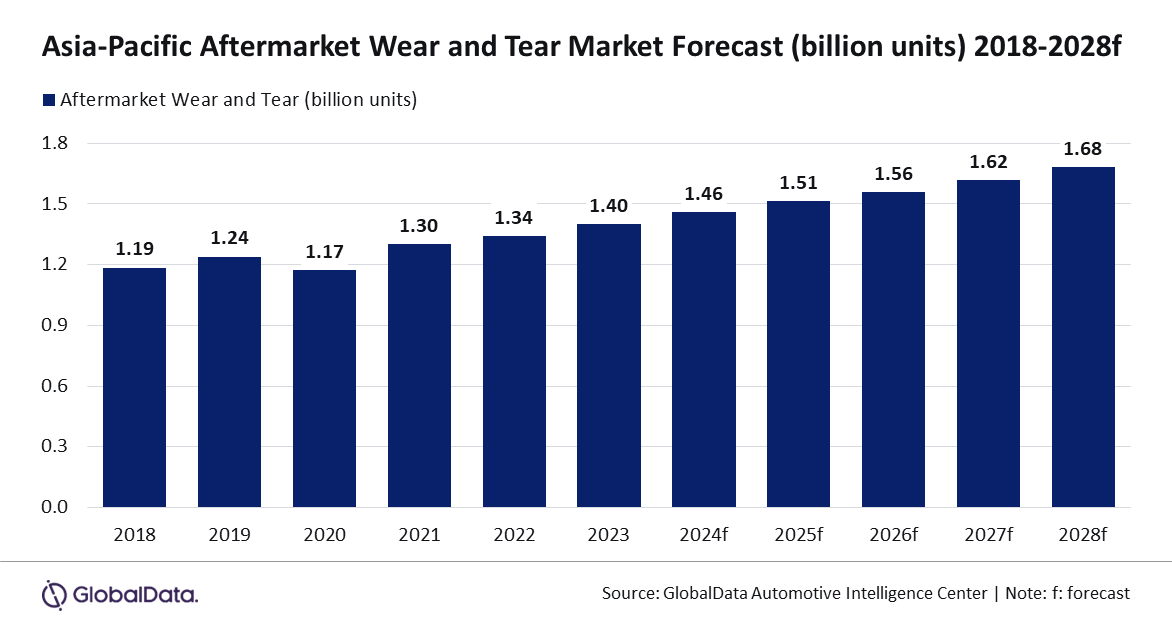
Being the most populated region globally with the largest number of on-road car volumes, Asia-Pacific (APAC) has an established aftermarket wear and tear market. In addition, a variety of demographics, changing consumer preferences, technological adaptability, and varying regulations have provided the aftermarket wear and tear market a dynamic growth opportunity. Against this backdrop, the APAC automotive aftermarket wear and tear market is forecast to record a compound annual growth rate (CAGR) of 3.7% over 2023–28, according to GlobalData, a leading data and analytics company.
GlobalData’s latest report, “Global Sector Overview & Forecast: Aftermarket Wear and Tear Q3 2024” reveals that the automotive aftermarket wear and tear market, including crash repair parts, mechanical parts, wear and tear parts, and tyres, was at 1.4 billion units in 2023 and is forecast to reach 1.68 billion units by 2028 in the APAC region.
Madhuchhanda Palit, Automotive Analyst at GlobalData, comments: “The driving force of the aftermarket wear and tear market may depend on multiple factors such as one particular country’s number of on-road vehicles, accident rate, driving habits, road conditions, and demographics. Countries that use cars as a daily commute and give preference towards using personal cars more than public transport, such as India and Thailand, are likely to have a higher aftermarket sales volume of wear and tear and mechanical parts.
“In addition, the increased number of cars on roads may increase the risk of collisions, thereby driving the market for aftermarket crash repair parts. However, it may depend on several other factors, such as road infrastructure, traffic regulations, and the rate of adaptability of advanced driver assistance system (ADAS) features in cars.”
Road and traffic conditions also have a significant impact over the aftermarket wear and tear market, as bad roads with frequent potholes impact suspension systems negatively over time, which may reduce their lifespan. Regions with uneven roads, hill station roads, or offroad conditions also tend to have a similar effect on the suspension system. Congested traffic conditions with frequent start and stop scenarios tend to have a toll on braking aftermarket components such as brake pads and brake shoes, limiting the lifespan of these components and requiring frequent replacements, driving the volume of the aftermarket wear and tear market.
Palit concludes: “The APAC automotive aftermarket wear and tear market is poised for significant growth over the next few years. The region’s diverse demographics, varying road conditions, and unique driving habits contribute to a dynamic market landscape. To capitalize on the opportunities, industry players must focus on innovation, product quality, and efficient distribution channels.”
