

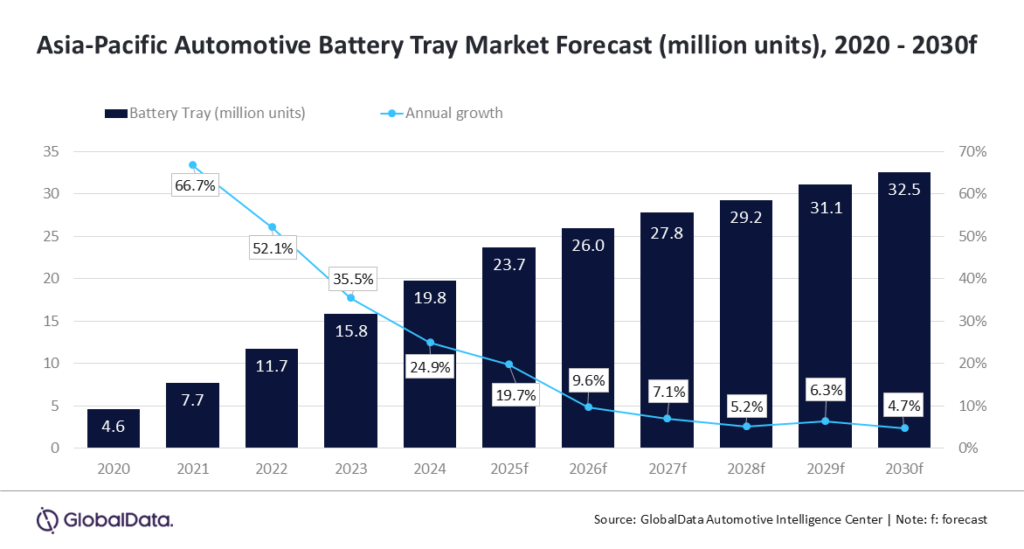
The automotive battery tray market in the Asia-Pacific (APAC) region is accelerating rapidly, powered by the dual imperatives of environmental regulation and rising demand for electric vehicles (EVs). Manufacturers are pivoting from traditional steel enclosures to lighter, more efficient alternatives—a trend reshaping both supply chains and product design landscapes. Against this backdrop, the APAC automotive battery tray market is projected to grow at a compound annual growth rate (CAGR) of 6.5% between 2025 and 2030, according to GlobalData, a leading data and analytics company.
GlobalData’s latest report, “Global Sector Overview & Forecast: xEV Systems Q3 2025,” reveals that the APAC automotive battery tray market is estimated at 23.7 million units in 2025 and is expected to reach 32.5 mill ion units by 2030.
Madhuchhanda Palit, Automotive Analyst at GlobalData, comments: “Stringent emissions standards, particularly in markets like China, Japan, South Korea, and Southeast Asia, are pushing automakers toward full or partial electrification. In response, demand for battery trays—essential for safely housing battery packs—has increased significantly. Lightweight designs are especially prized in APAC, where maximizing range with limited battery capacity is critical due to both regulatory incentives and consumer expectations. In addition, rising R&D investment across APAC’s automotive hubs is accelerating innovations in enclosure materials and manufacturing methods.”
Palit adds: “There is a growing emphasis on thermal management. APAC’s hot climates demand battery enclosures that can mitigate heat build-up, making trays designed with airflow channels, liquid cooling, or other heat control technologies increasingly indispensable.”
Additionally, aluminum and composite tray designs are delivering greatly improved strength-to-weight ratios, helping reduce vehicle mass and thereby boosting efficiency. Manufacturers in APAC are increasingly innovating around tray mounting techniques too, with adjustable straps, advanced fasteners, and tray geometries that resist vibration and protect against damage from off-road or harsh terrain driving. These advancements not only expand vehicle durability but also contribute to consumer perceptions of EV safety and reliability.
Palit concludes: “The APAC battery tray market is poised for significant expansion, driven by regulatory pressure, increasing EV adoption, and growing expectations for performance and sustainability. While the trajectory is promising, future growth will depend on continual innovation—especially in material science and thermal design—and on the ability of manufacturers to adapt to evolving policies and environmental conditions across diverse APAC markets.”
