

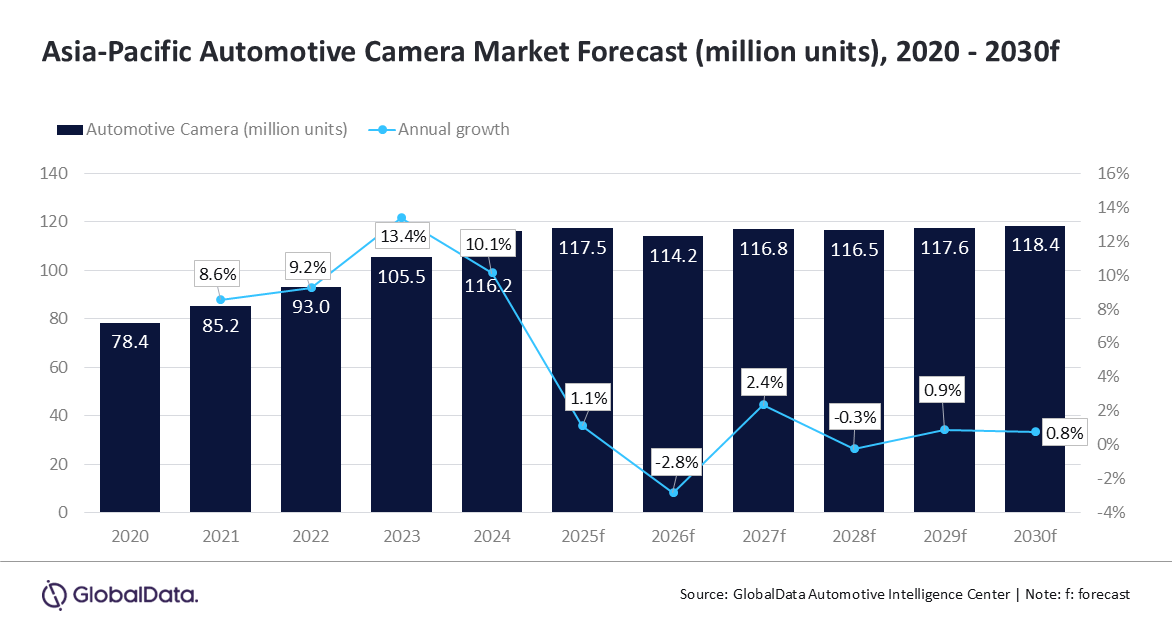
The automotive industry in the Asia-Pacific (APAC) region is experiencing a remarkable transformation, driven by the rapid integration of advanced camera technology. As vehicles become increasingly equipped with sophisticated safety features and autonomous driving capabilities, the demand for automotive cameras is expected to hold the market volume stably. Against this backdrop, the APAC automotive camera market is forecast to record a compound annual growth rate (CAGR) of 0.2% over 2025-30, according to GlobalData, a leading data and analytics company.
GlobalData’s latest report, “Global Sector Overview & Forecast: Automotive Camera Q2 2025,” reveals that the APAC automotive camera market with components consisting long-range cameras, DAS – rearview cameras, front cameras, rear cameras, and side cameras is poised to grow from an estimated volume of 117.5 million units in 2025 to 118.4 million units in 2030.
Madhuchhanda Palit, Automotive Analyst at GlobalData, comments: “With the proliferation of Advanced Driver Assistance Systems (ADAS), features such as lane departure warning, adaptive cruise control, and automatic emergency braking have become standard in many new vehicles. High-resolution cameras are now essential for enhancing the accuracy and reliability of these systems, enabling better object detection and classification. Furthermore, the development of diverse camera technologies, including stereo and night vision cameras, is paving the way for more sophisticated autonomous driving systems.”
The demand for automotive cameras in the APAC region is being propelled by several key factors. Firstly, the increasing emphasis on road safety has led governments across the region to impose stringent regulations mandating the inclusion of camera systems in vehicles. Countries like China and Japan are at the forefront of this movement, requiring rearview cameras in all new cars to enhance occupant and pedestrian safety.
Additionally, rising consumer awareness regarding advanced safety features is driving manufacturers to incorporate 360-degree cameras and other innovative technologies into their vehicles. This heightened focus on safety, combined with the growing popularity of self-driving cars, is expected to significantly boost the demand for AI-based camera systems in the APAC market.
Palit concludes: “The growth of automotive cameras in the APAC region is a pivotal development that will shape the future of the automotive market. With advancements in camera technology, regulatory support, and increasing consumer demand for safety features, the region is on the brink of a significant transformation. While challenges such as data privacy and technical performance remain, the opportunities for innovation and growth are considerable.”
