

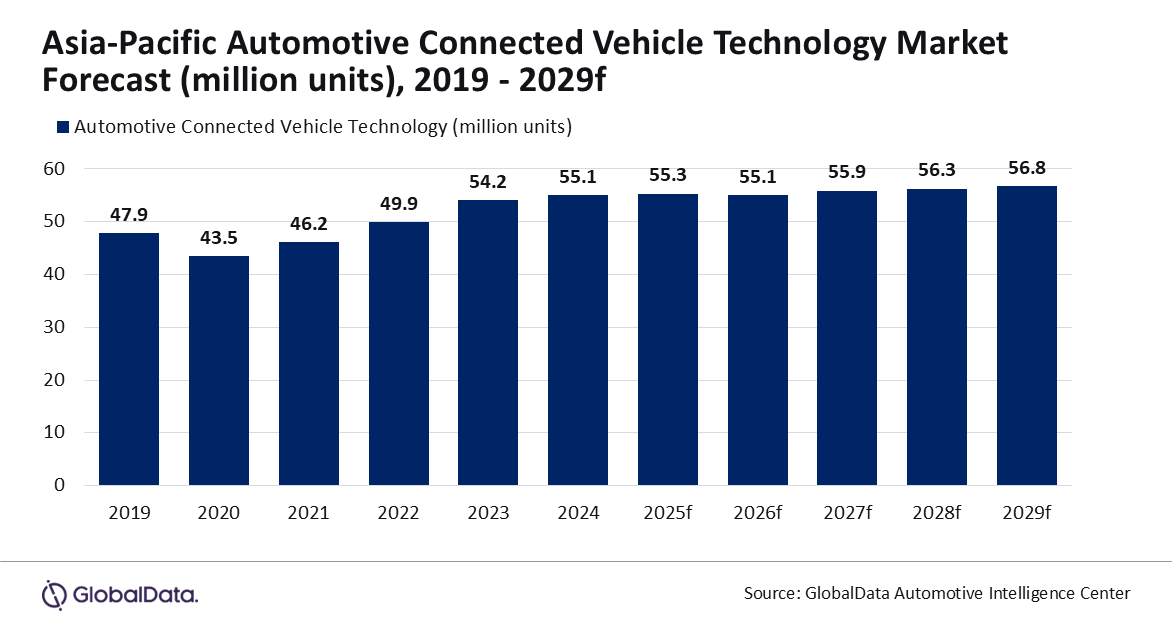
The Asia-Pacific (APAC) region stands at the forefront of the connected vehicle technology revolution. With a burgeoning population of tech-savvy consumers and a rapidly expanding automotive market, the integration of connectivity features into vehicles is not just a trend but a transformative shift that promises to redefine mobility in the region. Against this backdrop, the APAC connected vehicle technology market is expected to record a compound annual growth rate (CAGR) of 0.6% over 2024-29, according to GlobalData, a leading data and analytics company.
GlobalData’s latest report, “Global Sector Overview & Forecast: Connected Vehicle Technology Q1 2025,” reveals that the APAC automotive connected vehicle technology market is poised to grow from an estimated 55.1 million units in 2024 to 56.8 million units in 2029.
Madhuchhanda Palit, Automotive Analyst at GlobalData, comments: “As urbanization accelerates and traffic congestion becomes a pressing issue, consumers are gravitating toward vehicles equipped with advanced connectivity features. These features, which include real-time navigation, remote diagnostics, and enhanced safety systems, are not merely conveniences; they are essential tools for navigating the complexities of modern urban life.”
Moreover, new OEMs with roots in technology and electronics are leveraging their expertise in software development to create vehicles that prioritize connectivity and user experience. As a result, traditional automakers are compelled to innovate and adapt, leading to a dynamic environment where the value of vehicles increasingly hinges on their electronic components and connectivity capabilities.
Palit adds: “Younger generations, particularly in markets like China and India, are accustomed to seamless digital experiences and are demanding the same from their vehicles. This shift is prompting automakers to rethink their strategies and prioritize the integration of advanced infotainment systems, over-the-air updates, and personalized driving experiences.”
The future of connected vehicle technology in the APAC region is filled with considerable promise, yet it is not without challenges. The integration of connected vehicles into smart city initiatives presents an opportunity to optimize traffic flow and reduce emissions, aligning with global sustainability goals. However, concerns regarding data privacy and cybersecurity remain paramount.
Furthermore, the automotive industry must navigate the complexities of regulatory frameworks that govern connected technologies. As governments in the region work to establish guidelines for the safe and ethical use of connected vehicles, collaboration between automakers, technology providers, and regulatory bodies will be essential to foster innovation while ensuring consumer safety.
Palit concludes: “As automakers and technology companies continue to invest in this transformative sector, the APAC region is set to lead the way in redefining the driving experience. While challenges remain, the potential for innovation and growth in connected vehicle technology is undeniable, promising a future where mobility is smarter, safer, and more connected than ever before.”
