

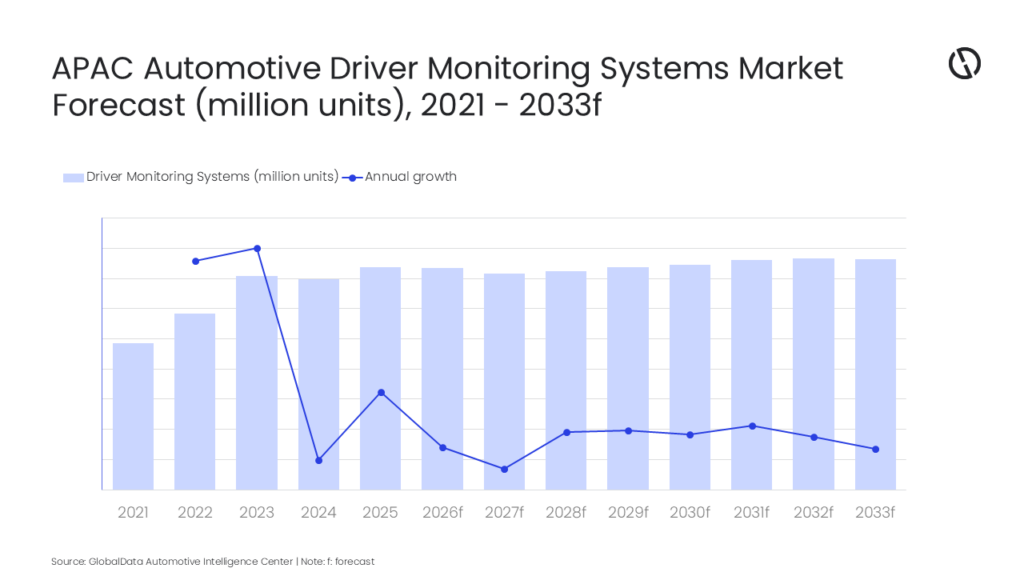
Driver monitoring systems use in-cabin cameras and sensors to assess driver attention, head movement, and eye position, helping to identify potential drowsiness or distraction. As vehicles incorporate more advanced driver-assistance functions, the ability to confirm that drivers remain attentive is becoming increasingly relevant to safety system design. Against this backdrop, the Asia-Pacific (APAC) driver monitoring systems market is projected to grow at a compound annual growth rate (CAGR) of 0.5% between 2026 and 2033, according to GlobalData, a leading intelligence and productivity platform.
GlobalData’s latest report, “Global Sector Overview & Forecast: Autonomous Driving Systems Q3 2026”, reveals that the APAC automotive driver monitoring systems market is poised to grow from an estimated volume of 7.4 million units in 2026 to 7.6 million units in 2033.
Madhuchhanda Palit, Automotive Analyst at GlobalData, comments: “As APAC includes many high-density urban environments, long-distance intercity routes, and mixed-traffic conditions, drivers may face sustained cognitive demands. Congestion can contribute to distraction and fatigue, while longer journeys may increase the risk of reduced alertness. These conditions are increasing interest in systems that can provide timely warnings when driver attention appears to decline. The competitive opportunity in the region lies in making the systems suitable for local driver behavior, cabin configurations, and varying lighting conditions.”
The growing availability of adaptive cruise control, lane-support functions, and other ADAS features is also increasing the relevance of driver monitoring. As vehicles take on more limited driving tasks, drivers may be more inclined to look away from the road or overestimate the capabilities of automated functions. Driver monitoring systems can help manufacturers reinforce that the drivers remain responsible for supervising the vehicle.
Recent developments include infrared cameras that can operate in low-light conditions, more precise tracking of eye-gaze and head position, and software that can distinguish between temporary glances and sustained distraction. Some systems are being integrated with hands-on-wheel detection, occupant monitoring, emergency calling functions, and assisted-driving controls.
Palit continues: “For APAC consumers, these features may be especially relevant where daily driving includes frequent congestion, nighttime travel, and complex interactions with two-wheelers, pedestrians, and roadside activity.”
Palit concludes: “Driver monitoring systems are likely to become a more common element of APAC vehicle safety strategies as assisted-driving functions expand. Their value will depend on accurate detection, appropriate warning design, and transparent handling of in-cabin data. Manufacturers that treat driver monitoring as a safety-support function, rather than an intrusive surveillance feature, may be better positioned to secure consumer acceptance across the region.”
