

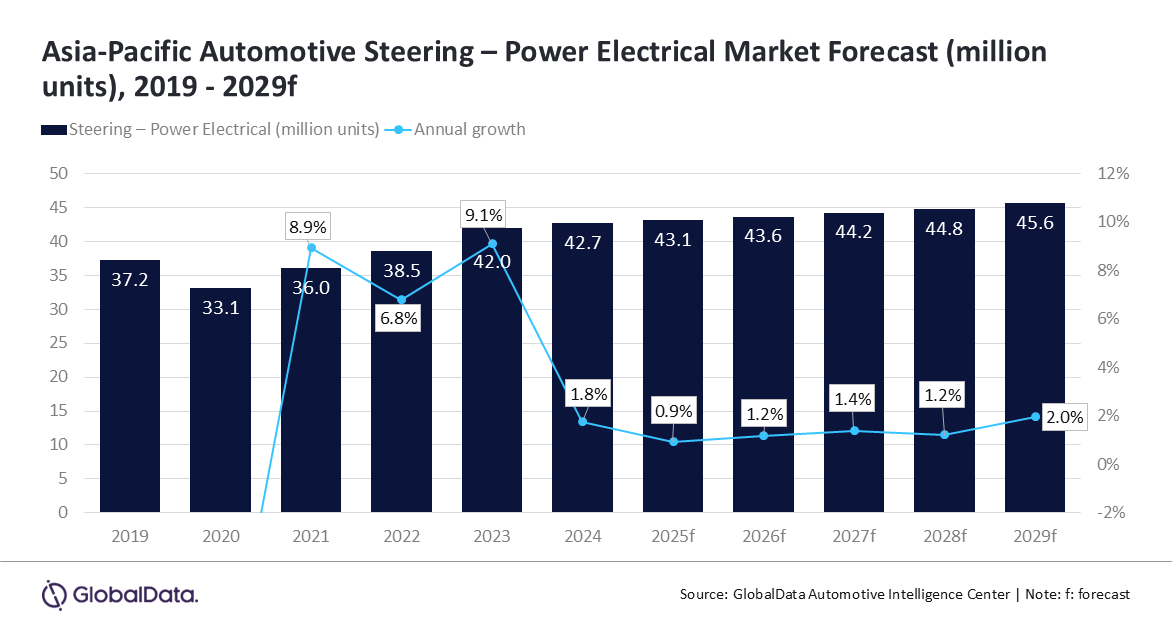
The automotive landscape in the Asia-Pacific (APAC) region is undergoing a transformative shift, particularly in the realm of steering systems. As the demand for electric vehicles (EVs) surges and technological advancements accelerate, steering systems are evolving to meet the needs of modern consumers while enhancing safety, efficiency, and sustainability. Against this backdrop, the APAC electric power steering market is expected to record a compound annual growth rate (CAGR) of 1.3% over 2024-29, according to GlobalData, a leading data and analytics company.
GlobalData’s latest report, “Global Sector Overview & Forecast: Automotive Steering Systems Q1 2025,” reveals that the APAC electric power steering market is poised to grow from a recorded volume of 42.7 million units in 2024 to 45.6 million units in 2029.
Madhuchhanda Palit, Automotive Analyst at GlobalData, comments: “The APAC region is witnessing a significant uptick in the adoption of advanced steering technologies, particularly Electric Power Steering (EPS) and Steer-by-Wire (SbW). The growing consumer preference for EVs, coupled with the need for enhanced vehicle performance, is propelling the demand for these systems. EPS, known for its energy efficiency and responsiveness, is becoming a standard feature in new vehicle models across the region. Manufacturers are optimizing EPS technology and integrating it with other electronic systems to provide improved driving experiences characterized by greater control and precision.”
In the context of environmental sustainability, the APAC automotive sector is prioritizing the development of steering systems that utilize lightweight materials such as carbon fiber and aluminum alloys to significantly reduces vehicle weight, thereby enhancing overall fuel efficiency. Additionally, the shift from traditional hydraulic systems to EPS and SbW not only enhances vehicle efficiency but also significantly reduces weight, leading to lower power consumption. This is particularly crucial in a region where regulatory pressures to minimize greenhouse gas emissions are intensifying.
Palit continues: “The growing trend towards Advanced Driver Assistance Systems (ADAS) and autonomous driving technologies is reshaping the demand for steering systems in the APAC region. As countries like Japan and South Korea lead the charge in autonomous vehicle development, the integration of sophisticated steering technologies is becoming imperative. These systems are designed to work seamlessly with ADAS features, such as lane-keeping and obstacle avoidance, enhancing safety and driving comfort. “
Palit concludes: “The future of steering systems in the APAC region is poised for significant growth, driven by technological advancements, consumer demand for efficiency, and a commitment to sustainability. With the integration of AI, lightweight materials, and enhanced connectivity, the steering systems of tomorrow will not only improve vehicle performance but also redefine the driving experience. As the automotive industry continues to evolve, steering systems will play a pivotal role in shaping overall market dynamics.”
