

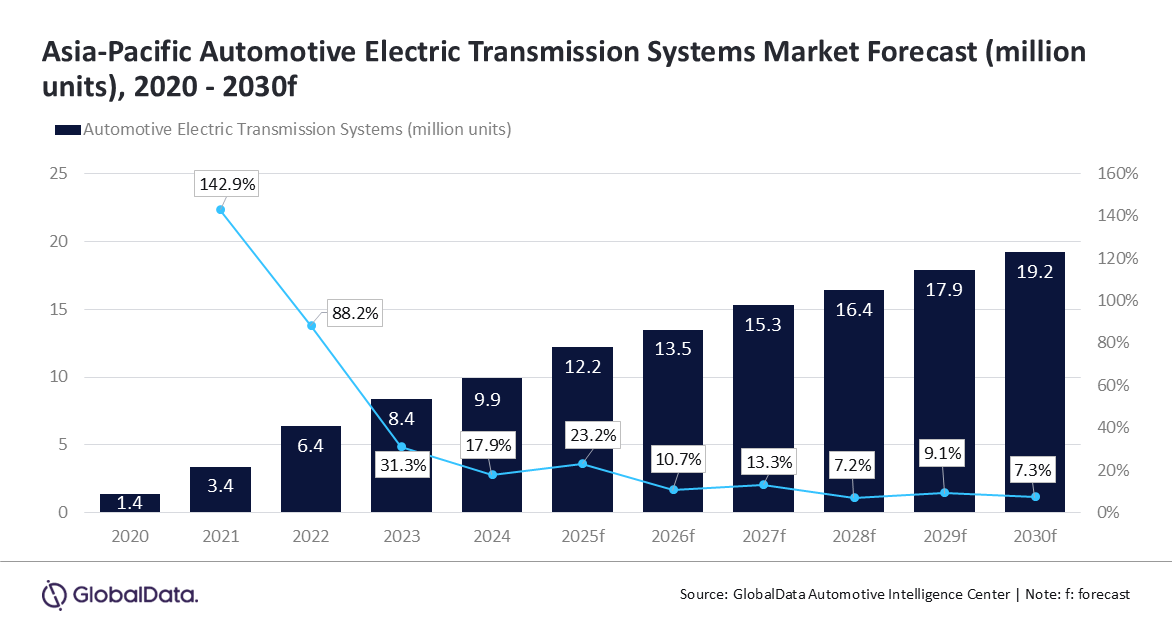
The automotive landscape in the Asia-Pacific (APAC) region is undergoing a transformative shift, driven by the increasing adoption of electric vehicles (EVs). As countries like China lead the charge in electrification, other nations within APAC are setting ambitious targets to enhance their EV markets, creating a robust environment for innovation and investment in electric transmission technologies. Against this backdrop, the APAC automotive electric transmission systems market is forecast to record an impressive compound annual growth rate (CAGR) of 9.5% over 2025-30, according to GlobalData, a leading data and analytics company.
GlobalData’s latest report, “Global Sector Overview & Forecast: Automotive Transmission and Clutch Technologies Q2 2025,” reveals that the APAC automotive electric transmission systems market is poised to grow from an estimated volume of 12.2 million units in 2025 to 19.2 million units in 2030.
Madhuchhanda Palit, Automotive Analyst at GlobalData, comments: “Governments across the APAC region are playing a pivotal role in accelerating the adoption of EVs, thereby bolstering the electric transmission market. Initiatives such as incentives, subsidies, and investments in charging infrastructure are becoming commonplace. For instance, India has set an ambitious target of achieving 30% EV penetration by 2030, supported by the recently launched PM-Electric Drive Vehicle Incentive and Ecosystem (PM-E-DRIVE) scheme. Similarly, Japan aims for all new passenger vehicle sales to be electrified by 2035, while Indonesia targets the deployment of 2 million electric cars by 2030.”
The APAC region boasts a strong automotive manufacturing base, particularly in countries like China, Japan, South Korea, and India. This robust industrial framework is ideally positioned to support the production of electronic transmission components. The growing consumer demand for fuel-efficient and automatic transmissions is driving innovation in advanced gear shifter systems, enhancing driving comfort and reducing driver fatigue.
As manufacturers explore new technologies to optimize motor power output and overall efficiency, the emergence of features such as in-wheel motors may redefine traditional transmission systems, which presents both opportunities and challenges for the market’s growth.
Palit concludes: “The electric transmission systems market in the APAC region is on an upward trajectory, fueled by government initiatives, a strong manufacturing base, and evolving consumer preferences. As the automotive industry continues to embrace electrification, the implications for the future are considerable. While uncertainties remain regarding technological advancements and market dynamics, the overall outlook suggests a promising horizon for electric transmission systems.”
