

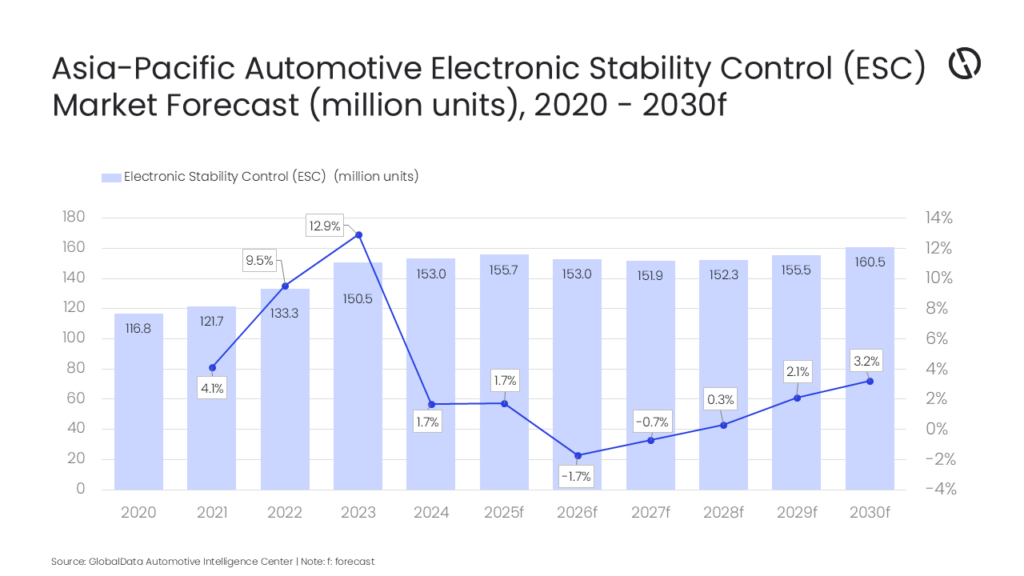
Electronic stability control (ESC) is steadily becoming a defining feature of modern automotive safety in the Asia-Pacific (APAC) region. Designed to prevent wheel lock-ups and sideslip—especially around curves or on slippery surfaces—ESC plays a pivotal role in helping drivers maintain control and stay on their intended path. As APAC markets like China are already mature, emerging economies including India and Indonesia are now driving considerable growth in ESC adoption. Against this backdrop, the APAC automotive ESC market is projected to grow at a compound annual growth rate (CAGR) of 0.6% between 2025 and 2030, according to GlobalData, a leading data and analytics company.
GlobalData’s latest report, “Global Sector Overview & Forecast: Sensors Q3 2025”, reveals that the APAC automotive ESC market is estimated at 155.7 million units in 2025 and is expected to reach 160.5 million units by 2030.
Madhuchhanda Palit, Automotive Analyst at GlobalData, comments: “In APAC, variable road conditions—ranging from sudden monsoon rains to aged or uneven highways—create scenarios where ESC sensors are proving transformative in enhancing both real-world safety and driver peace of mind. Additionally, technological advances are further accelerating ESC’s value proposition. As vehicle electrification and Advanced Driver Assistance Systems (ADAS) proliferate—especially in China and South Korea—ESC is being integrated into larger safety suites.
“Sensor fusion, software-based stability control, predictive algorithms enable ESC systems to act faster and more accurately. For APAC consumers, this means a driving experience that blends safety with consistency, even in lower-cost, mass-market models. Manufacturers investing in ESC sensors and refinement are likely to gain reputation as safety pioneers in their markets.”
Palit adds: “Safety rating programs such as ASEAN NCAP and Bharat NCAP are becoming powerful levers shaping market behaviour in APAC. Vehicles equipped with ESC tend to perform notably better in “Safety Assist” or similar evaluation categories, making ESC not just a safety-feature choice but a competitive necessity. For instance, recent ASEAN NCAP five-star winners—including the Zeekr X and OMODA C5—list ESC as standard equipment, which boosts their score under the Safety Assist category, strengthening consumer trust and purchase appeal.”
In addition, ESC is identified as a main risk-mitigation tool in ASEAN countries. Research prioritizing road safety interventions shows that ESC combined with ABS is one of the most effective measures for reducing traffic deaths and serious injuries in markets like Indonesia, Malaysia, Thailand, and Vietnam. For manufacturers, achieving high NCAP ratings not only supports regulatory compliance but enhances brand image, opening doors in export markets and attracting safety-conscious consumers.
Palit concludes: “ESC is poised to transition from a premium or high-end option to a baseline requirement in many markets, propelled by growing consumer safety awareness, regulatory pressures, and safety program incentives. For automakers, ESC adoption isn’t simply about compliance—it’s about differentiation, building trust, and aligning with evolving mobility norms in the region. As the APAC market continues its rapid automotive expansion, ESC will play a foundational role in shaping a future where safer, smarter vehicles are the norm rather than the exception.”
