

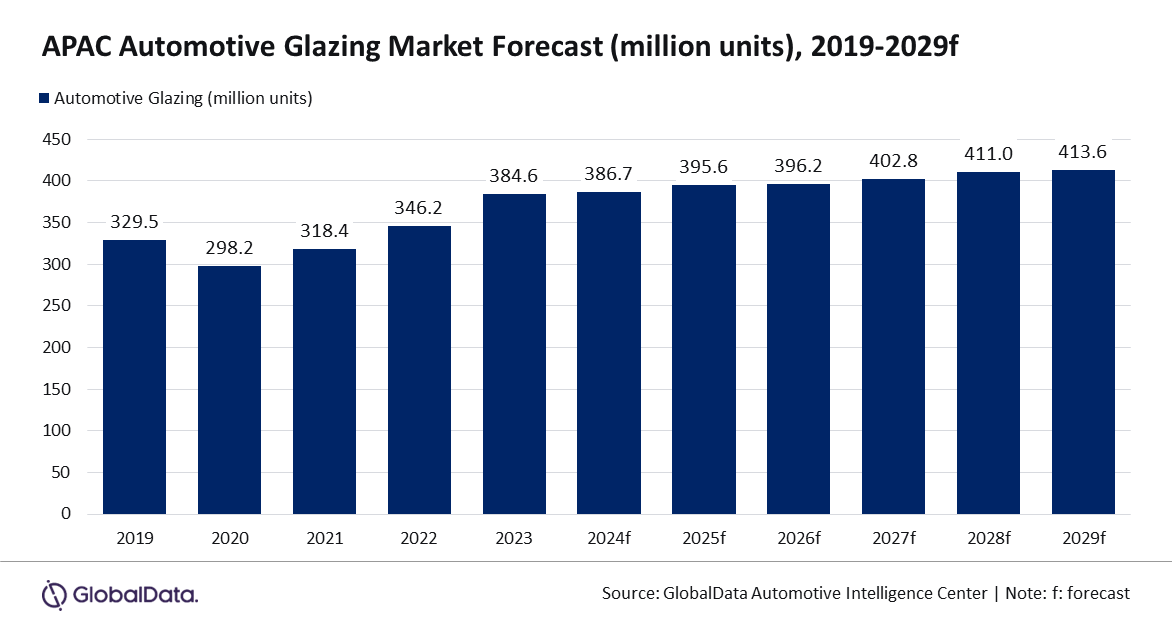
As the automotive industry progresses with technological advancements, enhancing vehicle performance and efficiency, customers increasingly demand superior driving comfort. This shift has heightened the importance of the automotive glazing segment, especially in the Asia-Pacific (APAC) region, where hot summer climates and dense traffic conditions are common. Moreover, the critical nature of road safety, particularly during nighttime driving, accentuates the essential role of automotive glazing components. Against this backdrop, the APAC automotive glazing market is forecast to experience a compound annual growth rate (CAGR) of 1.4% from 2024 to 2029, according to GlobalData, a leading data and analytics company.
GlobalData’s latest report, “Global Sector Overview & Forecast: Automotive Glazing – Q2 2024” reveals that the automotive glazings market in APAC is estimated at 386.7 million units in 2024 and is expected to reach 413.6 million units in 2029.
Madhuchhanda Palit, Automotive Analyst at GlobalData, comments: “In the APAC region, a majority of countries experience tropical climates characterized by hot summers, which can make driving uncomfortable for extended periods. This has led to a notable demand for infrared-reflective glazing, resulting in a well-established market. This specialized glazing effectively blocks infrared and heat rays from entering vehicles, thereby maintaining lower interior temperatures and enhancing driving comfort. Furthermore, the use of infrared-reflective glazing reduces the reliance on air conditioning in vehicles, leading to energy savings and improved fuel or battery efficiency.”
As the most densely populated area, the APAC region frequently experiences heavy traffic conditions. The implementation of acoustic windshields has proven beneficial in mitigating external noise, thereby elevating passenger comfort. This feature is particularly gaining popularity in hybrid and electric vehicles (EVs), where it is now offered as a standard amenity even in moderately priced models. Beyond their noise-cancellation capabilities, acoustic windshields are thicker and more durable than standard windshields, offering enhanced safety by diminishing the impact on passengers during collisions.
Palit adds: “The auto-dimming mirror segment is also attracting interest due to its contribution to safer nighttime driving, improving visibility by reducing glare from the headlights of oncoming vehicles.”
In the premium automotive sector, there is an escalating demand for modernization and augmented driving comfort among consumers. As a result, leading industry participants are focusing on innovation to sustain a competitive advantage. Notably, advancements in sensor technology have emerged in the glazing sector, including sensor-integrated mirrors and self-sensing laminated glass. These innovations are in the early stages of swift adoption, indicating a consistent upward trajectory.
Palit concludes: “The automotive glazing industry is witnessing steady growth in tandem with the increase in vehicle production. However, the majority of modernization and advancements are predominantly aimed at the premium vehicle segment. Research and development (R&D) initiatives are underway to render technological enhancements, such as auto-dimming mirrors, acoustic windshields, and infrared reflective glazing, more attainable for incorporation into economy-level vehicles.
“Furthermore, manufacturers are concentrating on novel innovations and features to enrich the driving experience. These endeavors are propelling innovation within the industry at large, striving to bolster sales and garner consumer interest.”
