

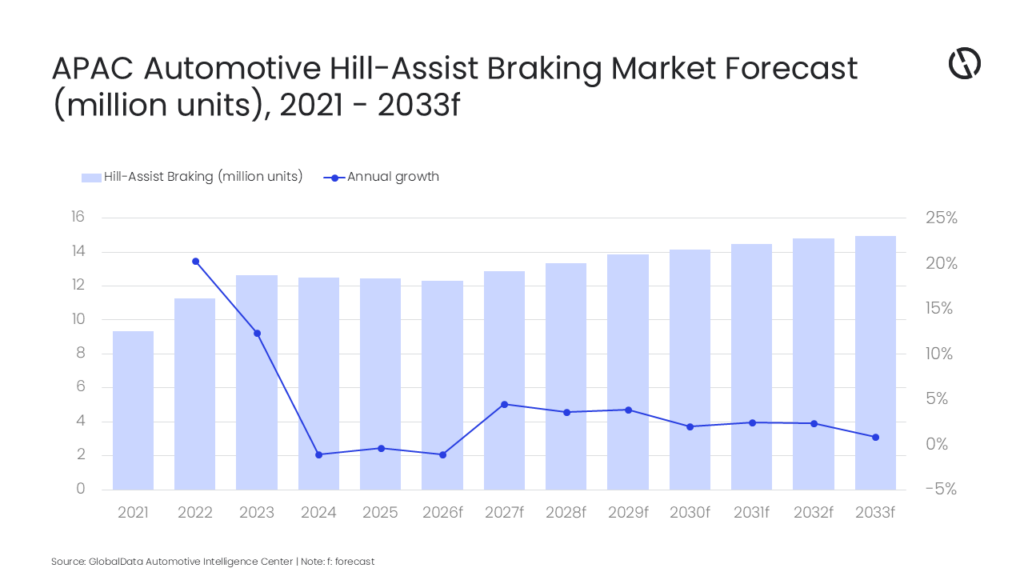
Asia-Pacific (APAC) has emerged as the largest and fastest-growing regional market for hill-assist braking. As vehicle production scales rapidly across India, China, and Japan, and as safety expectations rise among first-time and value-focused buyers, hill-assist braking is quickly moving from a “nice-to-have” to a “must-have” in everyday mobility. Against this backdrop, the APAC automotive hill-assist braking market is projected to grow at a compound annual growth rate (CAGR) of 2.8% between 2026 and 2033, according to GlobalData, a leading intelligence and productivity platform.
GlobalData’s latest report, “Global Sector Overview & Forecast: Automotive Braking Systems Q2 2026”, reveals that the APAC automotive hill-assist braking market is poised to grow from an estimated volume of 12.3 million units in 2026 to 14.9 million units in 2033.
Madhuchhanda Palit, Automotive Analyst at GlobalData, comments: “APAC consumers are increasingly prioritizing comfort that reduces daily driving stress, and hill-assist braking delivers exactly that in a simple, highly noticeable way. The braking benefit is especially relevant in APAC, where steep ramps, crowded intersections, and bumper-to-bumper inclines are common in major cities and across developing road networks alike. Importantly, the comfort value of hill-assist braking is resonating beyond premium segments. In markets such as India, the feature’s presence in budget and economy passenger cars reflects a broader shift: everyday buyers now expect confidence-enhancing features that were once associated with higher-end vehicles.”
Palit adds: “While EV growth is not the only driver behind hill-assist braking adoption, it acts as a reinforcing force: electrification tends to accelerate the rollout of modern safety and control systems, and hill-assist fits neatly into that “new-era vehicle” expectation. The result is a market environment where hill-assist braking adoption can expand in parallel with broader powertrain modernization.”
Moreover, APAC’s hill-assist momentum is also being shaped by how effectively the feature integrates into wider vehicle safety architectures. Leading suppliers such as Bosch and Continental are combining hill-assist functionality with systems like electronic stability control (ESC) and electric parking brakes, turning hill-assist braking from a standalone convenience into part of a more cohesive safety package. For APAC automakers, this integration is commercially attractive: it supports feature-led differentiation in competitive price bands while aligning with rising consumer expectations for “smart” safety.
Palit concludes: “Hill-assist braking’s rapid growth in APAC reflects a bigger transformation underway: safety and comfort features are being democratized at scale. With strong vehicle production momentum and intensifying consumer demand for stress-free driving, APAC is set to remain the global center of gravity for hill-assist adoption.
“Looking ahead, the most probable outcome is that hill-assist braking becomes increasingly normalized across passenger and commercial segments—less a headline feature, and more a baseline expectation—shaping how APAC manufacturers design, package, and market vehicles in the next phase of regional automotive growth.”
