

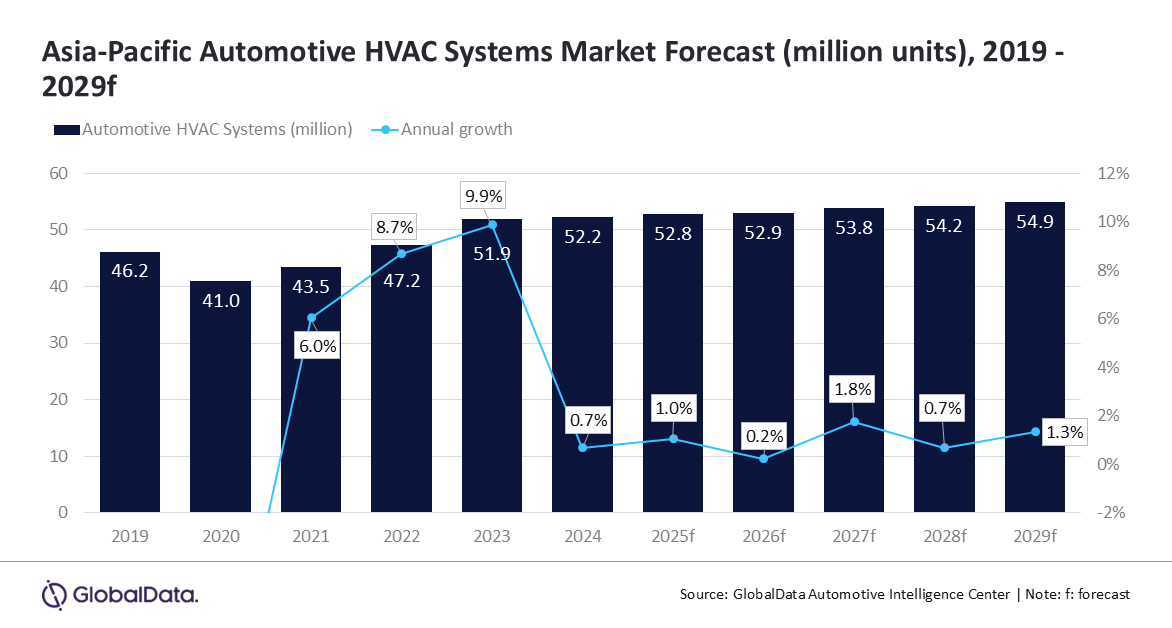
As the automotive industry continues to evolve, the importance of advanced heating, ventilation, and air conditioning (HVAC) systems has become increasingly evident, particularly in the Asia-Pacific (APAC) region. With its diverse climates and rapidly growing vehicle market, the APAC region is witnessing a significant transformation in automotive HVAC systems with a heightened focus on user comfort, the shift towards electrification, and groundbreaking technological advancements. Against this backdrop, the APAC automotive HVAC systems market is expected to record a compound annual growth rate (CAGR) of 1.0% over 2024-29, according to GlobalData, a leading data and analytics company.
GlobalData’s latest report, “Automotive Heating, Ventilation and Air-Conditioning (HVAC) Q1 2025,” reveals that the APAC automotive HVAC systems market is poised to grow from a recorded volume of 52.2 million units in 2024 to 54.9 million units in 2029.
Madhuchhanda Palit, Automotive Analyst at GlobalData, comments: “The APAC region is characterized by its hot summers and tropical weather conditions, making effective HVAC systems essential for passenger comfort. Manufacturers are increasingly prioritizing innovations that provide personalized experiences, such as multi-zone climate control and individual temperature settings. These advancements not only enhance comfort but also contribute to driver alertness and overall road safety. As consumer expectations rise, automotive companies are compelled to integrate sophisticated HVAC solutions that cater to the unique climatic challenges of the region, ensuring that vehicles remain a refuge from the heat.”
The rapid transition towards electric vehicles (EVs) in the APAC region is reshaping the HVAC landscape. Traditional vapor compression systems, while effective, are energy-intensive and can significantly impact battery range. As automakers embrace electrification, there is a growing emphasis on developing energy-efficient HVAC systems tailored for EVs.
Palit adds: “This shift is not only essential for optimizing energy consumption but also aligns with regulatory pressures aimed at reducing greenhouse gas emissions. Consequently, manufacturers are investing in innovative HVAC technologies that enhance energy efficiency, ensuring that the comfort of passengers does not come at the expense of vehicle performance.”
Recent technological advancements are revolutionizing the efficiency and functionality of automotive HVAC systems in the APAC region. The integration of advanced materials, sensors, and intelligent control systems is enhancing performance while reducing energy consumption. Notably, the use of composite nano-lubricants, such as Al2O3-SiO2 in PAG base oil, has shown considerable promise in optimizing the performance of HVAC components. These innovations not only improve thermal efficiency but also extend the lifespan of critical system parts, thereby contributing to the overall reliability of automotive HVAC systems.
Palit concludes: “The growth of automotive HVAC systems in the APAC region is indicative of broader trends within the automotive industry, where user comfort, electrification, and technological advancements are paramount. As manufacturers continue to innovate and adapt to the unique demands of the region, the future of automotive HVAC systems appears promising. With a focus on energy efficiency and personalized comfort, the APAC automotive market is poised for significant growth, paving the way for a more sustainable and enjoyable driving experience.”
