

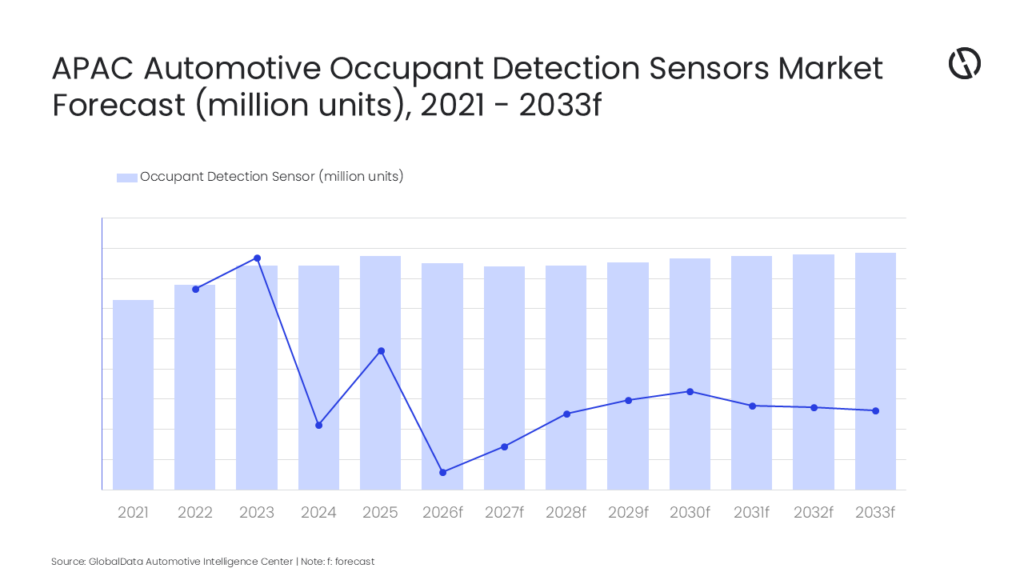
As vehicles become more connected and increasingly equipped with advanced restraint systems, occupant detection is becoming an important link between passive safety and intelligent vehicle control. Against this backdrop, the Asia-Pacific (APAC) automotive occupant detection sensors market is projected to grow at a compound annual growth rate (CAGR) of 0.7% between 2026 and 2033, according to GlobalData, a leading intelligence and productivity platform.
GlobalData’s latest report, “Global Sector Overview & Forecast: Sensors Q3 2026”, reveals that the APAC automotive occupant detection sensors market is expected to grow from an estimated volume of 75.1 million units in 2026 to 78.6 million units in 2033.
Madhuchhanda Palit, Automotive Analyst at GlobalData, comments: “APAC presents varied vehicle-use conditions, from dense urban commuting to family travel and long-distance intercity journeys. These patterns create demand for safety systems that can respond to different seating arrangements and occupant profiles rather than applying the same restraint strategy in every situation. The expansion of SUVs, electric vehicles, and connected passenger vehicles is also driving interest in cabin sensing.
“Occupant detection can help reduce unnecessary warnings when seats are empty, while improving the relevance of seatbelt reminders and restraint-system decisions when passengers are present. Therefore, in a market such as APAC, where vehicles are frequently used for family transport, the ability to identify children or occupants in the rear seats may become a more visible consumer requirement. More precise occupant information can also support adaptive airbags and seatbelt pretensioners.”
Manufacturers are positioning occupant detection as part of a broader occupant-protection and cabin-monitoring architecture. The technology is typically integrated with seatbelt systems, airbags, child-presence detection, rear-seat reminders, and emergency-response functions rather than marketed as a standalone feature.
Palit continues: “Global automakers, regional manufacturers, and component suppliers are taking different approaches depending on the vehicle segment and regulatory requirements. Higher-specification vehicles may use more advanced sensing capabilities, while cost-sensitive models are likely to prioritize seat occupancy and seatbelt status. In APAC, manufacturers will need to balance system capability with affordability, reliability, and the varying safety expectations across local markets.”
Palit concludes: “Occupant detection sensors are likely to become a more important part of vehicle safety systems across APAC as manufacturers move toward responsive, software-enabled cabins. Their value will depend on accurate detection and effective integration with restraint and warning systems. Wider adoption will be shaped by cost, regulatory developments, and whether manufacturers can demonstrate clear safety benefits without adding complexity or raising consumer concerns about in-cabin monitoring.Top of FormBottom of Form”
